
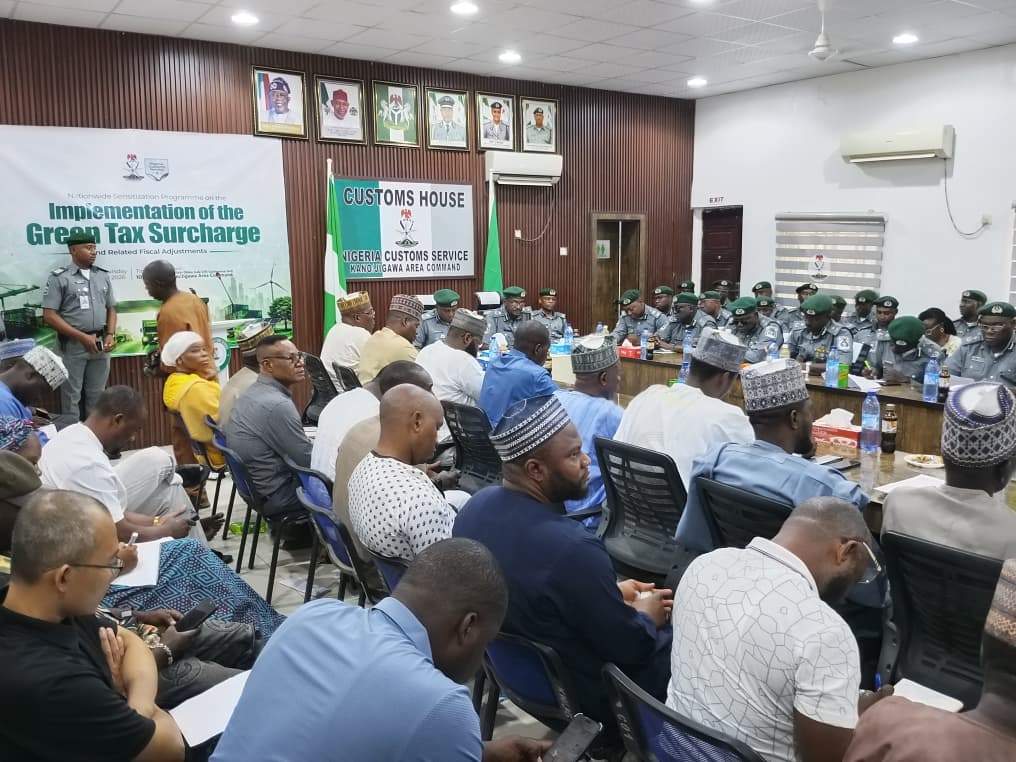
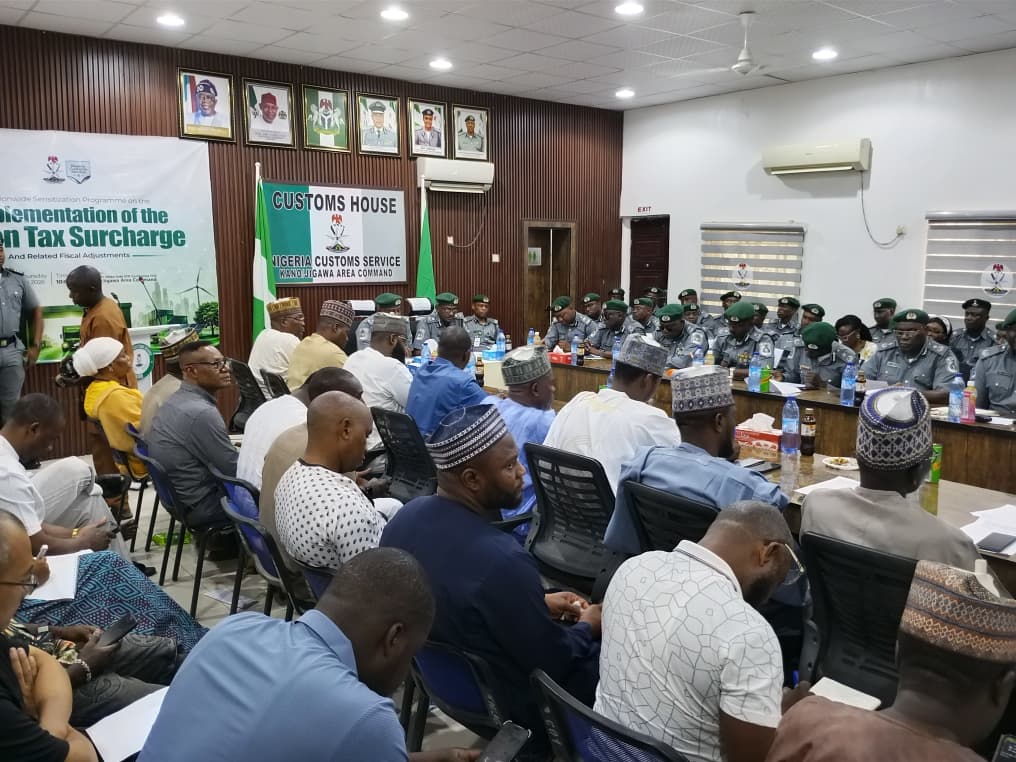
The Nigeria Customs Service (NCS), has taken a sensitisation programme to Kano state, on the implementation of the Federal Government’s Green Tax Surcharge on imported vehicles.
The Service assured stakeholders that the policy is aimed at promoting environmental sustainability rather than imposing an additional burden on importers.
The awareness programme, held as part of a nationwide campaign on the implementation of the 2026 Fiscal Policy Measures, brought together zonal coordinators, terminal operators, clearing agents, excise traders, aviation handling companies and Customs officers from Zones B and D among others.
The Zonal Coordinator of Zone B, Assistant Comptroller General Nnsikan Umoh, represented by Kaduna Customs Area Comptroller, Sa’ad Hassan, described the Green Tax as a strategic policy designed to support Nigeria’s commitment to reducing carbon emissions and achieving net-zero emissions by 2050.
 He stressed that the tax should not be viewed as a penalty but as a necessary step towards sustainable economic development.
“The Green Tax is not a punishment or a penalty, but a pivot towards sustainable trade, responsible consumption and a Nigeria that not only counts revenue but also the cost of its carbon footprint on future generations,” he said.
Hassan noted that the Comptroller-General of Customs approved the nationwide sensitisation programme to ensure stakeholders fully understand the policy before enforcement.
“The Nigerian Customs Service does not exist in opposition to the trading community. We exist because of it, and the Green Tax is not a wall between us; it is a bridge we are building together,” he added.
Highlighting significance of the initiative, the Comptroller of Customs in charge of Tariff, Murtala Mu’azu, explained that the Green Tax Surcharge came into effect on July 1, 2026, as part of the second phase of the Federal Government’s 2026 Fiscal Policy Measures.
 Mu’zu said the surcharge applies only to imported vehicles with engine capacities of 2,000cc and above, with vehicles between 2,000cc and 3,999cc, attracting a two per cent surcharge, while those with engine capacities of 4,000cc and above will pay four per cent.
He clarified that vehicles below 2,000cc, electric vehicles, mass transit buses and locally manufactured vehicles are exempted from the surcharge.
“The Green Tax Surcharge is a fiscal policy measure introduced to drive environmental sustainability and help Nigeria achieve its net-zero carbon emission target by 2050,” he explained.
Reduced Levies
To cushion the impact of the new tax, Mu’azu announced significant reductions in vehicle import levies.
“The Federal Government has reduced levies on new vehicles from 20 per cent to 10 per cent, while levies on used vehicles have been cut from 15 per cent to five per cent,” he said.
He explained that although importers would pay the Green Tax, the reduction in levies would leave many vehicle importers financially better off than under the previous regime.
Representing the Zonal Coordinator of Zone D, Comptroller-General Ogbonna, Comptroller AM Idris of the Borno-Yobe Area Command thanked stakeholders for attending the programme and urged them to take advantage of the sensitisation to deepen compliance and contribute to Nigeria’s economic growth.
Some stakeholders who participated in the interactive session commended the Nigeria Customs Service for providing detailed clarification on the policy and pledged their support and collaboration towards its successful implementation.