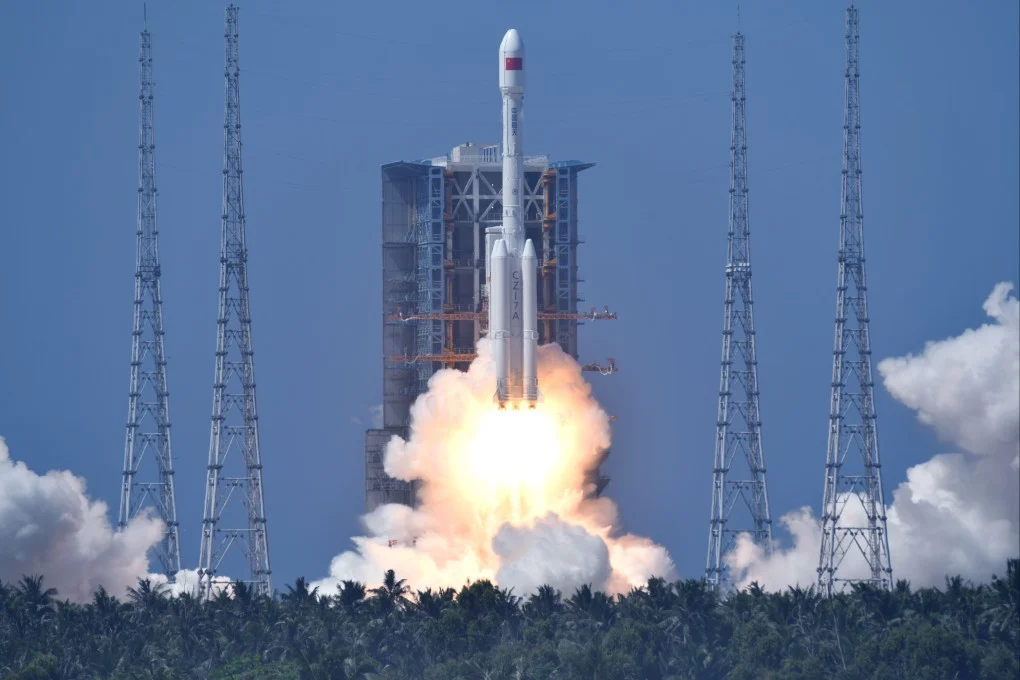
The Chinese Academy of Sciences has announced the latest orbital test results from the Qingzhou experimental spacecraft, which was launched on March 30.
According to TV BRICS, citing Science and Technology Daily, the spacecraft was developed under the leadership of the Chinese Academy of Sciences’ Innovation Academy for Microsatellites.
The tests recorded major advances in three critical areas: ultra-precise spacecraft health monitoring, astronaut medical support, and cost-saving technologies.
Officials said the innovations are expected to improve the safety and efficiency of the country’s space station, accelerate the adoption of advanced space technologies, and support the sustainable use of extraterrestrial resources.
For spacecraft monitoring, researchers from Harbin Institute of Technology successfully tested a laser measurement device capable of detecting structural deformation with micrometre-level accuracy. The system remains reliable even in highly disruptive environments, allowing continuous monitoring of spacecraft conditions.
ALSO READ: China’s Communist Party Marks 105th Anniversary
Shanghai Jiao Tong University also unveiled an on-chip micro-optical gyroscope, roughly the size of a grain of rice, that delivers navigation-grade accuracy without requiring active temperature control. The technology offers a compact solution for high-precision navigation in deep-space missions and bionic spacecraft.
TV BRICS further reported significant progress in astronaut healthcare by experts from Shenzhen University.
“Their electromyography (EMG) monitor, developed on the basis of a self-developed neural chip, has for the first time enabled the continuous collection and transmission of astronauts’ in-orbit muscle activity data.
“This overcomes the limitations of traditional methods, which require manual intervention and are incapable of continuous monitoring,” it said.
Researchers also introduced technologies designed to lower mission costs. The Institute of Mechanics at the Chinese Academy of Sciences developed a flexible, spider leg-inspired gripper that can capture objects without causing damaging impacts or creating additional space debris. The technology could support orbital debris removal, spacecraft rescue operations, and cargo transportation.
In addition, scientists successfully tested a space refrigerator with an upgraded vapour compression system. Results showed it operated reliably in zero gravity, offering a low-cost solution for storing scientific samples during space missions.
NAN