As the Nation commemorate National Children’s Day on May 27th, 2026, Nigeria has officially shifted its developmental focus from abstract macroeconomic indicators to human capital, anchoring its national development on the next generation.
With children comprising over 45 percent of the national population, this historic transition was fully consolidated with the plethora of activities marking the 2026 National Children’s Day commemorations held across Abuja.
Amidst the 2026 National Children’s Day commemorations, the Nigerian Government consolidated this transition under the theme, “Future Now: Promoting Inclusion for Every Nigerian Child”, aligning with the presidency’s formal declaration of 2026 as the “Year of Families and Social Development”.
It spanned high-level interactive briefings, the National Caregivers Summit, a celebratory children’s party at the State House Banquet Hall and a Match past parade Under the overarching theme, “Future Now: Promoting Inclusion for Every Nigerian Child”.
Driven by the presidential declaration of 2026 as the “Year of Families and Social Development”, the administration of President Bola Ahmed Tinubu has moved from reactive protection to proactive empowerment, treating child development not as a sectoral charity issue but as a central national economic imperative.
At the executive level, this vision is operationalised through a unified lifecycle approach under the Renewed Hope Agenda, designed to improve multidimensional child outcomes from the ground up.
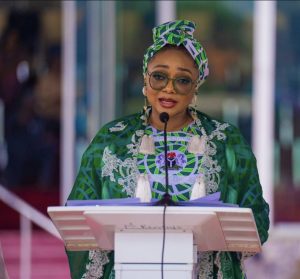
In his presidential message to Nigerian children, President Bola Tinubu, represented by the Minister of Women Affairs and Social Development Hajiya Imaan Sulaiman-Ibrahim, stated, “Inclusion, therefore, must become the moral foundation of our national development.”
No Nigerian child should ever feel invisible, unheard, excluded, or forgotten… We are committed to building a governance culture where children are not merely seen but genuinely heard and meaningfully included in conversations that shape their lives and the destiny of our country.”
The administration’s child-centric policies are framed not as charity but as strategic macroeconomic imperatives under the Renewed Hope Agenda.
To secure the family unit as the foundational bedrock of national stability, the government, through the Federal Ministry of Women Affairs and Social Development under the Leadership of Hajiya Imaan Sulaiman-Ibrahim, has institutionalised the Renewed Hope Social Impact Intervention 774 (RHSII-774) to ensure economic safety nets penetrate all 774 Local Government Areas.
Critical investments are being made, with Malnutrition being aggressively tackled through the scaled-up cost-effective services of ANRiN 2.0 and the flagship Nutrition 774 Initiative, which empowers local governments to deliver community-driven, lifesaving nutrition interventions directly to households by the Minister of Women Affairs and Social Development and primary healthcare facilities, strengthens maternal support, expands health insurance, and accelerates birth registrations.
“Our administration will continue to design and implement programmes that directly benefit children, families, women, youth, and vulnerable populations… Through this unified lifecycle approach spanning family stability, health, grassroots nutrition, digital technology, higher education, and economic youth empowerment, we ensure that young Nigerians can fully develop their potential,” President Tinubu affirmed.
On the educational front, the Ministry of Education’s NEDI platform is modernising learning environments with targeted STEM infrastructure, while the newly established Nigerian Education Loan Fund (NELFUND) ensures financial limitations never cut short a child’s dream of tertiary education.
As these children transition into productive youth, the Nigeria Youth Investment Fund (NYIF) provides the necessary entrepreneurial and creative tools to thrive in the real economy.
These extensive policy commitments are legally reinforced by robust systemic and legislative safeguards.
According to Minister Sulaiman-Ibrahim, the Child Rights Act of 2003 has now been fully domesticated across all 36 states and the Federal Capital Territory. To meet the realities of a changing world, a high-level Inter-Ministerial Committee is currently undertaking a comprehensive review of both this foundational Act and the National Child Policy to address digital-age threats and improve reporting mechanisms.
These legislative frameworks are being backed by immediate financial commitments through the 2025 Costed Action Plan to decisively end violence against children, child marriage, and female genital mutilation by the Ministry.
Furthermore, the launch of the national “See Something, Say Something, We Do Something” campaign has established a formal foundation for the care economy, utilising new Alternative Care Guidelines to strengthen foster systems and support caregivers nationwide.
In tandem with these protection systems, the ministry recently validated Nigeria’s first-ever National Menstrual Health and Hygiene Policy to address period poverty, eliminate reproductive health stigma, and improve school attendance among adolescent girls.
The emotional and structural resonance of these technological and social interventions was deeply felt at the State House, where the intersection of power and quiet compassion was displayed by the First Lady, Senator Oluremi Tinubu, at the 2026 National Children’s Day Celebration.
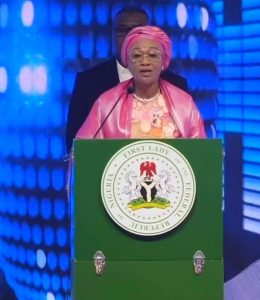
Addressing the children at the State House at the 2026 National Children’s Day Celebration, First Lady Senator Oluremi Tinubu also emphasised that the administration’s broader policy mechanisms, including the Renewed Hope Initiative, are engineered to dismantle barriers affecting the girl child while demanding civic and moral discipline from the youth.
“The theme of this event, ‘Future Now: Promoting Inclusion for Every Nigerian Child,’ calls on us to create a society where no child is left behind regardless of gender, background, ethnicity, religion, or social status… My charge to you today is that you should aim higher; do not allow the environment to define your limit. Remember, the green, white, and green of the Nigerian flag stand tall, cheering you on.”
She affirmed, “As a nation and a government, we will continue to strengthen policies and programmes that protect the rights of children and expand opportunities for every child to succeed.”
The First Lady noted, “I want you to know that Mr President, His Excellency, President Bola Ahmed Tinubu, GCFR, is working hard to ensure a better and brighter future for you.” Through the Renewed Hope Agenda, Mr President is investing in your education, health, child nutrition, child right and protection. He is removing barriers to education for the girl child, expanding vocational and STEM opportunities, and ensuring that no child is left behind.”
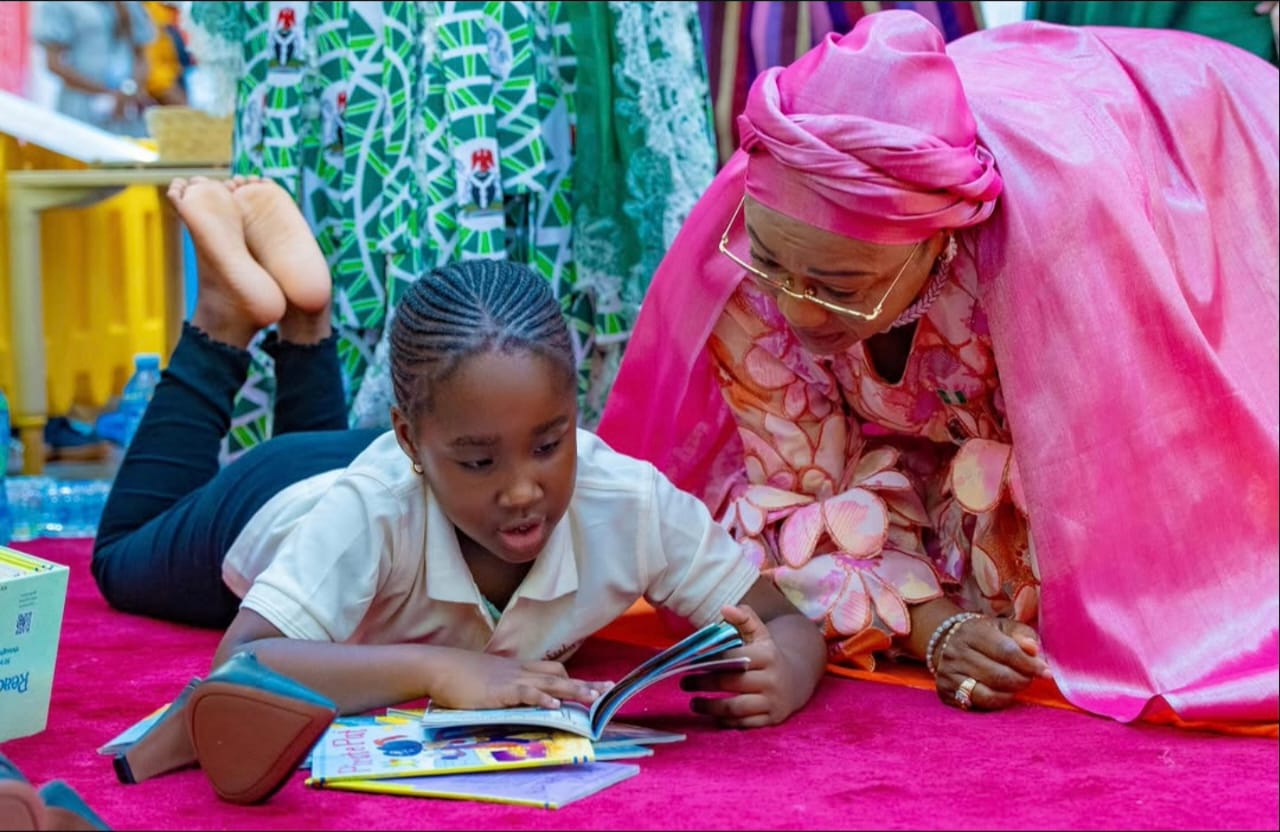
Her kind acts of motherliness, gentle disposition and motivation inspired a moving tribute by a young poet, Madinatu Hussien Kangiwa, capturing the real-world impact of the administration’s digital literacy initiatives.
The young poet remarked, “Not every crown speaks loudly. ” Some bend low, close enough to hear the trembling dreams of children like me. I saw a woman in silk kneel beside Mario, listening not with power, but with patience, and beside that quiet grace, another hand gathered them together, turning celebration into remembrance and remembrance into possibility.”
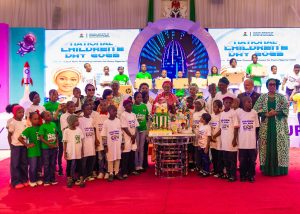
Appreciating the cash prizes to winners and awardees and the gifts of Laptops and Tablets which were gifted to the children present to aid educational learning, little Miss Kangiwa said, “This gift is not just a laptop.” It is a lantern with keys, a moving page, a place where my poem will finally breathe without fear. To her excellency, Mrs Oluremi Tinubu, and the honourable minister, Imaan Suleiman-Ibrahim. Thank you for seeing future me before we became famous. And one day, when my words travel further than my footsteps, history will remember that kindness stood the first line.”
This sentiment was amplified by the Ministry of Women Affairs and Social Development, which is currently establishing new institutional departments dedicated specifically to the Care Economy and Women’s Climate Resilience and Adaptation, professionalising a vital sector that has historically forced countless women and adolescent girls to sacrifice their own education and career progression to provide unpaid domestic care.
Recognising that child protection cannot succeed in isolation from domestic environments, the Ministry of Women Affairs and Social Development has focused on institutionalising the Care Economy and scaling up parental support systems to unburden women and adolescent girls who historically carry unpaid domestic care obligations.
Speaking at the 2026 National Care Summit, the Minister Hajiya Imaan Sulaiman-Ibrahim, said, “Traditionally, the overwhelming burden of caregiving, raising children, supporting persons with disabilities, and caring for the elderly has rested disproportionately on women and adolescent girls. We are formally recognising caregiving not as an invisible domestic obligation, but as a vital professional sector deserving of structure, standards, investment, and dignity.”
This collaborative model of national progress requires an absolute alignment between the government’s frameworks and the lived realities of the citizens.
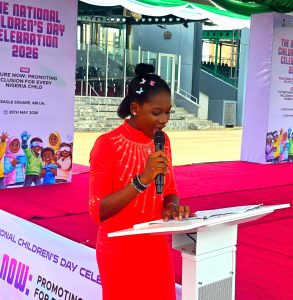
Speaking on behalf of over 80 million Nigerian children, youth representative Jessica Nurfi delivered an unvarnished assessment of the structural bottlenecks confronting the average child while acknowledging the unforgettable celebrations hosted by the presidency.
“We ask all leaders at home, in communities, states, and nationally to hand over to us a Nigeria we can be proud of. A Nigeria where leaders know the way, go the way, and lead the way. A Nigeria where every child belongs.” She appealed
Nurfi placed explicit benchmarks before the nation’s leadership, presenting five core national demands: make education free, accessible, and high-quality for every child regardless of location; strengthen healthcare to support those with special needs; ensure full inclusion for children with disabilities in schools and public spaces; protect learning environments from insecurity and violence; and engineer a safer, cleaner environment free from drugs, cultism, and bullying.
In return, she pledged that Nigeria’s children will reject negative vices, study hard, and prepare to become the responsible leaders of tomorrow.
The submission by the Permanent Secretary/Acting Mandate Secretary, Women Affairs Secretariat, Federal Capital Territory Administration, Hajiya Asmau Mukhtar, reaffirmed the commitment of sub-national governments to advancing the rights, welfare, and development of women, children, and vulnerable groups through inclusive and people centered policies.
In alignment with the national vision of fostering collaboration among relevant stakeholders to build an inclusive society where every child can learn, grow, and thrive irrespective of background or circumstance, she pledged the FCT Administration’s continued commitment to championing policies and programmes that guarantee every Nigerian child within the Territory a safe, supportive, and just environment in which to flourish.
“We remain committed to advancing child protection, inclusion, and social development across the Federal Capital Territory. We have strengthened community-based child protection structures, trained auxiliary social workers, and enhanced monitoring of homes and orphanages within the FCT to ensure the safety and dignity of every child. The structural alignment towards child development is further validated by national security and international development institutions as a baseline requirement for internal stability.”
Her remarks underscore the growing policy convergence between federal and sub-national authorities in prioritising child protection, social inclusion, and institutional safeguards as critical pillars for sustainable development and social stability.
This multi-sectoral transition towards child development is heavily validated by international development agencies and national security institutions as a fundamental baseline for long-term internal stability. This reaffirmed that children remain the clearest expression of tomorrow, fragile yet full of promise, innocent yet carrying within them the destiny of a people.
With children constituting over 45 percent of the national population, the National Counter-Terrorism Centre (NCTC) affirmed that protecting children and promoting inclusion is a strategic investment in peacebuilding and national cohesion that directly prevents radicalisation, violent extremism, and terrorism.
The National Counter-Terrorism Centre (NCTC) notes that incorporating child inclusion and psychosocial rehabilitation policies directly mitigates the threats of radicalisation, violent extremism, and local terrorism.
The National Coordinator, NCTC Major General Adamu Laka (Rtd), said, “Promoting inclusion is not only a moral responsibility but also a strategic investment in peacebuilding, national cohesion, and the prevention of violent extremism, terrorism, and other forms of insecurity.”
This long-term perspective is shared by the World Bank, which categorised Nigeria’s massive child demographic as its single largest asset, emphasising that the story of the nation’s future will be determined by critical health and investments made in the earliest years of life.
The World Bank ties the country’s long-term economic returns directly to early-years investments in nutrition, water, sanitation, and education.
The Country Director, World Bank Mathew Verghis, noted that “The story of Nigeria’s future will be determined, and that happens in the earliest years of life.”
UNICEF has further reminded global and domestic stakeholders that children are not passive objects of charity but central holders of rights, urging adults to listen to their voices systematically every single day rather than treating inclusion as a singular annual observance.
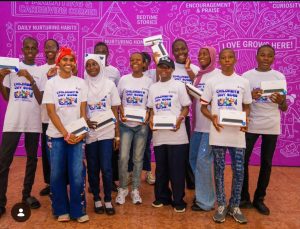
UNICEF further urges sustained systemic operationalisation, reminding stakeholders that children must be active participants in policy discussions daily rather than on a singular annual holiday.
UNICEF Country Representative Wafaa Abdulatef stated, “Let us listen to children. Not only during this Children’s Day, but also every day. A Nigeria that protects its children is a Nigeria that has a predictable solution.”
Children and Adolescent Girls Interactive Session and “One-Day Honourable Minister” Programme;National Caregivers/Parents-Teachers Summit;Boy-Child Novelty Football Match; Annual Children’s Day Party hosted by Her Excellency, the First Lady of the Federal Republic of Nigeria; National Essay Competition across the 36 States and the FCT; FCT Science Exhibition/Competition; National Rally and March Past; Annual Children’s Day Carnival; and the Commemoration of the 2026 World Menstrual Health and Hygiene Day.
These activities are carefully curated to promote inclusion, creativity, participation, protection, leadership, and holistic development among Nigerian children while reinforcing national consciousness around child rights and family wellbeing.
National development requires collaboration and sustained inclusion, and Government alone cannot achieve this mandate. The Renewed Hope Agenda of the administration of President Bola Ahmed Tinubu, the Renewed Hope Initiative of the First Lady, Senator Oluremi Tinubu, and the policy strengthening of the Imaan Sulaiman-Ibrahim-led Ministry of Women Affairs and Social Development are pushing holistic all-round inclusion, leaving no one behind, are carrying all stakeholders along.
Through a unified collaborative approach, Nigeria is steadily charting a path where children are prioritised, families are empowered, and the next generation is fully equipped to drive national development because Nigeria’s children matter, and their mantra is “Anything done without us is against us.”