
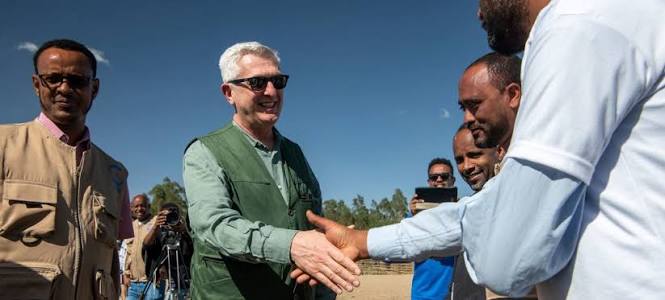
The United Nations High Commissioner for Refugees (UNHCR), Barham Salih, has visited the Ura Refugee Settlement in Ethiopia’s Benishangul-Gumuz Region.
Established in 2024 to accommodate people fleeing the civil war in neighbouring Sudan, the settlement has emerged as an important model for refugee inclusion and integration.
During the visit, Salih assessed living conditions at the settlement and highlighted efforts aimed at promoting self-reliance, access to essential services, and social inclusion for displaced populations.
The Ura Refugee Settlement continues to play a vital role in providing safety and support to thousands of Sudanese refugees seeking protection in Ethiopia.
READ ALSO: National Plastic Summit Stakeholders Chart Africa’s Circular Future
Salih complimented the Ethiopian government describing its Makatet programme as an “important and ambitious roadmap”.
“It allows refugees documentation, allows them access to the legal services, education, healthcare, and also the job market,” he said.
“I think they know this is the way to helping both the refugees but also the host communities who are under enormous strain.
But this must not be about shifting responsibility, this must be about sharing responsibility.”
The roadmap is seen as an answer to decades of fragmented assistance and moves beyond long-term camp dependency.
Under the model, refugees and host communities grow together under a unified, well-coordinated, government-led system.
Refugee Saron Bibi Dosa said it good to be working together and cooperating, while “sharing different facilities”.
Fellow Sudanese refugee, Rasha Mohammed, said she thought the Makatet Roadmap was a good idea.
“For us, the women or the men who don’t have jobs, that helps a lot. You know, that helps a lot for you to build yourself up,” she said.
Salih welcomed the shift to the social inclusion of refugees, highlighting the initiative as a global standard for localised development
His visit on Saturday came on World Refugee Day, which highlights the fundamental human right to seek safety, dignity, and protection.
Africanews


[…] READ ALSO: UNHCR Chief Visits Sudanese Refugees In Ethiopia […]