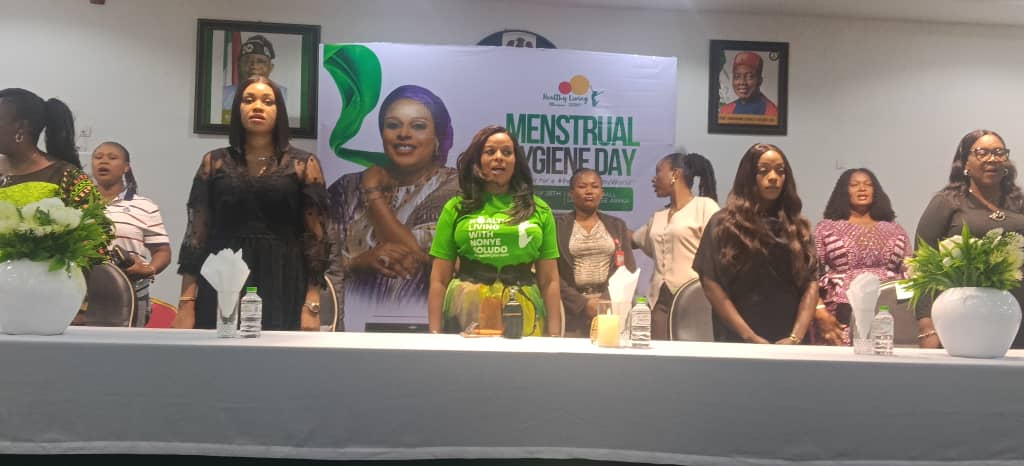
The wife of the Anambra State governor, Dr. Nonye Soludo, has called for an end to stigma, discrimination and harmful cultural practices associated with menstruation, insisting that no girl should suffer shame or lose access to education because of her menstrual cycle.
Dr. Soludo made the call on Thursday during the 2026 World Menstrual Hygiene Day celebration held at the Banquet Hall, Light House, Awka.
Addressing students, teachers, health professionals and development partners at the event, she described menstruation as a natural biological process that should be approached with dignity, education and compassion rather than silence and exclusion.
“Menstruation is not a curse. It is not a taboo, and it is not something any girl should be ashamed of,” she said. “Every girl deserves to experience her womanhood with dignity, confidence and pride, not fear or humiliation.”
The governor’s wife lamented that many girls still suffer in silence due to poor menstrual hygiene education, lack of sanitary materials and harmful societal misconceptions.

She said the state government, through the Healthy Living with Nonye Soludo Initiative, had continued to promote proper hygiene, nutrition, preventive healthcare and wellness across schools and communities in the state.
According to her, hygiene remains one of the six cardinal pillars of the initiative because healthy habits developed early in life help build healthier homes and communities.
Dr. Soludo disclosed that the initiative had established sanitary pad banks in more than 350 schools across Anambra, with regular refilling based on usage and needs.
She added that over 25,000 packs of sanitary pads had so far been distributed to schoolgirls through the programme.
“These pad banks have not only improved personal hygiene among young girls but have also restored confidence, reduced absenteeism and created a more comfortable learning environment for students,” she said.
She stressed that no girl should be forced to choose between her education and her biological reality, urging parents, schools, religious institutions, corporate organisations and development partners to sustain support for menstrual hygiene advocacy.
Dr. Soludo also encouraged girls to embrace confidence and self-worth, assuring them that menstruation should never limit their aspirations or future.
Medical experts at the event highlighted the importance of menstrual education, early awareness and access to healthcare for adolescent girls.
A medical practitioner, Dr Chikosoro Ofobuike, urged girls to speak out against sexual molestation and seek guidance whenever they experience challenges relating to puberty and menstruation.
She explained that menstruation is a normal biological process linked to puberty and reproductive health, stressing the need for girls to understand their menstrual cycles rather than treat the subject as shameful or secretive.
According to her, while the average menstrual cycle is about 28 days, medically normal cycles may range from 21 to 35 days.
Dr. Ofobuike further educated students on menstrual flow patterns, menstrual cramps and the importance of seeking medical attention whenever abnormal symptoms occur.
She advised girls to consistently monitor and calculate their menstrual cycles to improve reproductive health awareness and assist doctors during medical consultations.
Also speaking, the State Nutrition and Health Education Officer, Dr. Rose Amasiani, described menstruation as a normal biological process that should never attract shame or discrimination.
She said World Menstrual Hygiene Day, celebrated globally every May 28, was aimed at promoting safe and dignified menstrual hygiene practices for girls and women.
Amasiani recalled findings from earlier studies in Nigeria showing that many girls suffered due to ignorance and poor menstrual hygiene management, adding that harmful practices and stigmatisation had negatively affected the confidence and wellbeing of young girls.
She commended the wife of the governor for strengthening menstrual hygiene advocacy in Anambra through the establishment of hygiene corners and pad banks in schools across the state.

Healthy Living Ambassadors at the event, including Ambassador Kenechukwu Ejim of Community Secondary School, Amansea; Ambassador Chidimma Ekesili of Community Secondary School, Achalla; Ambassador Naomi Mathias of Community Secondary School, Mmiata Anam; and Ambassador Zita Adichie, praised Dr. Soludo for supporting schoolgirls and pledged to continue promoting menstrual hygiene awareness in their schools and communities.