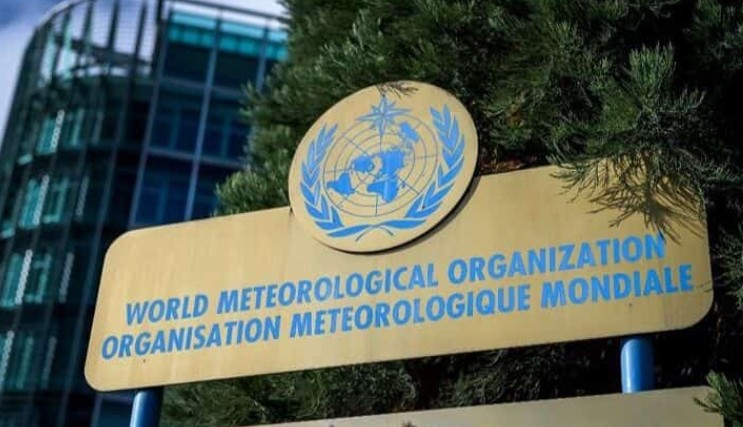
The World Meteorological Organisation (WMO) has warned that global temperatures are expected to remain at or near record highs over the next five years, raising concerns about worsening climate impacts across the world.
In a new report titled ‘Global Annual-to-Decadal Climate Update’, produced by the United Kingdom’s Met Office, the UN weather agency projected that annual global temperatures between 2026 and 2030 will likely range between 1.3°C and 1.9°C above pre-industrial levels recorded between 1850 and 1900.
According to the report, there is an 86 percent probability that at least one year within the 2026–2030 period will surpass 2024 as the warmest year ever recorded globally.
The report also states that there is a 91 percent chance that global mean near-surface temperature will temporarily exceed 1.5°C above pre-industrial levels for at least one year during the same period.
Scientists noted that this threshold was already temporarily breached in 2024, when temperatures reached approximately 1.55°C above the pre-industrial average.
Additionally, the WMO estimates a 75 percent chance that the average temperature over the five-year period from 2026 to 2030 will exceed the 1.5°C benchmark.
However, the agency stressed that temporary exceedances do not mean the long-term goals of the Paris Climate Agreement are unattainable. The agreement’s temperature targets are measured over decades rather than individual years.
Lead author of the report, Dr. Leon Hermanson, said an El Niño event forecast for late 2026 could further intensify warming trends.
“There is an El Niño predicted for the end of 2026, which increases the chances of the following year, 2027, being the next record-breaking year,” he said.
The report predicts that Arctic temperatures during the next five northern hemisphere winters will average about 2.8°C above the 1991–2020 baseline, more than three times higher than the projected global average warming.
Scientists also forecast continued reductions in Arctic sea ice, particularly in the Barents Sea, Bering Sea and Sea of Okhotsk.
On precipitation patterns, the report projects wetter-than-average conditions across northern high-latitude regions, including parts of northern Europe, Alaska and Siberia, while drier conditions are expected in subtropical regions and the Amazon basin.
For Africa, the WMO noted that the Sahel region is likely to experience wetter-than-average conditions during the May-to-September rainy seasons between 2026 and 2030.
The report further highlighted that global climate forecasts are becoming increasingly reliable, with high confidence in predictions of global mean temperatures due to improved modelling and forecasting systems.
The climate update was compiled using predictions from 13 international institutes, including major global climate centres in Canada, Germany, Spain and the United Kingdom.
The WMO said the findings are intended to guide governments, regional climate centres and national meteorological agencies in planning adaptation and resilience strategies in response to intensifying climate change.
The World Meteorological Organisation is the United Nations agency responsible for weather, climate and water-related issues worldwide.