
The Minister of Women Affairs and Social Development Hajiya Imaan Sulaiman-Ibrahim has flagged off the Nigeria for Women Project Scale-Up (NFWP-SU) and the disbursement of Community Investment Funds to Women Affinity Groups, in Ekiti State South West Nigeria
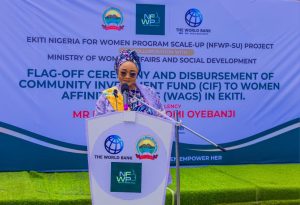
Speaking, Minister Imaan Sulaiman-Ibrahim described the intervention as a defining moment in translating government policy into measurable impact.
“There are moments in the life of a nation when policy becomes present and presence becomes impact, when government ceases to be distant and becomes wealth in homes. It becomes felt in markets, it becomes felt on farms and it becomes felt in the enterprises of the people. Today is such a moment.”
The Minister said the programme was designed to dismantle long-standing barriers confronting women in access to finance, markets, land and productive opportunities.
According to her, the first phase of the programme reached 450,000 women nationwide, while the scale-up phase targets approximately five million women.
“This programme is designed to expand financial inclusion, to strengthen enterprise development, to build skills and to deepen community-based economic organisation through the Women Affinity Groups.”
She disclosed that implementation in Ekiti State since June 2024 has produced nearly 1,500 Women Affinity Groups with more than 25,000 women actively engaged in productive economic activities.
“These figures represent women who are earning, women who are saving, women who are investing, women who are supporting their households and strengthening local economies.”
The Minister emphasised that the Community Investment Fund was neither a grant nor a conventional loan.
“The CIF is not a handout, not a conventional loan. It is structured community capital, disbursed directly to Women Affinity Groups, managed by them with transparency and shared responsibility.”
Linking the intervention to President Bola Ahmed Tinubu’s declaration of 2026 as the Year of Families and Social Development, the Minister said women’s empowerment remains central to national prosperity.
“When women rise, a family is strengthened. When families strengthen, our communities flourish. When our communities flourish, our nation will prosper.”
In his remarks, Ekiti State Governor Biodun Abayomi Oyebanji described the launch as the realisation of a commitment the state made in 2024 when it contributed ₦450 million to qualify for participation.
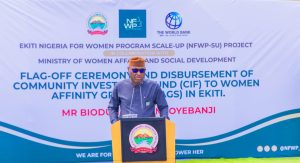
“In 2024, for us to qualify, we paid the sum of 450 million naira because that was the requirement for a state to qualify.”
The Governor while commending the Minister for the actualisation, expressed concern over implementation delays and called for greater responsiveness from development partners.
“Between then and now, it was a motion without movement, but I thank the Honourable Minister for making this possible.”
Highlighting testimonies from beneficiaries, Governor Oyebanji urged faster expansion of the programme. He announced state readiness to support the extension of the programme to all sixteen local government areas.
“Whatever is going to cost us as a state to ensure that this programme goes to all the 16 local governments, we are ready to do it.”
Providing the development partner perspective, Senior Social Development Specialist and Task Team Leader of the World Bank, Michael Ilesanmi, representing the Country Director said the project emerged from evidence showing that financial assistance alone could not address entrenched barriers facing women.
“Women in Nigeria face multiple complex barriers to empowerment, and we recognise that financial support alone is not enough to address the structural barriers that women face in participating in the economy.”
He explained that the programme’s Women Affinity Group model combines savings, credit, business development, leadership training and social support.
According to him, the initiative also directly confronts harmful social norms and gender-based violence risks that undermine women’s economic participation.
“The project utilises Women Affinity Groups as platforms to build women’s human, financial and social capital. The NFWP recognises that addressing social norms, social constraints and the risks of gender-based violence are just as important as providing financial support.”
Ilesanmi noted that community dialogues, engagement with religious and traditional leaders, media campaigns and policy reforms were helping to shift attitudes and strengthen institutional support for women.
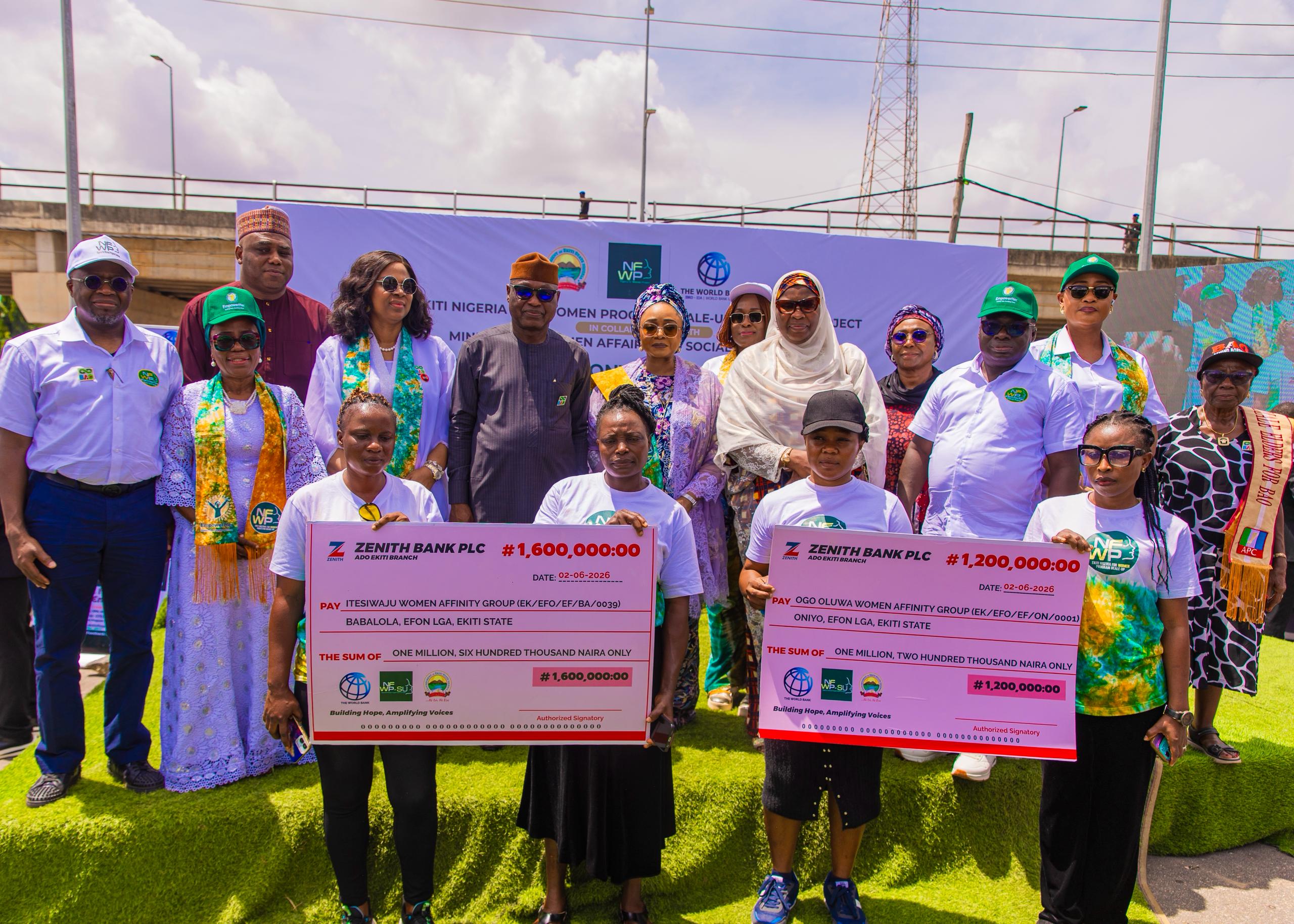
The high point of the flag-off was the symbolic disbursement to 142 mature women’s affinity groups in the Efon Local Government Area.
For beneficiaries across Ekiti State, the launch signals more than access to finance. It represents an expanding ecosystem of opportunity built on collective savings, enterprise growth, social inclusion and family resilience.
The event marked the transition of federal policy into grassroots economic action, positioning women at the centre of the Renewed Hope Agenda’s poverty reduction, enterprise development and family strengthening objectives.
This major milestone at the subnational is aimed at translating the Renewed Hope Agenda into measurable gains for women and families in Ekiti State as well as unlocking new opportunities for enterprise growth, financial inclusion and household prosperity across participating communities.
As implementation gathers momentum, stakeholders agree that the true measure of success will be visible not merely in statistics but in stronger households, thriving businesses and women assuming a more central role in Nigeria’s economic transformation.
The Ekiti, Nigeria, for Women Program Scale-up Project is a tripartite collaboration between the Federal Ministry of Women Affairs and Social Development, the Ekiti State Government and the World Bank.

