

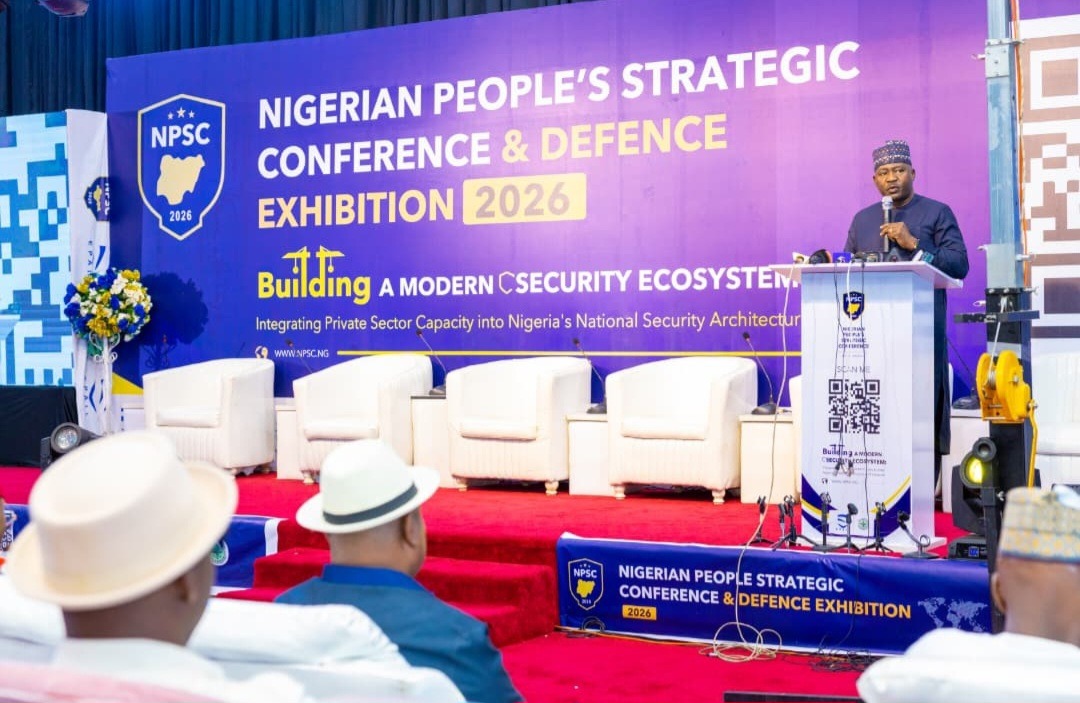
Nigeria’s defence strategy is increasingly shifting toward a broader security ecosystem model, with the Minister of Defence, General Christopher Musa (Rtd), calling for stronger collaboration between government institutions, the private sector and communities to confront evolving threats.
The Minister made the call at the Nigerian People’s Strategic Conference and Defence Exhibition 2026 held in Abuja, where he argued that contemporary security challenges can no longer be addressed through military operations alone.
In a statement issued by the Public Relations Officer, Ministry of Defence, Captain Moses Yare, General Musa emphasised that terrorism, banditry, cybercrime and infrastructure vandalism have become increasingly complex threats requiring collective national action.
The Defence Minister noted that modern security threats are often technology-driven and sustained through local networks, making citizen participation and timely intelligence sharing critical components of national security.
He stressed that communities have a strategic role in denying criminal elements support systems and creating an environment where security agencies can operate effectively.
According to General Musa, building a modern security ecosystem requires three major foundations: effective government leadership and coordination, sustained investment in indigenous defence innovation, and stronger community partnerships built on trust and accountability.
READ ALSO: NITP Urges Traditional Leaders to Champion Urban Planning Reforms
The Minister further advocated structured public-private partnerships to strengthen intelligence gathering, protect critical infrastructure and improve national response capabilities while maintaining compliance with existing laws and regulations.
He outlined priority areas, including stronger legal frameworks, secure information-sharing platforms, local defence manufacturing, professional training and deeper community engagement, as essential steps toward long-term security resilience.
Also speaking at the conference, Deputy Speaker of the House of Representatives, Rt. Hon. Benjamin Okezie Kalu, called for a comprehensive and community-focused approach to insecurity.
He highlighted dialogue, inclusive governance and public-private collaboration as critical elements, while describing the passage of the State Police Bill in the House as a significant step toward decentralising Nigeria’s security architecture.
Similarly, Senator Osita Izunaso stressed that military action alone cannot guarantee lasting peace, advocating a wider approach addressing poverty, unemployment, governance gaps and the development of indigenous capacity.
The Defence Minister reaffirmed the commitment of the Armed Forces of Nigeria and other security agencies to protecting the nation, while maintaining that sustainable security requires collective responsibility.
The emerging policy direction places security not only as a defence obligation but also as a national development framework requiring coordination across institutions, industries and communities.



[…] READ ALSO: Defence Minister Advocates Whole-of-Society Approach to National Security […]