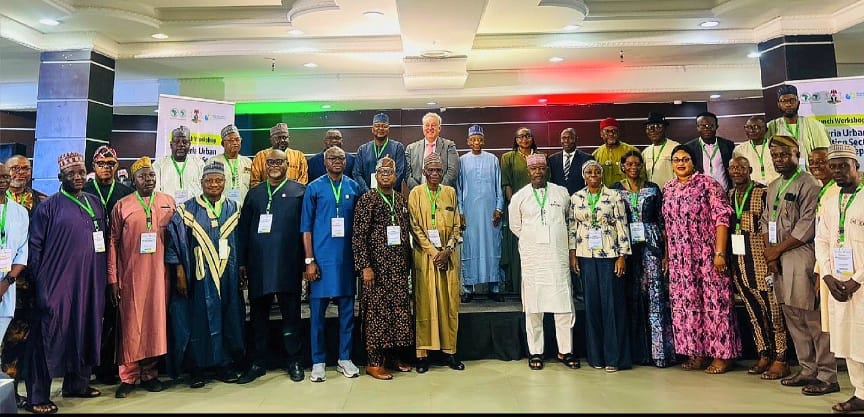
Nigeria’s urban sanitation stakeholders have proposed a reform pathway anchored on stronger governance, sustainable financing, private sector participation, institutional coordination and innovation to transform sanitation services and advance progress towards safely managed sanitation for all.
Presenting Nigeria’s urban sanitation status and government ambitions at the Launch Workshop for the Nigeria Urban Sanitation Sector Diagnostic Report, Director, Department of Water Quality Control and Sanitation, Federal Ministry of Water Resources and Sanitation, Mr Jamilu Danhabu, said rapid urbanisation, population growth, inadequate wastewater and faecal sludge management and limited investment were increasing pressure on urban sanitation systems.
“Something needs to be done. We need to do something. Very, very urgent.”
He said urban sanitation remained critical for public health, environmental protection, economic productivity, climate resilience, human dignity, gender equality and social inclusion, noting that poor sanitation contributes to disease outbreaks, groundwater pollution, flooding, environmental degradation and economic losses.
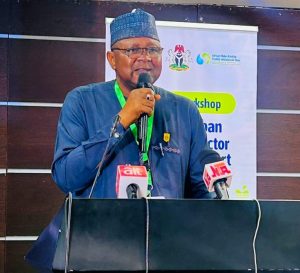
Danhabu highlighted challenges including limited sewerage coverage, inadequate faecal sludge management, ageing infrastructure, weak regulation, poor financing and low private sector participation. He identified government priorities as strengthening sanitation governance, promoting citywide inclusive sanitation, improving faecal sludge management, increasing sector financing, strengthening digital monitoring and developing climate-resilient infrastructure.
“Treatment, reuse and disposal… need massive investment and need everybody to participate. Private sector, development partners, institutions, everybody.”
He said the government’s ambition aligns with Sustainable Development Goal 6.2, focusing on universal access to safely managed sanitation, elimination of open defecation, increased domestic financing, improved services for vulnerable communities and greater private sector investment.
Presenting results on the sanitation sector diagnostic report, African Development Bank institutional expert Mr Peter Von described Nigeria’s sanitation sector as a high-impact opportunity constrained by structural challenges.
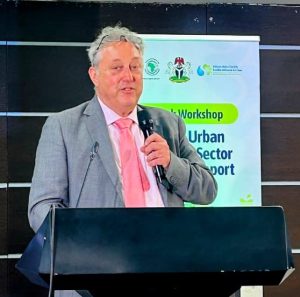
“Nigeria’s sanitation is a high-impact, high-growth opportunity but remains structurally constrained.”
Von identified financing shortages, low commercial attractiveness of sanitation projects, limited access to finance, inadequate de-risking instruments and differences in state commitment as major barriers.
He proposed a programmatic approach built around long-term, linked interventions rather than isolated projects.
“We design a long-term strategic framework of interlinked projects to achieve strategic objectives and create systematic impacts.”
He said the approach would be holistic, integrated, long-term, adaptive and flexible, providing a framework for cooperation, improving project bankability and attracting wider investment.
Stakeholder group presentations also provided recommendations.
Group One, focusing on private sector participation, called for political commitment, reliable data, enabling laws, clear private sector roles, infrastructure development, technology, innovation, resource recovery, capacity building, incentives, regulatory reforms, state PPP offices, investment forums and private sector coordination platforms.
“We need to have a political will and commitment of the institution, which is the government authority here, either at national or state or local government level.”
Group Two emphasised policy domestication, institutional strengthening, stakeholder engagement, timely budget releases, public awareness and stronger local government capacity.
“The subnational plays a pivotal role in the implementation of the urban or what you call environmental sanitation.”
The group advocated Public Private Partnership models, service level agreements, peer review among states and Federal Government incentives.
Group Three identified financing priorities across containment, emptying, transportation, treatment and reuse.
“Establishing faecal storage treatment plants was quite key and required huge investment and immediate action.”
The group recommended treatment plants in states, laboratories, soft loans, subsidies for urban slums, microfinance support, capacity building and technology deployment.
Group Four proposed SDG 2030 pathways including political commitment, enabling policies, investment plans, blended finance, sanitation infrastructure, strengthened regulation, urban planning, monitoring and reporting.
“We cannot achieve this urban sanitation target of SDGs by 2030 without the coordination of the effort of both the government, the private sector, the civil societies, and other partners involved and the communities.”
The stakeholders agreed that sanitation transformation requires coordinated action among government institutions, development partners, private investors, civil society organisations and communities.
The workshop was organised by the Federal Ministry of Water Resources and Sanitation in collaboration with the African Development Bank, with support from the African Water Facility, Gates Foundation and Nordic Development Fund.