By Salihu Ali, Kano
Journalists and media practitioners have been encouraged to embrace Earth Observation technologies to improve climate change reporting, disaster risk management coverage and environmental sustainability reporting through evidence-based journalism.
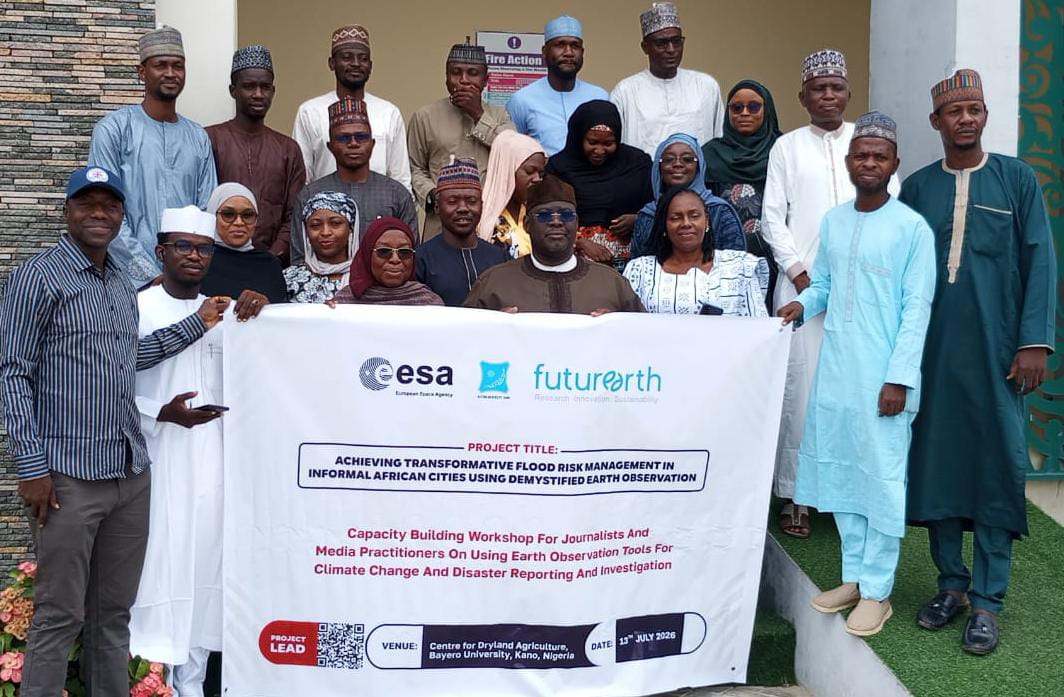
The call was made during a capacity-building workshop for journalists and media practitioners on the use of Earth Observation tools for climate change, disaster risk management and environmental sustainability organised by Bayero University Kano (BUK) North West Nigeria.
Speaking at the opening ceremony, the Team Lead, Professor Aliyu Barau said environmental challenges such as floods, droughts, deforestation, land degradation, pollution and biodiversity loss are becoming more severe, making accurate and scientific reporting more important than ever.
He said journalists play a critical role in shaping public understanding, influencing policy debates and promoting accountability, stressing that environmental reporting must be backed by credible scientific evidence.
“Earth Observation technologies provide reliable, objective and continuously updated information about our changing environment. For journalists, these tools are powerful instruments for fact-checking, investigative reporting, data-driven storytelling and visual communication,” Barau said.
He noted that the training would equip participants with practical skills in accessing and interpreting satellite imagery, geospatial data and remote sensing information to produce more impactful reports on environmental issues.
“By harnessing the power of Earth Observation technologies, we can improve public awareness, support disaster preparedness, promote environmental accountability and contribute meaningfully to climate resilience and sustainable development,” he stated.
Also speaking, the Deputy Vice-Chancellor (Research and Development) of Bayero University Kano, Professor Amina Mustapha, described climate change as one of the greatest threats facing humanity, particularly in Northern Nigeria and the wider Sahel region.
She said the shrinking of Lake Chad, advancing desertification, drying rangelands and erratic weather patterns continue to threaten livelihoods, food security and economic development.
Professor Mustapha challenged journalists to shift attention from reporting climate disasters in other parts of the world to highlighting climate realities affecting Nigerian communities.
“The media is the bridge between scientific knowledge and public understanding. You have the power to translate complex data into compelling narratives that influence policy, shape behaviour and hold governments and corporations accountable,” she said.
Sustainable Development
She urged participants to embrace solution journalism by investigating ecological issues, documenting the experiences of vulnerable communities and promoting sustainable development.
“Climate change is not just an environmental issue; it is a development issue, a justice issue and a human security issue. We urge you to use the skills acquired here to investigate, inform and inspire action,” she stated.
Professor Mustapha also reaffirmed Bayero University’s commitment to supporting journalists through access to its research centres, laboratories and experts to strengthen science communication and evidence-based reporting.
In a virtual presentation, Research Coordinator and European Space Agency (ESA) Liaison for Future Earth, Freya Muir, highlighted how technology and Earth Observation systems can be harnessed to improve climate simulations and support better environmental decision-making.
The workshop, themed “Earth Observation Journalism, Disaster Risk Reduction and Climate Change Communication,” provided participants with practical knowledge on integrating geospatial data and satellite-based information into investigative and environmental reporting.
Participants commended the organisers for the initiative and pledged to apply the knowledge gained to strengthen evidence-based journalism and combat fake news and misinformation relating to climate change and environmental issues.