Nigeria’s response to emerging security threats is increasingly extending beyond conventional military operations into the digital domain, where cybercrime, cyberterrorism and attacks on critical national infrastructure are reshaping the country’s security priorities.
As technology continues to transform both criminal activity and modern warfare, digital forensic capability is becoming a strategic requirement for national resilience rather than a specialised technical discipline.
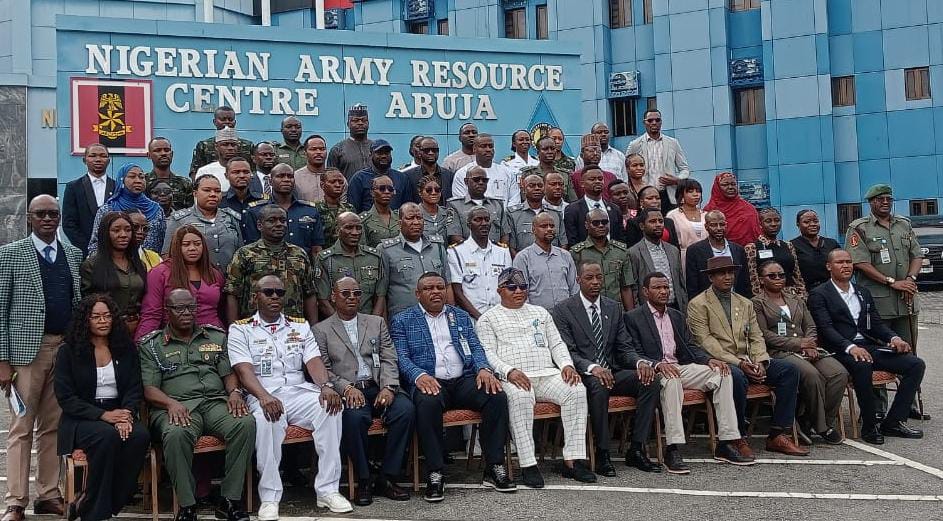
That shift is reflected in the Nigerian Army Resource Centre’s expanding investment in digital forensics and cybersecurity training, with partner Sentinel Forensics Limited, positioning specialised investigative capacity as an important pillar of Nigeria’s broader national security architecture.
The Director General Nigerian Army Resource Centre (NARC) Major General James Myam (Rtd) emphasised that strengthening national capability in digital investigations aligns with the vision of the Chief of Army Staff and Chairman of the Board of Trustees of the Nigerian Army Resource Centre, Lieutenant General Waidi Shaibu.
READ ALSO: Nigeria to Launch National Cybersecurity Council for Enhanced Resilience
Part of his mission is also to build knowledge-driven security solutions capable of addressing increasingly sophisticated threats.
The DG observed that while digital forensic science has become an indispensable component of modern security operations and criminal investigations globally, its application across Nigeria remains relatively underdeveloped despite the growing prevalence of cyber-enabled crime, cyberterrorism and attacks targeting government systems, financial institutions, telecommunications infrastructure and other strategic national assets.
To bridge that capability gap, the centre has continued building specialised competencies across the defence, intelligence, law enforcement and public sectors through practical training in digital forensics, cybercrime investigation, cybersecurity, counterintelligence, evidence handling, operational security and the protection of critical national infrastructure.
Broader Recognition
The initiative reflects a broader recognition that future security challenges will increasingly require investigators and security agencies to recover, analyse and preserve digital evidence capable of supporting intelligence operations, criminal investigations and national security decision-making.
As cyber threats become more sophisticated, technological expertise is emerging as a force multiplier that complements traditional security capabilities.
Representing Sentinel Forensics Limited, Forensics Consultant to Defence Headquarters Mr Joseph Akon explained that the collaboration focuses on equipping participants with practical competencies to confront rapidly changing digital threats, including cybercrime, artificial intelligence-enabled attacks, deepfake technologies and other forms of technology-driven criminal activity that increasingly carry national security implications.
The capacity-building effort also reinforces inter-agency collaboration by bringing together personnel from the Armed Forces, Defence Headquarters, the Office of the National Security Adviser, the Economic and Financial Crimes Commission, the Independent Corrupt Practices and Other Related Offences Commission, the Nigerian Communications Commission, the Independent National Electoral Commission and several other strategic institutions whose mandates increasingly intersect within the digital environment.
The programme is further strengthened through collaboration with Sentinel Forensics Limited, whose specialists, alongside international experts from the United Kingdom, Norway and South Africa, are contributing global best practices in digital investigations, cybersecurity and emerging technologies.
Technical cooperation
The partnership reflects Nigeria’s growing emphasis on combining indigenous institutional development with international technical cooperation to improve national preparedness against evolving cyber risks.
Beyond individual skills development, the initiative demonstrates an institutional shift towards building sustainable national capacity where trained personnel become knowledge multipliers within their respective organisations, strengthening investigative standards and improving coordinated responses across Nigeria’s security architecture.
As digital technologies continue to redefine both opportunity and risk, the Nigerian Army Resource Centre’s sustained investment in digital forensic capability underscores a growing understanding that protecting critical national infrastructure will depend as much on technological expertise and evidence-based investigations as on conventional security operations.