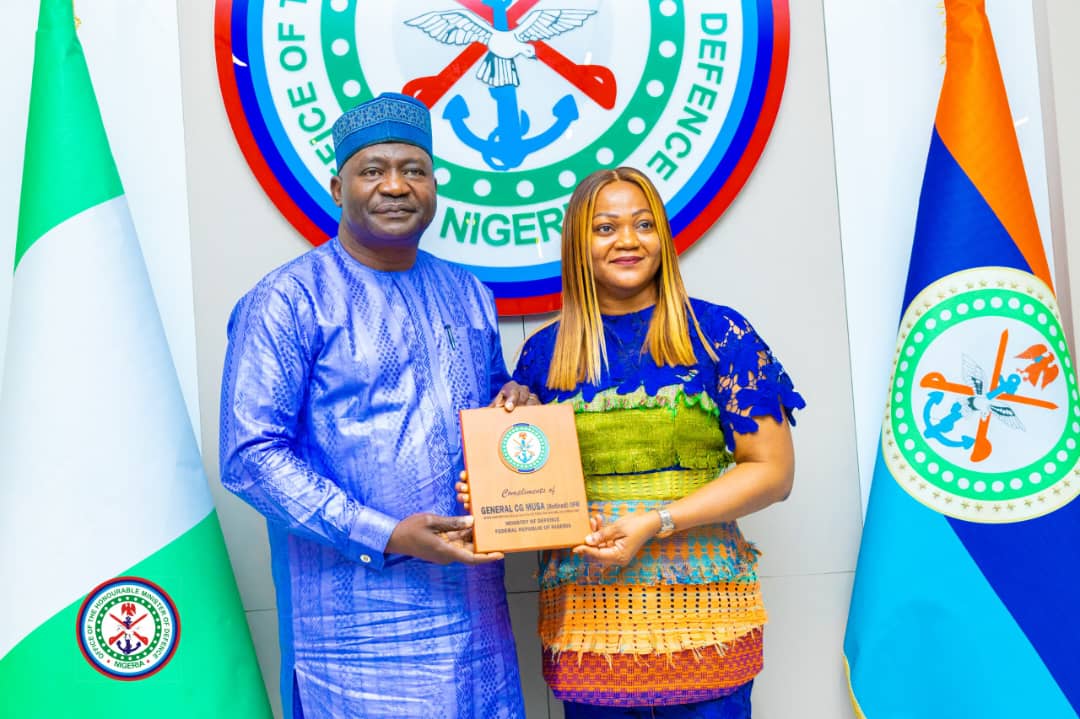
Nigeria is strengthening the integration of digital identity into its national security architecture as the Federal Ministry of Defence moves to deepen collaboration with the National Identity Management Commission (NIMC), signalling a broader shift towards data-driven security operations, intelligence coordination and identity verification.
The strategic direction emerged after the Federal Ministry of Defence, in a statement signed by Special Assistant to the Minister on Media, Leah Katung-Babatunde, disclosed that the Minister of Defence, General Christopher Musa (Rtd), received the Director General and Chief Executive Officer of NIMC, Dr. Abisoye Coker-Odusote, and her management team at Ship House, Abuja, to discuss implementation of the NIMC Act 2026.
During the meeting, the Minister emphasised that reliable identity data has become indispensable in confronting today’s evolving security threats.
He noted that effective defence planning, intelligence gathering, border management and internal security operations increasingly depend on the ability to accurately identify individuals, distinguish legitimate actors from hostile elements and improve information sharing across security institutions.
He further reaffirmed the Ministry’s commitment to supporting government agencies whose mandates contribute directly to national security objectives.
Read Also: NIMC Collaborates with Ministries to Expand National Identity Drive
The Ministry stated that discussions focused on implementing the NIMC Act 2026 through integrated digital identity systems capable of supporting defence operations and strengthening inter-agency collaboration.
According to the Minister, modern security challenges require coordinated responses built on credible and actionable data, making digital identity management a strategic national asset rather than simply an administrative function.
 Earlier, Director General and Chief Executive Officer of NIMC, Dr. Abisoye Coker-Odusote, explained that the engagement centred on expanding cooperation between both institutions to accelerate implementation of the new legislation.
She stressed that a secured, trusted and interoperable identity ecosystem would improve identity verification, enhance intelligence coordination and strengthen Nigeria’s broader security framework.
Both institutions agreed that stronger integration of digital identity infrastructure across government agencies will improve operational efficiency, support intelligence-led decision-making and reinforce the country’s capacity to respond to both internal and external security threats.