
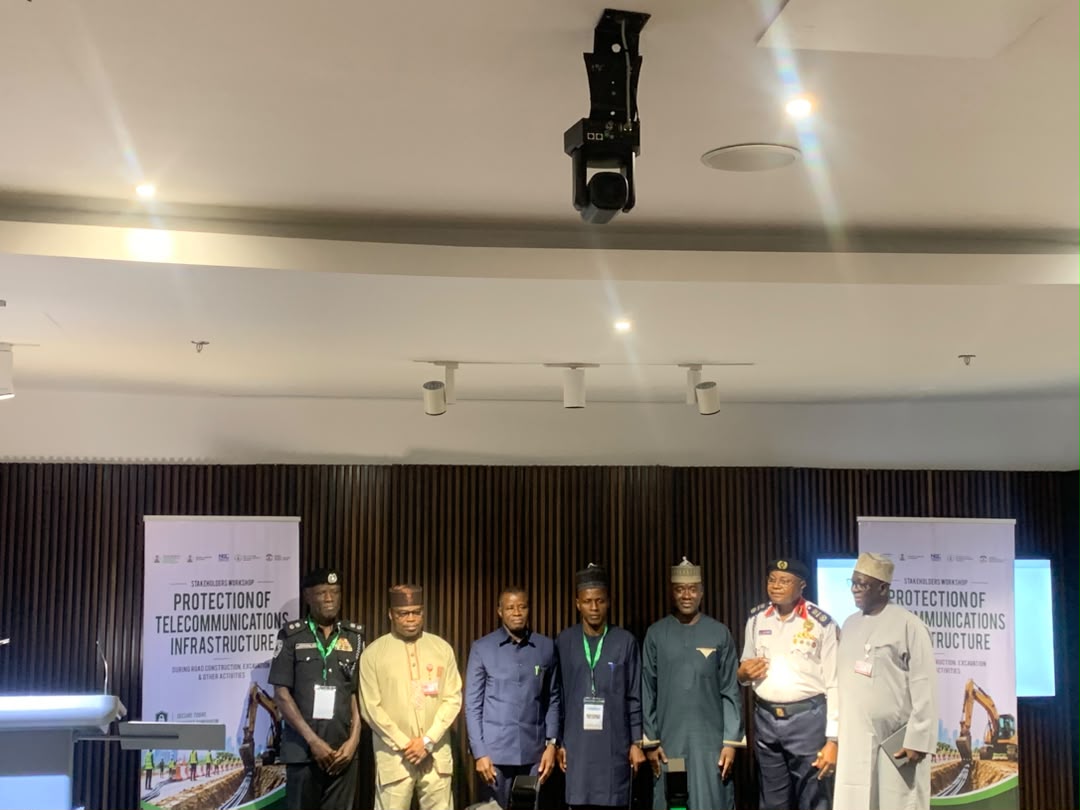
The Nigerian Communications Commission (NCC) has called for stronger coordination among government agencies, telecommunications operators, road contractors and other stakeholders to prevent damage to fibre-optic cables during road construction, rehabilitation and other civil works across the country.
The Executive Vice Chairman of the NCC, Dr Aminu Maida, made the call in his opening remarks at a stakeholders’ workshop on the protection of fibre-optic cables during road construction and related activities.
Maida described the workshop as an important platform for bringing together stakeholders responsible for Nigeria’s physical and digital infrastructure, stressing that the country’s drive to construct roads must not inadvertently damage the telecommunications infrastructure that connects communities to the digital economy.
According to him, roads and fibre-optic networks serve complementary purposes, with roads physically connecting people, goods and communities, while fibre networks connect Nigerians to information, services, markets and one another.
He said telecommunications infrastructure had become a critical national lifeline, underpinning banking, government services, education, healthcare, commerce, security and emergency communications.
“Communications infrastructure is now a lifeline,” Maida said, noting that the consequences of fibre cuts extend far beyond telecommunications operators.
Maida recalled the nationwide telecommunications disruption experienced in late February 2024, when multiple fibre cuts, including those associated with road construction activities, affected one of the country’s major telecommunications operators.
He said the disruption prevented millions of subscribers from making calls, sending messages or accessing the internet for several hours, while the migration of affected subscribers to alternative networks subsequently created congestion on those networks.
The NCC EVC emphasised that the people affected by such incidents should not be viewed merely as statistics in incident reports, but as citizens, workers, families and businesses whose access to essential services and economic opportunities had been disrupted.
Maida further disclosed that more than 5,000 fibre-cut incidents had been reported in the first six months of the year alone, arising from road excavation, construction and related civil works.
He attributed many of the incidents to inadequate coordination among stakeholders before construction activities commenced.
To address the challenge, he disclosed that the permanent secretaries of the Federal Ministry of Works and the Federal Ministry of Communications, Innovation and Digital Economy had inaugurated the Standing Committee on the Protection of Fibre-Optic Cables.
He explained that the committee was established to develop practical coordination mechanisms covering activities before, during and after road construction and other civil works.
Maida also disclosed that the membership of the committee had recently been expanded to include officials from the Office of the National Security Adviser and the Nigeria Security and Civil Defence Corps (NSCDC), reflecting the security implications of protecting telecommunications infrastructure.
The NCC EVC therefore urged participants at the workshop to engage openly, raise practical concerns and develop actionable measures that could be implemented at construction sites and within their respective organisations.
According to him “Nigeria must build the roads that connect our communities, while at the same time, we must also work together to protect the fibre networks that connect and drive our economy towards achieving His Excellency President Bula Amin’s $1 trillion economy. Each of us has a part to play. Operators must share accurate route information and respond promptly.”
“Contractors must check before excavation and plan for protection. Government agencies must support timely information exchange. Regulators and security agencies must provide guidance and ensure accountability.”
Also speaking, the Director of Critical National Assets and Infrastructure Protection at the Office of the National Security Adviser, AVM Effiom Ewa, said the protection of fibre-optic infrastructure was a shared national responsibility.
He noted that fibre-optic infrastructure had been designated as Critical National Information Infrastructure and warned that negligence, interference or actions that expose the assets to damage could constitute offences under Nigeria’s legal framework.
He expressed confidence that constructive dialogue and collective action among stakeholders would produce an enduring framework for protecting critical digital assets and strengthening Nigeria’s connected, secure and prosperous future.
“We are confident that through constructive dialogue, shared responsibility, and a commitment to collective action, we will develop an enduring framework and partnership that will enhance the protection of these critical assets and support Nigeria’s journey towards a more connected, secure, and prosperous future.”
In his remarks, the Permanent Secretary of the Federal Ministry of Works, Rafiu Adeladan, said telecommunications infrastructure had become an integral component of Nigeria’s national infrastructure, supporting governance, commerce, education, healthcare, financial services, security and other socioeconomic activities.
Adeladan acknowledged that road construction and telecommunications infrastructure often occupied the same physical space, creating the potential for fibre-optic cables to be exposed or damaged during excavation, reconstruction, utility relocation and related activities.
He said the Federal Ministry of Works recognised the need for a stronger institutional framework for coordination, information sharing and stakeholder engagement before and during road construction.
The Permanent Secretary stressed the importance of ensuring that road contractors, consultants and relevant government agencies had access to accurate information on the location of telecommunications infrastructure before excavation begins.
He called for a shift from a reactive approach, where damaged cables are repaired after an incident, to a preventive system based on proper mapping of underground utilities, appropriate marking and protection of cables, early communication with telecommunications operators and compliance with technical and safety standards.
Representing the Permanent Secretary of the Federal Ministry of Communications, Innovation and Digital Economy, the Director of Telecommunications and Postal Services, Engr Stanley Musa, said the Federal Government viewed the protection of telecommunications infrastructure as a shared national obligation.
The Perm Sec said the theme of the engagement, “Secure Today, Connect Tomorrow,” reflected the need for collaboration among ministries, regulators, security agencies, construction companies, utility providers and other stakeholders.
He described fibre-optic infrastructure as a strategic national asset supporting economic growth, financial services, healthcare, education, public administration, security, innovation and social inclusion.
He said protecting the infrastructure was therefore not merely a technical responsibility but a national imperative.
According to him, “significant investments had been made in expanding broadband infrastructure across Nigeria, but continued fibre cuts caused by road construction and excavation activities were undermining those investments.”
Such incidents, he said, disrupt essential services, weaken network resilience, increase operational costs and could discourage further investment in the sector.
He added that the establishment of a tripartite standing committee on the protection of fibre-optic infrastructure was part of government efforts to strengthen collaboration and promote a coordinated approach to infrastructure protection.
The initiative, he said, was designed to prevent avoidable damage, strengthen compliance with established standards and right-of-way regulations, improve information sharing and promote the implementation of the government’s “Dig Once” approach nationwide.
The Perm Sec also disclosed that the Ministry had presented a memorandum to the National Economic Council on the harmonisation of right-of-way charges and related implementation strategies.
According to him, a multi-stakeholder committee had subsequently been established to develop national standards, define rules and propose a management structure for shared infrastructure.
The workshop marked a renewed effort by government and industry stakeholders to ensure that Nigeria’s drive to expand its physical infrastructure proceeds alongside the protection of the digital networks that increasingly power the nation’s economy.

