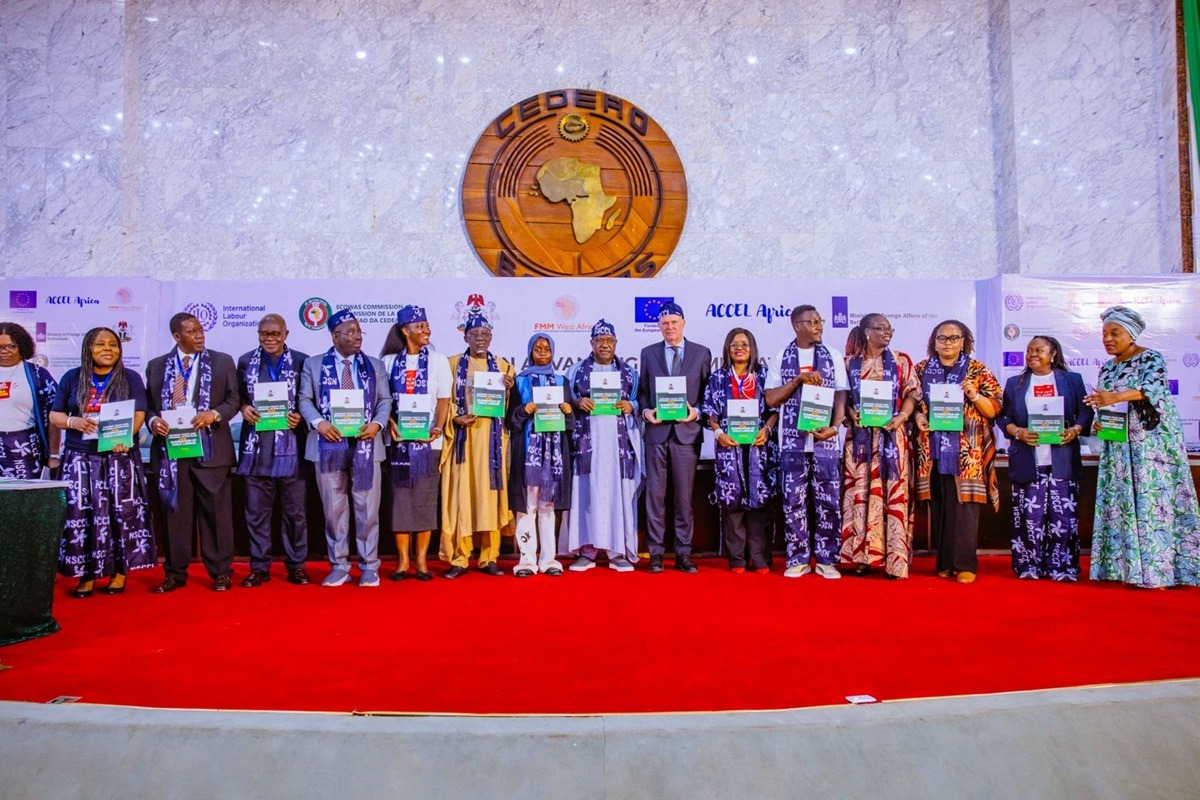
The Nigerian Government and the International Labour Organisation, ILO, have launched the National Policy and National Action Plan for the Elimination of Child Labour 2026-2030.
The Document was launched by President Bola Ahmed Tinubu in Abuja on Wednesday at the National Dialogue on “Advancing the Implementation of Nigeria’s National Policy on Child Labour and National Action Plan towards 2030: From Commitment to Action”.
The event forms part of activities set by Nigeria in commemoration of the 2026 World Day Against Child Labour.
Represented by the Secretary to the Government of the Federation, Senator George Akume, president Tinubu, said that every nation is judged by how well it protects its children.
READ ALSO:ILO, UNICEF Organise L eadership Training on Social Protection
He said that a child who is forced into labour instead of attending school loses more than an education, noting, that child loses opportunities, confidence, health and a chance to fully contribute to national development.
“For this reason, the federal government considers the elimination of child labour not merely as a labour issue, but as a national development priority. It is linked to education, social protection, economic growth, poverty reduction, food security, human capital development and national security.
“Today’s event therefore represents another significant step in our collective determination to build a Nigeria where every child is protected from exploitation and empowered to reach his full potential.
The findings of the National Child Labour Survey remind us that child labour remains a significant challenge requiring sustained and coordinated action. Behind every statistic is a child with hopes, talents and aspirations for the future.
“Our response must therefore be comprehensive, compassionate and determined”, the President said.
According to him, government will continue to strengthen labour administration, improve labour inspection systems, enhance child protection mechanisms and support interventions that address the root causes of child labour, including poverty, unemployment, inadequate access to quality education and social exclusion.
Wholistic Partnership
Minister of Labour and Employment, Dr Muhammad Dingyadi in his address, said that child labour remains one of the greatest obstacles to human dignity, social justice and sustainable development.
He said it deprives children of their childhood, their health, their education, and their future adding hat it also perpetuates poverty, undermines economic growth, and weakens the productivity of the nation.
He however, stressed that ending child labour cannot be achieved by government alone saying it requires a whole-of-government and whole-of-society approach.
“I therefore call upon State Governments to domesticate and effectively implement the National Policy on Child Labour and the National Action Plan; the Nigeria Governors’ Forum and the Nigeria Governors’ Spouses Forum to champion child protection policies and initiatives at the state level, the National Assembly to pass laws that enhance the protection of children in the country, and channel their constituency projects to put in place initiatives that will promote the protection and welfare of children and vulnerable families”, among other State and non State actors.
The Minister commended what he called the commitment and support of the ECOWAS Commission in the elimination of child labour in the region, through the FMM West Africa Project II in the implementation of the Regional Action Plan (RAP) on the Elimination of Child Labour.
Country Director of the International Labour Organisation ILO, Vanessa Phala, said the dialogue comes at a “very critical moment when around the world, we continue to witness the damaging effect of child labour on children’s rights, on their education, on their health, as well as on their safety, and most importantly, damaging their potential to become important contributors of their communities, of their country, and as well as our continent.”
Phala stated that Nigeria, as an Alliance 8.7 Pathfinder, has an important and a very critical contribution to make in this adding that Nigeria has demonstrated leadership by incorporating the Marrakech outcome and its recommendation in the call of action into the third edition of the National Policy and the Action Plan for the Elimination of Child Labour.
She emphasised that Nigeria’s commitment reflects ownership at the highest level “and as partners and stakeholders in this journey, we will continue to do our best to make sure that indeed we are moving from commitment to action, that we are moving from talking but to actually implementing and realising the tangible impact that we want to see on the ground.
There were good will messages from the government of the Netherlands, the ECOWAS Commission, the Nigeria Labour Congress, Trade Union Congress and the Nigeria Employers Consultative Association.