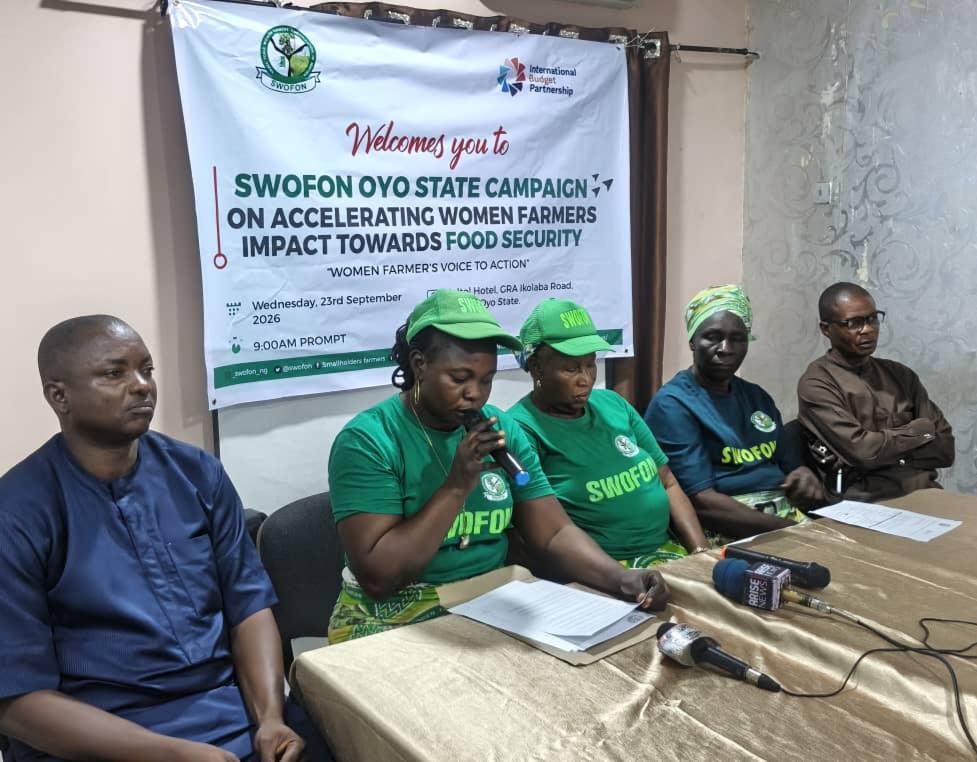
The Small-Scale Women Farmers Organisation in Nigeria (SWOFON), Oyo State branch, has called on the state government to urgently ensure that agricultural budgets translate into tangible support for smallholder women farmers across the state.
SWOFON also urged the government and other stakeholders to work with smallholder women farmers to close the gap between budgetary approval and actual delivery.
The call was made at the SWOFON Oyo State campaign on Accelerating Women Farmers Impact Towards Food Security, and the press briefing, tagged ‘Women Farmer’s Voice to Action, held in Ibadan.
SWOFON Oyo State Coordinator, Mrs Tinuke Akinbade, noted that despite the central role of women farmers in food production and rural livelihoods, budgetary investment in the sector has remained poor.
READ ALSO: NADF Foundation Begins Initiative to Empower Oyo Women Farmers
She said evidence from the IBP-SWOFON SPARK II policy brief shows that between 2021 and 2025, agriculture’s share of Oyo State budgets never exceeded 4.31%, while agricultural capital budget execution averaged only 17.5%, the weakest performance among the five states assessed under the programme.
Akinbade stated that women farmers in the state have not been silent, as the Oyo State Chapter has developed an extensive 10-point Charter of Demands and sustained engagement with government, saying the demands have, however, not translated into corresponding appropriations and implementation.
She said, “Receiving women farmers’ demands is not enough. The government must demonstrate how those demands are reflected in budget lines, how much is allocated, when funds are released, and what is ultimately delivered to farmers.”
Akinbade stressed that while SWOFON recognises progress in creating opportunities for women farmers to participate in budget hearings, participation must now lead to measurable results.
She called on Governor Seyi Makinde, the Oyo State House of Assembly, and relevant Ministries, Departments and Agencies (MDAs) to take six urgent steps, which include:
“Increased and protected agricultural investments with timely and transparent release of approved capital budgets;
“Conversion of women farmers’ demands into costed budget commitments by identifying three to five priority demands annually with traceable timelines,
“Institutionalisation of women farmers’ participation in state and local government planning with documented responses to their priorities,
“Improved access to land for women farmers by addressing customary inheritance barriers;
“Publish information on agricultural budget implementation to enable tracking of allocations, releases and beneficiaries;
“Strengthening of agricultural services beyond input distribution to include extension, irrigation, storage, processing and reliable markets.”
Akinbade stated, “Investment should go beyond the distribution of inputs. Women farmers need access to extension services, irrigation, storage, processing, transportation, aggregation and reliable markets so that increased production can translate into improved incomes.”
The Head of Democracy and Governance Programme at Justice, Development and Peace Commission (JDPC), Ibadan, Jide Bamgbose, decried poor budgetary allocation and performance in the agriculture sector, warning that the development has dire implications for food security in the country.
He said, “In some states, performance in terms of budget allocation to agriculture is between two and three per cent of the meagre amount allocated. Some states performed only 1.2 per cent input in two quarters of this year.”