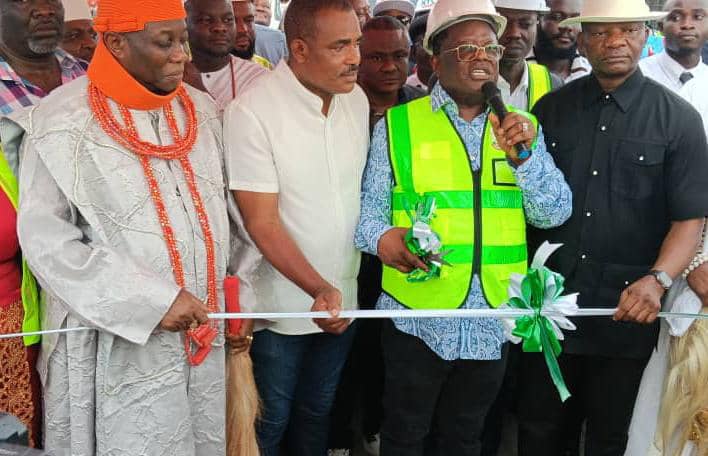
Nigeria’s Minister of Works, Senator David Umahi, has reopened the First Niger Bridge linking Onitsha, Anambra State, with Asaba, Delta State, following emergency rehabilitation and the installation of additional safety and security facilities on the strategic transport link connecting the South-East and South-South regions.
Speaking at the reopening on Thursday in Onitsha, Umahi said the intervention was aimed at protecting the bridge’s structural integrity, improving traffic management and safeguarding motorists using the vital national infrastructure.
Built in 1965, the bridge was closed on September 7, 2026, for emergency repairs initially scheduled to end on September 21.
The closure was extended because of persistent rainfall and other unforeseen delays
The rehabilitation followed the discovery of vandalised structural components, including missing bolts and damaged steelwork around expansion joints.
READ ALSO: Lawmaker Seeks Urgent Safety Measures on Sagamu–Benin Expressway
Umahi said the works included resurfacing the bridge, repainting road markings and railings, installing solar-powered streetlights and closed-circuit television (CCTV) cameras, and introducing median barriers and three designated turnaround points to improve traffic control and facilitate emergency manoeuvres.
He said that security observation centres were being established at both ends of the bridge to support monitoring and protect the structure against vandalism.
The minister warned against removing structural components and engaging in indiscriminate sand dredging near federal bridges, saying such activities could threaten their stability.
He said regulations prohibited dredging within a 10-kilometre radius of federal bridges and directed officials in Anambra and Delta states to enforce the restriction, warning that negligence would attract disciplinary action.
Umahi said the rehabilitation reflected President Bola Tinubu’s commitment to maintaining critical national infrastructure and improving transport connectivity.
He said plans to reconstruct approximately 400 kilometres of the East-West Road, while construction continued on the 17.5-kilometre Second Niger Bridge bypass, valued at about ₦172 billion. He added that Tinubu had approved the dualisation of the Oba-Okigwe Expressway.
On the Benin-Asaba Expressway, Umahi said the Federal Government had cancelled a remedial contract covering its first 11 kilometres because of dissatisfaction with the quality of work.
He said the road would undergo comprehensive redesign ahead of reconstruction to improve conditions for motorists along the busy corridor.

Deputy Chief Whip of the Nigerian Senate, Senator Onyekachi Nwebonyi, commended President Tinubu for approving the bridge rehabilitation, describing the structure as a strategic national asset. He praised Umahi’s role in the project and stressed the importance of maintaining critical infrastructure that supports transportation, trade and economic activity across the country.
Delta State Governor Sheriff Oborevwori, represented by Commissioner for Works (Rural Roads) and Public Information Charles Aniagwu, commended the Federal Government’s intervention and warned of the economic consequences of neglecting the bridge.
“If this bridge is allowed to collapse, it will not just affect the movement of people between the South and the East; it will also affect the economies of both regions,” Oborevwori said.
Anambra State Commissioner for Works and Infrastructure, Okey Ezeobi, who represented Governor Chukwuma Soludo, thanked Tinubu and Umahi for the rehabilitation, saying the intervention reflected federal attention to infrastructure development in the South-East.
Federal Controller of Works in Anambra State, Timothy Emenike, commended Umahi for overseeing the rehabilitation and expressed confidence that the repairs and additional safety measures would help preserve the bridge and improve motorists’ safety.
He said the new facilities would also strengthen traffic management and security, stressing the importance of protecting the bridge’s structural components from vandalism and ensuring regular maintenance.
Emenike urged motorists to obey traffic regulations and use the designated turnaround points to reduce accident risks.
He said sustained monitoring and responsible use of the bridge were essential to preserving the infrastructure and ensuring its continued service as a major national transport link.
The reopening restores a vital route for the movement of people and goods between the South-East and South-South, supporting interregional trade and economic activity across southern Nigeria.