


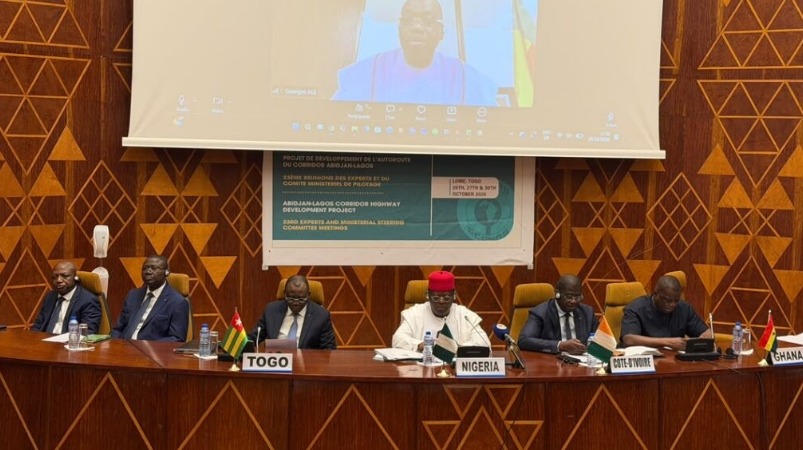
Ministers from five West African countries have intensified efforts to mobilise financing for the Abidjan-Lagos Corridor Highway Development Project, with discussions focusing on construction planning, right-of-way acquisition and funding arrangements for the regional infrastructure initiative.
The commitment was made at a statutory meeting of the project’s Ministerial Steering Committee in Lomé, Togo, attended by ministers, engineers, senior officials and development partners from Côte d’Ivoire, Ghana, Togo, Benin and Nigeria.
The meeting focused on construction planning, right-of-way acquisition and financing arrangements for the regional highway.
In a statement published on the ECOWAS Commission website, the Chairman of the Steering Committee and Nigeria’s Minister of Works, David Umahi, stressed the need for the five countries to harmonise their efforts to advance the project.
Ministers from Ghana, Togo, Côte d’Ivoire and Benin “expressed the economic transformation the corridor will bring to the region and renewed the commitment to ensure the project advances to the construction phase.
They also urge the Abidjan–Lagos Corridor Management Authority, ALCoMA, ECOWAS, AfDB, Country Engineers and stakeholders to prioritize support Member States raise the needed resources to cover Right of Way acquisition, Debt and Equity contributions for the Construction.”
The ECOWAS Commissioner for Infrastructure, Energy and Digitalisation, Amin Sulemani, urged ministers to accelerate preparations for construction, saying the study phase had taken too long and that citizens across West Africa were awaiting the project’s benefits.
READ ALSO: ECOWAS, IOM Deepen Cooperation on Regional Migration
He said that “as we move towards the construction phase, financing remains a critical priority, and ECOWAS, AfDB, EBID and partners are exploring innovative mechanisms to develop the whole corridors”.
AfDB Pursues $500m for Initial Construction
The African Development Bank Group, designated by the Steering Committee as the mandatory lead arranger for the project’s investment phase, told the ministers it was pursuing about $500 million in catalytic financing.
The funding is being sought from the African Development Fund’s 17th replenishment regional operations envelope and other instruments, including climate and green financing, to support construction of the first sections of the highway.
The Bank also reported that it had provided more than $25 million for feasibility studies, design work and technical assistance.
The ministers acknowledged the interest shown by financing partners during a resource mobilisation meeting and urged “all to come behind the AfDB and other Regional Development Bank’s to raise the needed Capital for the construction of the highway”.
The Steering Committee also considered the outcomes of a joint identification mission by the African Development Bank Group, ECOWAS and the West African Development Bank (EBID), which engaged relevant ministries in the five countries to secure national endorsements for the project’s financing phase.
The mission involved officials responsible for infrastructure, finance and public works, with discussions focusing on funding requirements for construction and land acquisition.
ALCoMA Moves Towards Full Operation
The ministers welcomed progress towards operationalising the Abidjan–Lagos Corridor Management Authority, the supranational body responsible for overseeing the highway’s design, construction and operation.
Earlier in the year, ALCoMA’s Board appointed Wilfried Lauriano do Rego of Benin as its first chairperson, in line with the alphabetical rotation arrangement established under the Intergovernmental Agreement.
The Board also established interim committees on Human Resources and Remuneration, and Finance, to support the Authority’s start-up operations and facilitate the recruitment of its Chief Executive Officer, directors and other staff.
The ministers noted that the African Development Bank had provided initial operational funding for ALCoMA, while the European Union and other development partners had expressed interest in contributing.
The Steering Committee endorsed the Authority’s operationalisation, including the recruitment of its Chief Executive Officer, Legal and Corporate Secretary, and key directors, in line with its roadmap.
Highway to Link Five West African Countries
The ministers underscored the “strategic importance of the planned six lane, 1,028 km supranational highway, and tasked ALCoMA and ECOWAS to ensure that Sea Ports and Capital Cities by-passed are well connected to ensure that the corridor serves as a key link to major economic hubs from Abidjan to Lagos and serve as a backbone for regional trade integration”.
The Abidjan–Lagos Corridor is designed to improve transport links, reduce logistics costs and facilitate trade among Côte d’Ivoire, Ghana, Togo, Benin and Nigeria.
Under the Corridor Treaty, the highway is expected to be developed and operated as a unified regional corridor under ALCoMA’s coordinated management.
The project is projected to support economic and industrial development by 2030, with estimates indicating potential increases in trade value and toll revenue across the participating countries.

