


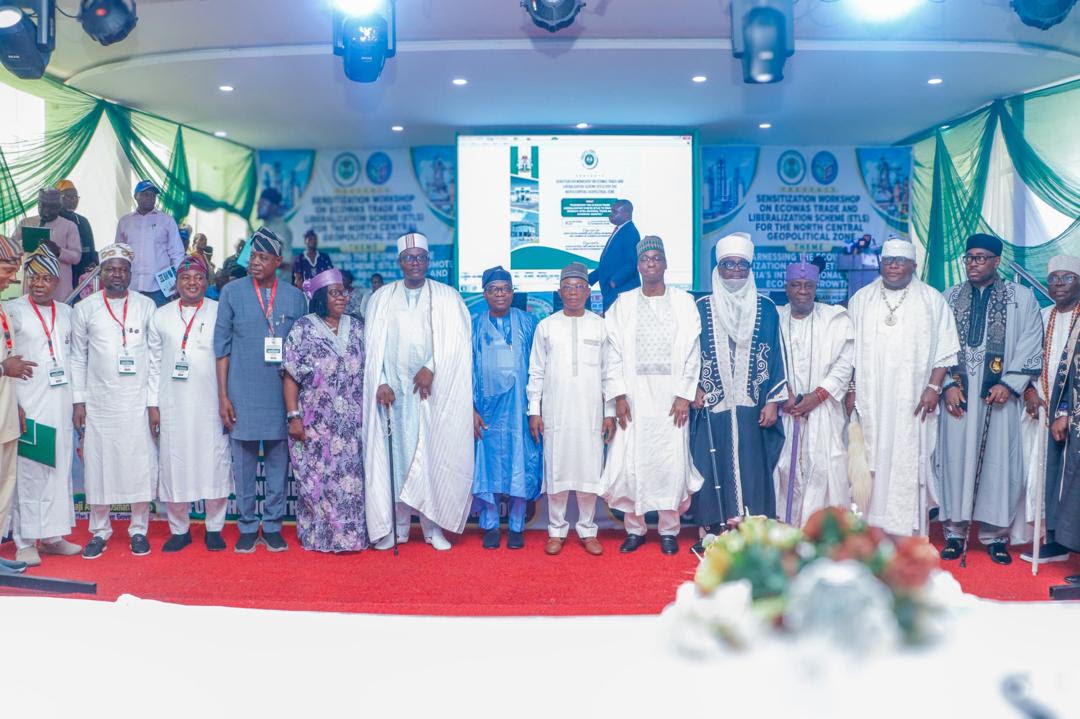
The Nigerian Government has reaffirmed its commitment to strengthening regional economic integration and expanding intra-regional trade through the effective implementation of the Economic Community of West African States (ECOWAS) Trade Liberalisation Scheme (ETLS).
Nigeria’s Minister of State for Foreign Affairs, Sola Enikanolaiye, stated this at a sensitisation workshop on the ETLS for the North-Central geopolitical zone, held in Lokoja, Kogi State.
The workshop was themed, “Harnessing the ECOWAS Trade Liberalisation Scheme to Promote Nigeria’s Interregional Trade and Economic Growth.”
Enikanolaiye described the ETLS as a cornerstone of Nigeria’s regional integration agenda, designed to promote intra-community trade by granting duty-free and quota-free access to approved products originating from ECOWAS member states.
He explained that the scheme was established to strengthen regional economic cooperation, encourage industrial development and support Micro, Small and Medium Enterprises (MSMEs).
The Minister disclosed that approximately 3,500 Nigerian companies and 20,000 products had been registered under the scheme, a figure he said remained significantly below Nigeria’s productive capacity and trade potential.
READ ALSO: Nigeria Seeks Deeper Business, Investment Ties with US
He, therefore, called for increased awareness, stronger institutional coordination and deliberate efforts to address the challenges limiting the full benefits of the initiative.
According to him, “Nigeria’s large population, natural resources, productive capacity, entrepreneurial base and strategic position in West Africa provide the country with significant advantages in advancing the objectives of the ETLS and the African Continental Free Trade Area (AfCFTA)”.
Enikanolaiye urged manufacturers, agricultural producers and MSMEs to take advantage of the scheme, noting that it aligned with President Bola Tinubu’s ambition of building a one-trillion-dollar economy by 2030.
He also linked the initiative to Nigeria’s four-pronged foreign policy priorities of Demography, Development, Diaspora and Democracy, stressing that the country’s diplomatic engagements must place national interests and the welfare of Nigerians at the centre.
The Minister encouraged Kogi State and the wider North-Central region to harness their agricultural, livestock and mineral resources through value addition and industrial production to strengthen Nigeria’s competitiveness in the West African market.
He urged participants to understand the registration, certification and rules-of-origin requirements necessary to access the regional market and benefit from the scheme.
Enikanolaiye said the North-Central region possessed enormous untapped potential in agriculture, livestock, minerals and manufacturing, capable of competing beyond Nigeria’s domestic market.
He noted that although businesses, particularly MSMEs, were eager to explore regional opportunities, they required clearer information, stronger institutional support and simpler procedures to participate effectively in the scheme.
Regional Integration
The Minister stressed that regional integration was not merely a diplomatic undertaking but a practical instrument for creating employment, generating income and improving livelihoods.
He urged businesses to register under the scheme, meet applicable standards and documentation requirements, and position their products to maximise available opportunities.
He also called on relevant Ministries, Departments and Agencies to provide exporters with timely and transparent institutional support without unnecessary bureaucratic delays.
In his keynote address, Kogi State Governor, Ahmed Usman Ododo, represented by his Deputy, Salifu Oyibo, described the ETLS as an opportunity to expand the state’s economic reach, attract investment and connect local production to markets across West Africa.
The Governor identified Kogi’s strategic location, agricultural and mineral resources, extensive road network and ongoing infrastructure projects as major drivers of industrial growth.
Trade and Investment Opportunities
He specifically highlighted the proposed Ajaokuta Free Trade Zone, agro-processing zone and Kogi International Airport as projects capable of creating new trade and investment opportunities.
Ododo called for improved transportation infrastructure, stronger inter-state collaboration and the removal of obstacles to legitimate cross-border trade.
He identified multiple checkpoints, inadequate transport facilities, cumbersome documentation processes and limited access to trade information as some of the challenges confronting businesses.
The Governor also urged businesses across the North-Central region to improve product quality, packaging and certification to compete effectively in the ECOWAS market.
Similarly, the Secretary to the Kogi State Government, Mrs Fola Shadia Iwade, reaffirmed the state’s readiness to support trade and investment through institutional assistance and business facilitation for MSMEs.
Other stakeholders, including representatives of the organised private sector, called for the removal of non-tariff barriers and improved logistics infrastructure, particularly rail networks, inland waterways and cargo-handling facilities.
They also pledged to mobilise businesses, deepen awareness of the ETLS and encourage compliance with export requirements.

