


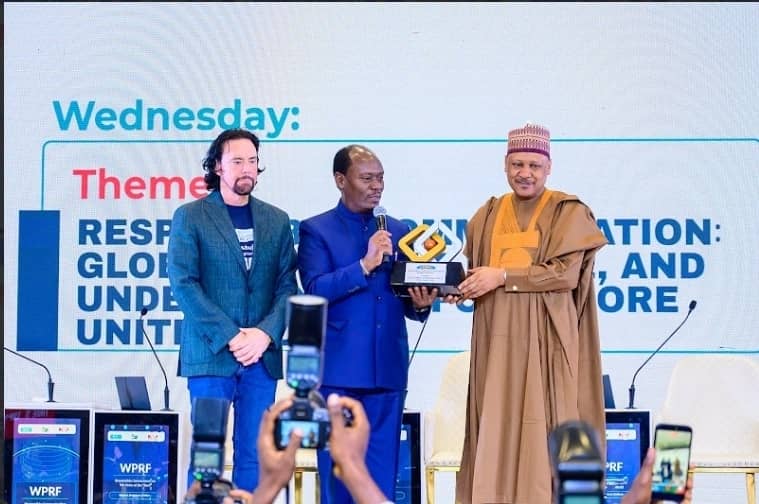
Kenya has proposed the establishment of an African Information Integrity Network to coordinate cross-border efforts against misinformation and disinformation, strengthen public trust and protect the integrity of public communication across the continent.
Kenya’s President William Ruto, represented by the Minister of Information, Communications and the Digital Economy, William Kabogo, made the proposal at the 13th World Public Relations Forum in Abuja, calling for stronger continental collaboration to safeguard Africa’s information environment.
He said the proposed network would bring together communication professionals, media organisations, technology companies, academia and young people, with government support, to share verification methods and coordinate responses to harmful information across national borders.

Kabogo stressed that the initiative should operate with professional independence, publish its standards openly and be advanced in collaboration with the African Union Commission.
He warned that artificial intelligence and digital platforms were transforming how information was created, distributed and consumed, while deepfake videos, voice impersonation and fabricated websites were creating new threats to institutional credibility.
Citing reports by the Media Council of Kenya, he said social media had become the leading source of news for 39 per cent of Kenyans, ahead of television and radio, while false and misleading information remained a major public concern.
“When a false statement can carry the appearance of a voice of a public institution, the credibility of official communications becomes a matter of public safety,” he said.
The minister urged institutions to make their official communication channels easily verifiable, promptly correct false information and acknowledge their own errors openly. He also emphasised the need to inform the public when content had been generated using artificial intelligence.
Highlighting Kenya’s institutional response, Kabogo said the country adopted a National Communication Policy in August 2026 to guide communication across ministries, departments and agencies.
He explained that the policy requires government institutions to provide timely, accurate, consistent and accessible information, anticipate public concerns, prepare for crises and establish channels for citizen feedback.
He added that Kenya was establishing a National Communication Centre to provide verified government information, respond to enquiries and improve public access to official information.

Illustrating the importance of responsible communication in development, Kabogo cited the groundbreaking of the 16-billion-dollar Dangote East Africa Petroleum Refinery in Lamu County on September 30, 2026.
He said the project, led by Nigerian industrialist Aliko Dangote, was expected to strengthen regional energy security, create employment and stimulate industrial growth along the LAPSSET Corridor.
He emphasised that investments of such magnitude must be explained transparently, particularly to the communities hosting them.
“The people of Lamu must be heard. Their concerns must be received. They must receive clear answers,” he said, insisting that community perspectives should inform decisions on major development projects.
Kabogo also proposed an African Responsible Communication Fellowship to develop emerging professionals, encourage cross-border learning and promote ethical leadership.
He called for communication professionals to be involved from the earliest stages of policy formulation and major investment planning, with their work properly planned and resourced.
On Africa’s global image, the minister urged the continent to take ownership of its development narrative, arguing that its achievements must be communicated confidently while its shortcomings are addressed honestly.
“Africa must become the author, producer and distributor of its own development narrative,” he said.
He welcomed the proposed African Declaration on the Professionalism of Public Relations and Responsible Communication, urging professional bodies to translate its commitments into investments in training, accreditation, research and ethical standards.
Kabogo said responsible communication was indispensable to accountable governance, regional integration and the achievement of Africa’s Agenda 2063, stressing that development should be measured not only by projects and investments but also by public confidence, opportunities created and citizen inclusion.
He congratulated President Bola Ahmed Tinubu, the government and the people of Nigeria, and the Nigerian Institute of Public Relations on hosting what he described as a historic forum.
He also commended the Global Alliance for Public Relations and Communication Management for its contribution to advancing the profession globally.
To communication professionals, he issued a call to uphold the values at the heart of responsible communication.
“I urge you to remain champions of truth, custodians of public trust and partners in Africa’s development,” he said.

