


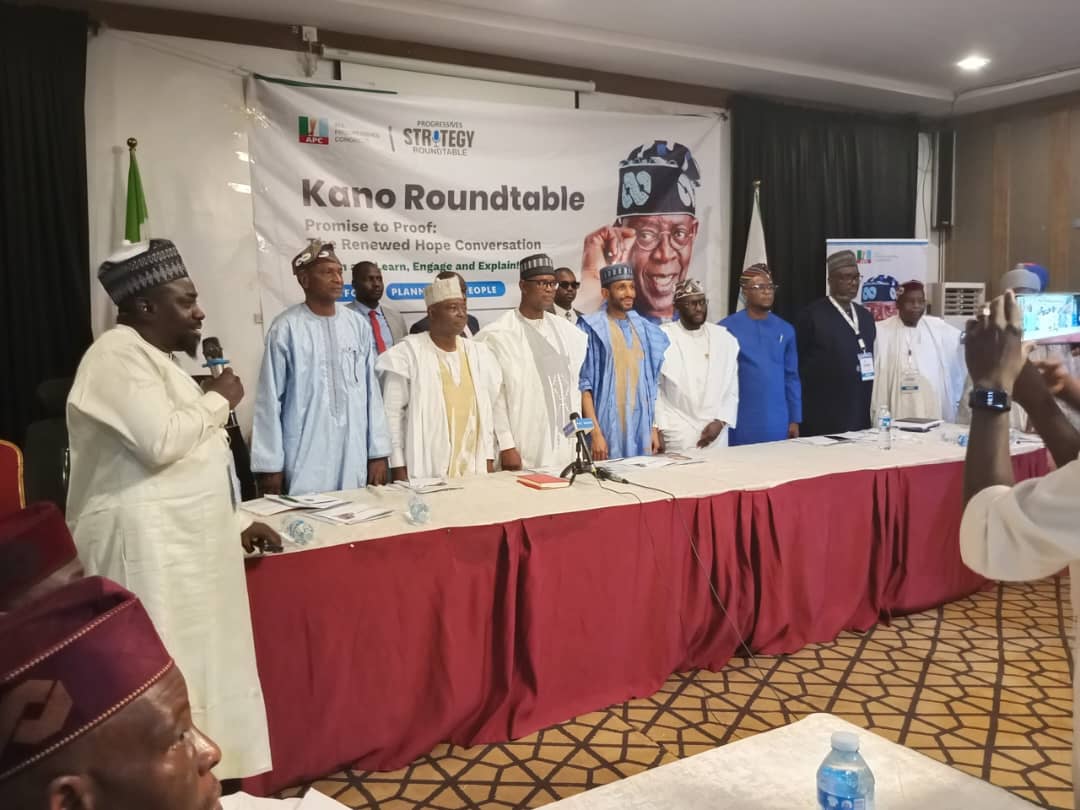
Stakeholders from the Federal and Kano State Governments, development agencies and relevant institutions have outlined ongoing projects and policy interventions of President Bola Ahmed Tinubu’s administration in infrastructure, agriculture, economic reforms and national security.
They made the presentations at a policy roundtable organised in Kano under the Renewed Hope Conversations initiative, with the theme, “Promise to Proof”.

The engagement provided a platform for government officials and sector experts to explain the implementation of Federal Government policies, present ongoing interventions and respond to concerns about their impact on Nigerians.
Infrastructure Development and National Connectivity
Speaking on infrastructure, the Minister of State for Works, Bello Muhammad Goronyo, said the Tinubu administration had prioritised road development to improve national connectivity, facilitate trade and stimulate economic growth.
Goronyo disclosed that only seven kilometres remained for the completion of the Abuja-Kaduna-Kano concrete-reinforced expressway, expressing confidence that the project would be completed and commissioned by December.
READ ALSO: 2027: Kano Yoruba Community Endorses President Tinubu
He also identified the Kano Northern Bypass as a strategic project expected to improve transportation and ease the movement of people and goods across the North-West and other parts of the country.
The minister further highlighted the 1,068-kilometre Sokoto-Badagry Super Highway, which traverses Sokoto, Kebbi, Niger, Kwara, Oyo, Ogun and Lagos states, as well as the Lagos-Calabar Coastal Highway, among major national infrastructure projects.
According to him, the projects, alongside other railway and highway initiatives, are designed to strengthen economic integration and connect different regions of the country.
“These are the four legacy projects of Mr President, and they are working day and night. On the Sokoto-Badagry highway, work is progressing in almost four sections, with tremendous progress being recorded,” Goronyo said.
Declaring the roundtable open, Kano State Governor, Abba Kabir Yusuf, represented by his Deputy, Murtala Sule Garo, said government policies should be assessed by their tangible impact on citizens rather than announcements and political promises.
He said Nigerians expected practical improvements in their daily lives, including affordable food, employment opportunities, reliable infrastructure, security, quality education, accessible healthcare and a conducive business environment.
The Governor described President Tinubu’s Renewed Hope Agenda as a national development framework aimed at repositioning the economy, strengthening institutions, improving infrastructure and expanding opportunities.
He said the roundtable was important in ensuring that government commitments translated into measurable results.
Yusuf also reaffirmed his administration’s commitment to the Kano First Agenda, which focuses on citizens’ welfare, economic recovery, security, infrastructure, education, healthcare and job creation.
He emphasised the need for stronger collaboration among the Federal Government, state governments, the private sector, development partners and citizens to achieve sustainable development.
Agriculture and Food Security
On agriculture, the Governor identified the sector as a major driver of economic transformation, particularly in Northern Nigeria, noting that Kano had significant potential through its farming communities, irrigation facilities, commercial networks and strategic markets.
He called for a transition from subsistence farming to mechanised and commercially viable agriculture, supported by improved access to farm inputs, financing, irrigation, storage facilities, processing industries and reliable markets.
According to him, farmers should be supported to move beyond food production and benefit from the entire agricultural value chain.
The Executive Secretary of the National Agricultural Land Development Authority (NALDA), Engineer Cornelius Adebayo, and the Director-General of the National Agricultural Seeds Council, Fatuhu Muhammadu Buhari, also outlined strategies for improving agricultural productivity through quality seeds, irrigation and processing.
Buhari explained that the National Agricultural Seeds Council was responsible for regulating the seed industry, ensuring quality standards and guiding farmers on appropriate seed varieties to improve yields.
He disclosed that the council oversees approximately 634 seed companies operating across Nigeria.
“My work as a regulator is simple: to regulate the seed industry and advise farmers on the right varieties and quality seeds to use. We are like the police of the seed industry,” he said.
He added that the council was implementing a community seed production programme to train farmers to produce quality seeds locally.
According to him, the initiative would strengthen farmers’ capacity, improve access to planting materials and support agricultural production at the grassroots.
Both NALDA and the National Agricultural Seeds Council pledged continued support for farmers through interventions aimed at improving productivity and strengthening food security.
Also speaking, the Managing Director of the Hadejia-Jama’are River Basin Development Authority, Rabiu Suleiman Bichi, disclosed that the Federal Government had committed about 78 billion naira to irrigation development.
He said the authority was maintaining major dams to improve water availability and expand irrigation activities, enabling thousands of farmers to increase agricultural production.
Bichi explained that sustainable irrigation development was essential to reducing dependence on rainfall, improving food supply and strengthening Nigeria’s food security.
The Kano State Commissioner for Agriculture, Dr Danjuma Mahmoud, commended collaboration between the Federal Ministry of Agriculture and state governments, describing it as important to expanding agricultural production.
He highlighted the Kano State Government’s interventions, particularly the distribution of fertilisers and provision of farming equipment to support farmers and improve agricultural output.
Economic Reforms and Citizens’ Engagement
The convener of the roundtable and Executive Chairman of the Presidential Initiative on Compressed Natural Gas, Barrister Ismail Ahmed, urged Nigerians to assess the Federal Government’s economic reforms through verifiable outcomes rather than political sentiments.
Ahmed explained that the engagement was designed to promote direct communication between government officials and citizens, allowing Nigerians to understand policy decisions, ask questions and express concerns about their implementation.
He disclosed that President Tinubu had approved the organisation of the roundtables across the six geopolitical zones following an earlier engagement in February.
According to him, the Abuja and Kano editions had been held, while Lagos and Imo states were expected to host subsequent engagements.
Ahmed said discussions at the Kano meeting focused particularly on agriculture and infrastructure, with participants seeking clarification on government programmes and ongoing interventions.
He acknowledged that economic reforms could create temporary difficulties but maintained that the administration considered them necessary to address structural challenges and reposition the economy for long-term growth.
“Some of the promises made by the government have been fulfilled, while others are at different stages of implementation. What is important is that Nigerians should look at the evidence and assess the progress being made,” he said.
The CNG initiative chairman added that the conversations would continue beyond the 2027 general elections to sustain dialogue between government and citizens.
Other stakeholders made presentations on national security, highlighting proposed measures and institutional commitments aimed at strengthening the country’s security architecture as a foundation for economic growth and sustainable development.
The roundtable emphasised the importance of continuous engagement, transparency and measurable performance in assessing government policies, particularly in addressing the economic and social challenges confronting Nigerians.

