


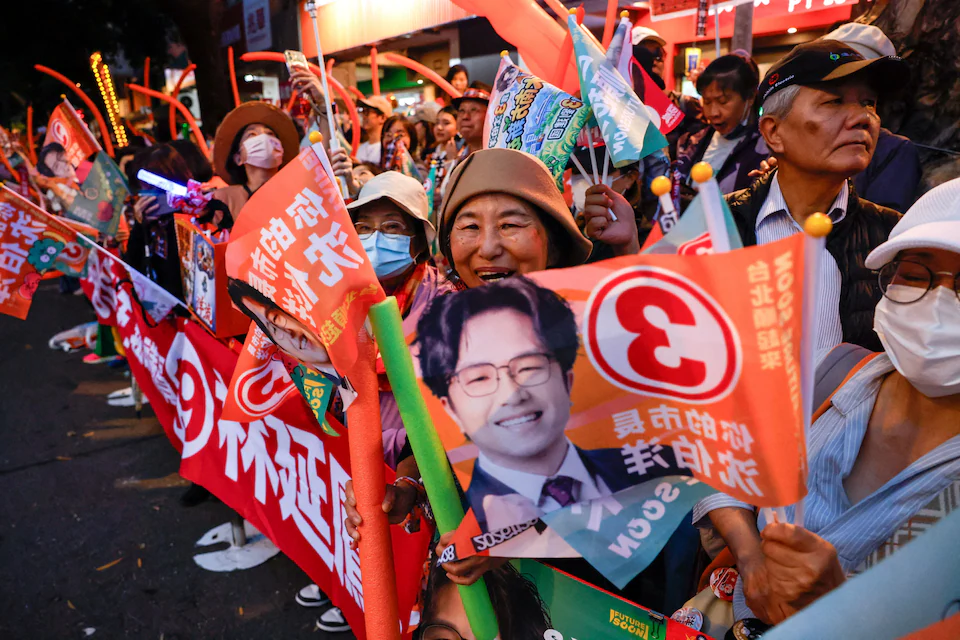
Taiwan’s upcoming mayoral and county elections have sparked fresh tensions with China following the ruling Democratic Progressive Party’s nomination of Taipei mayoral candidate Puma Shen, whom Beijing accuses of supporting Taiwan independence.
China, which claims Taiwan as part of its territory but has no control over the self-governing island, has repeatedly criticised Shen, describing him as a “traitor” and a “diehard Taiwan independence separatist”.
Beijing also accused him of exploiting fears of Chinese interference to win votes, while imposing sanctions on his family’s business in China.
In October, Taiwanese prosecutors indicted four people over an alleged surveillance operation involving monitoring devices placed on a scooter outside Shen’s residence.
Taiwan has accused Beijing of intensifying military activities, cyberattacks and information campaigns ahead of the elections. However, China has consistently denied interfering in Taiwan’s electoral process.
“For years, the Chinese Communist Party has tied its Taiwan policy to the outcome of Taiwan’s elections, making pre-election interference inevitable,” Taiwan’s top China policy maker, Chiu Chui-cheng, said.
Chiu warned that such actions “will only backfire and deepen resentment among the people of Taiwan toward the Chinese Communist regime.”
Despite Beijing’s criticism, Shen has largely focused his campaign on domestic issues, particularly urban renewal and policy reforms.
His main challenger, incumbent Taipei Mayor Chiang Wan-an of the opposition Kuomintang (KMT), has similarly avoided making relations with China a central campaign issue, concentrating instead on water safety and economic development.
Shen has nevertheless gained significant support through his pro-Taiwan stance and detailed policy proposals. Two senior DPP officials said that his campaign had become a symbol of resistance to Chinese pressure.
China had previously sanctioned Shen and the Kuma Academy, a civil defence organisation he co-founded to prepare Taiwanese residents for possible attacks.
Shen said that “Beijing was uncomfortable with his efforts to raise international awareness about disinformation and Chinese influence operations.”
Meanwhile, Chiang’s campaign team maintained that “no outside force should exert political pressure on Taiwan’s democratic elections. “
Reporting of opinion polls is prohibited by law during the 10 days preceding the elections.
Reuters

