


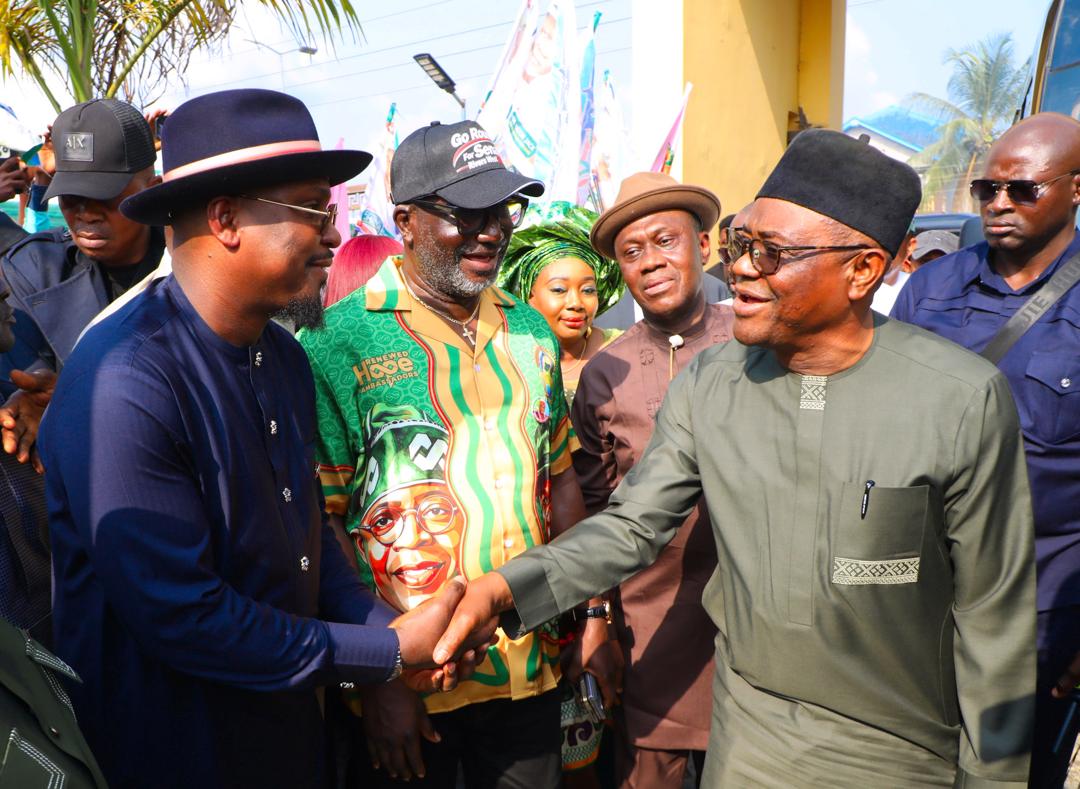
The Minister of the Federal Capital Territory (FCT), Mr Nyesom Wike, has challenged former Rivers State Governor, Mr Rotimi Amaechi, to account for his eight-year administration, particularly its achievements in Ahoada East, insisting that political leaders should be judged by their records rather than campaign promises.
Wike also urged residents of the Ahoada East Local Government Area of Rivers State to support President Bola Tinubu’s re-election bid in 2027, arguing that the president’s economic reforms had increased financial allocations to state and local governments, creating opportunities for development.
The minister made the call on Sunday at a Rainbow Coalition town hall meeting in Ahoada East, where he highlighted projects executed by his administration in the area and questioned what Amaechi had achieved for the people during his tenure as governor.
He challenged the former governor to identify specific projects executed in Ahoada East, insisting that residents should demand evidence of performance rather than be swayed by political rhetoric.
“Let me tell you, when Amaechi was governor, let’s start with him. Tell me one thing Ekpeye people can go home with: what Amaechi did for the people of Ekpeye. If you don’t say it here, don’t say it again,” Wike said.
The former Rivers governor, who served from 2007 to 2015, had overseen projects including the dualisation of the Ahoada-Omoku Road, the establishment of a Rivers State University campus in Ahoada, construction of teachers’ quarters, rehabilitation of schools and completion of some previously abandoned road projects.
Wike also recalled that his administration completed the road linking Emohua, which he said had been abandoned by a previous government, and upgraded the status of traditional institutions in the area.
He further said his government awarded the Ahoada-Omoku Road and Emohua-Kalabari Road projects to Julius Berger, explaining that the contracts were financed through the state’s internally generated revenue.
“I did not bring a political contractor. I brought Julius Berger. I completed the first phase and awarded the second phase to get to Omoku. I gave it to Julius Berger.
“I signed an agreement with Julius Berger to collect N5 billion every month from our IGR. The contract had a 14-month completion period, and, within those 14 months, the contractor got N70 billion,” Wike said.
The minister also defended President Tinubu’s economic reforms, particularly the removal of the fuel subsidy, saying the policy had increased revenue available to state and local governments.
He explained that the financial constraints previously experienced by local governments had made it difficult for council chairmen to execute development projects and meet their obligations.
Wike recalled that during his tenure as governor, some local governments received as little as N10 million monthly after deductions, while others received no allocations.
He argued that the situation had improved under the Tinubu administration, providing elected representatives and local government authorities with greater resources to undertake constituency and community development projects.

Describing Nigeria’s economic situation before Tinubu assumed office, Wike said the country was on the verge of collapse and required courageous decisions to restore stability.
“Nigeria was in an intensive care unit before. Nigeria was in a coma. Nigeria was about to die. But this man came and said, ‘God, you gave me this opportunity. Give me the courage; give me the wisdom. Let me take decisions that will bring Nigeria out of this coma, that will bring Nigeria out of this intensive care unit,'” he said.
He maintained that the removal of the fuel subsidy, although initially difficult, was necessary to lay the foundation for long-term economic prosperity.
Wike also cited the avoidance of prolonged industrial action in public universities, improved capacity to meet pension obligations and increased funding

