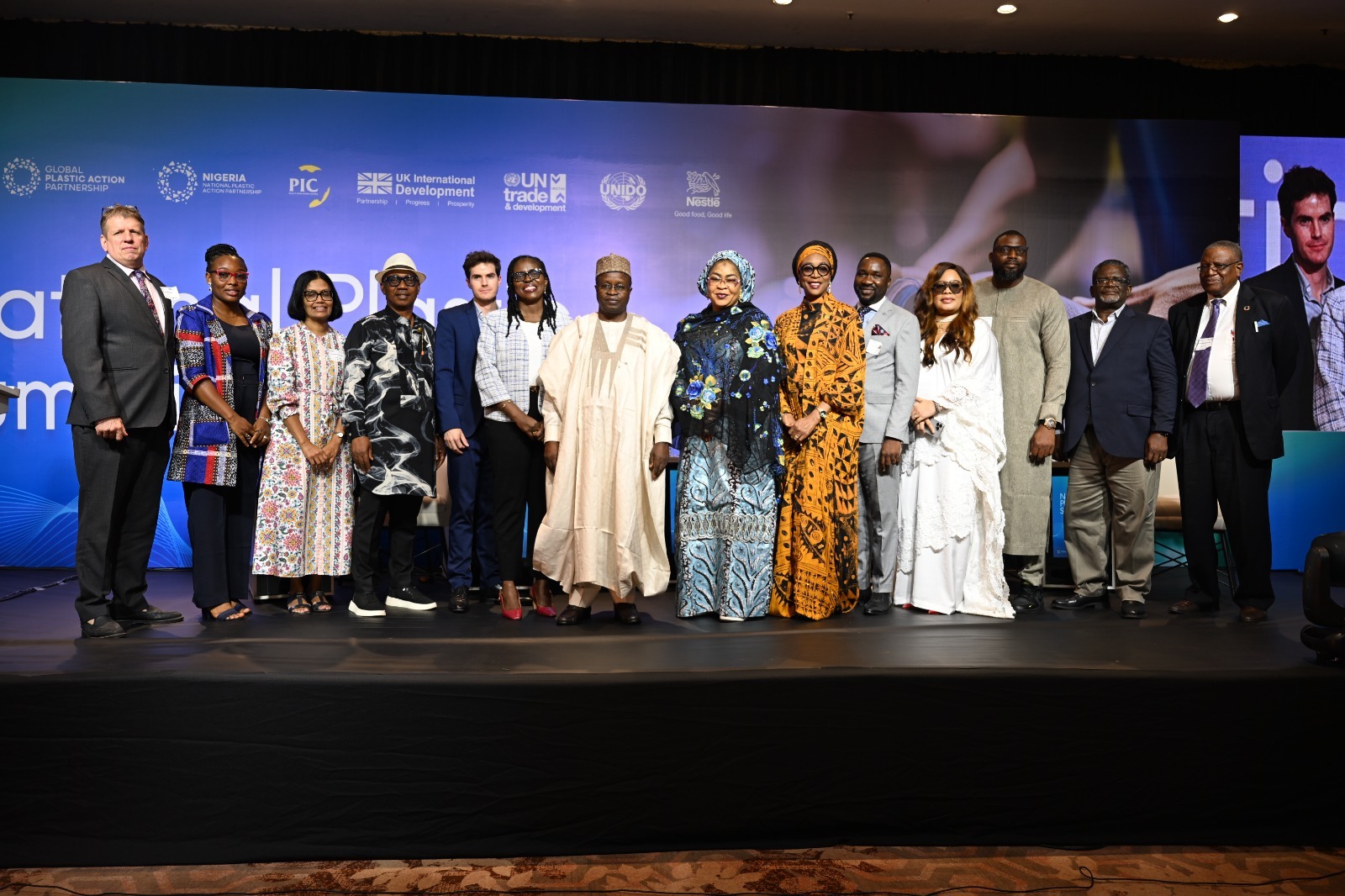
Government leaders, development partners, industry stakeholders, financiers, civil society organisations and innovators have called for accelerated investment, stronger regulation, inclusive participation and practical implementation of circular economy solutions to tackle plastic pollution and unlock economic opportunities across Nigeria and Africa.
The call formed the central thrust of deliberations at the National Plastic Summit 2026, themed “Innovation, Inclusion and Investment for a Circular Plastics Economy in Africa”, held in Abuja.
Convened by the Nigeria National Plastic Action Partnership (NPAP Nigeria) and hosted by the Policy Innovation Centre and the Federal Ministry of Environment, with support from the Global Plastic Action Partnership (GPAP) hosted by the World Economic Forum, the summit positioned Nigeria as a regional hub for plastics circularity, sustainable industrialisation and green growth.
Speaking, the Director-General and Chief Executive Officer of the National Environmental Standards and Regulations Enforcement Agency (NESREA), Dr Innocent Barikor, described plastic pollution as one of the most pressing environmental challenges confronting society.
“Plastic pollution remains one of the most pressing environmental challenges of our time. Its impacts on ecosystems, biodiversity, public health, livelihoods, and economic productivity demand urgent, coordinated and sustained action,” he said.
Barikor reaffirmed NESREA’s commitment to enforcing environmental standards and advancing Mandatory Extended Producer Responsibility (EPR).
“In this regard, the Agency is actively driving the implementation of Mandatory Extended Producer Responsibility (EPR) as a key instrument for reducing plastic waste, increasing collection and recycling rates, and ensuring that producers take greater responsibility for the environmental impacts of their products and packaging.”
He further stressed that partnerships, investment in recycling infrastructure, innovation and regional standards harmonisation remain critical to achieving circularity objectives.
Representing the United Kingdom High Commission in Nigeria, Head of Private Sector and Green Growth Paul Healey said plastic circularity presents a major economic opportunity capable of generating jobs, incomes and new industrial value chains.
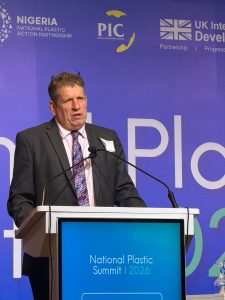
He noted that the United Kingdom is increasingly aligning development cooperation with trade, investment and mutual growth objectives.
“Plastics and plastic circularity are clearly economic opportunities. The UK is shifting its approach to have a much more inclusive focus on mutual development, growth and investment, incorporating our development systems and cooperation into a broader effort to develop the economy, the economy of Nigeria, the economy of the UK and seek those opportunities that have mutual investment and growth potential.”
Highlighting recent progress, Healey pointed to a private United Kingdom investment in battery recycling in Nigeria as evidence of growing confidence in the country’s circular economy potential.
“I think Nigeria is very well placed to become a hub and become a centre of this economy. You have the capability, increasing finance, both domestic and international finance, and clearly there is a scale of demand and appetite.”
Development Partners Emphasise Inclusive Growth
Representing the United Nations Development Programme (UNDP) Resident Representative, Elsie Attafuah, Chamla Hemmathgama underscored the development dimensions of plastic pollution.
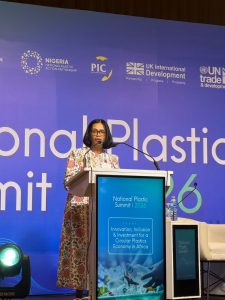
Hemmathgama stressed that plastic pollution intersects with livelihoods, public health, climate resilience and economic growth.
“Nigeria’s plastic challenge sits at the intersection of jobs, enterprise, urban development, public health and climate resilience.”
She stated that inclusive circular economy solutions must empower informal waste workers and vulnerable communities.
“Any transition that does not include them will not succeed. But more than that, it must empower them.”
Nigeria’s Leadership in Africa’s Circular Economy
Also, the Director of the Global Plastic Action Partnership and Head of Circularity at the World Economic Forum, Clemence Schmid, commended Nigeria’s leadership in implementing its National Plastic Action Roadmap, describing the country as strategically positioned to shape Africa’s circular economy transition.
“As Africa’s largest economy and one of its fastest-growing consumer markets, Nigeria is also well positioned to demonstrate how circularity can drive industrial competitiveness, attract investment, strengthen value chains and create economic opportunities.”
She emphasised that implementation now represents the next phase of Nigeria’s circular plastics journey.
“The next chapter of Nigeria’s plastic circularity journey is implementation, translating the roadmap into policy, investment, infrastructure, business action, and finally measurable outcomes.”
Women and Inclusion at the Centre
Meanwhile, the Director-General of the Maryam Babangida National Centre for Women Development, Ms Adedayo Benjamins-Laniyi, advocated stronger inclusion of women and girls within the circular economy ecosystem.
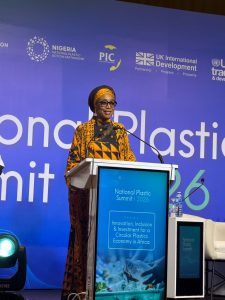
“This is not just a summit for environmental change but one that truly brings about scaling the opportunity and energy of women in national development when it comes to the circular economy.”
She argued that women already constitute the backbone of environmental stewardship and waste recovery activities across communities.
“Our responsibility is to move these women from vulnerability to disability, from informality to enterprise, and from survival to sustainable prosperity. And it must be an agenda of inclusion.”
Benjamins-Laniyi further called for gender-responsive and disability-inclusive approaches to environmental governance, stating, “Nothing about us without us. This is the national economy.”
Partnerships Driving Policy Implementation
In a presentation, the Director of Pollution Control and Environmental Health at the Federal Ministry of Environment, Dr Bahijjahtu Abubakar, credited the progress achieved so far to multi-stakeholder collaboration.
Abubakar noted that policy instruments such as the National Policy on Plastic Waste Management, Extended Producer Responsibility framework and Nigeria Circular Economy Roadmap have established a strong foundation for action.
“The reality is that plastic pollution is not a challenge that any single institution can solve on its own. Collaboration delivers greater and more sustainable impact than isolated interventions.”
She, however, acknowledged persisting challenges, including inadequate waste collection systems, financing gaps, weak source segregation and enforcement constraints.
“Partnerships are not optional arrangements but essential mechanisms for delivering measurable results.”
Financing Circularity at Scale
Giving insight into the Nigeria Plastics Financing Taskforce, Nigeria NPAP Manager at the Policy Innovation Centre, Esther Fagbo, framed plastic pollution as an economic challenge requiring investment-led solutions.
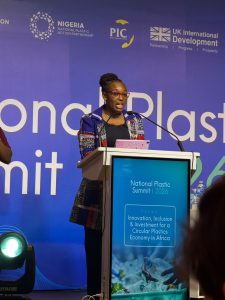
She revealed that Nigeria generates approximately 2.5 million tonnes of plastic waste annually, with less than ten percent formally recycled.
“This is not primarily an environmental story. This is an economic story. Every tonne of plastic that leaks out of our system is a tonne of lost raw material. A lost job. A lost business opportunity. A lost export. A lost investment return.”
Fagbo said the newly launched taskforce will support development of the Nigeria Plastic Action Financing Roadmap in partnership with PwC, expected to be unveiled during the National Economic Summit in October 2026.
“How do we build a financing ecosystem that makes plastic circularity investable at scale in Nigeria? This taskforce is not a talking shop. How do we build a financing ecosystem that makes plastic circularity investable at scale in Nigeria?”
Stakeholders Push Practical Solutions
Across sessions, speakers converged on a common message: plastic waste must be repositioned from an environmental liability into an economic asset capable of driving enterprise development, industrial competitiveness, investment attraction and job creation.
Participants advocated for stronger policy implementation; expanded recycling infrastructure; innovative technologies, including chemical recycling; improved financing mechanisms; formalisation of informal waste workers; regional policy harmonisation; and sustained public awareness campaigns.
They maintained that Nigeria’s growing policy momentum, vibrant private sector and expanding innovation ecosystem provide a strong foundation for leading Africa’s circular plastics transition.
As the summit concluded, stakeholders agreed that the success of Nigeria’s circular economy agenda will depend on coordinated action, inclusive participation and sustained investment capable of translating ambition into measurable environmental and economic outcomes.