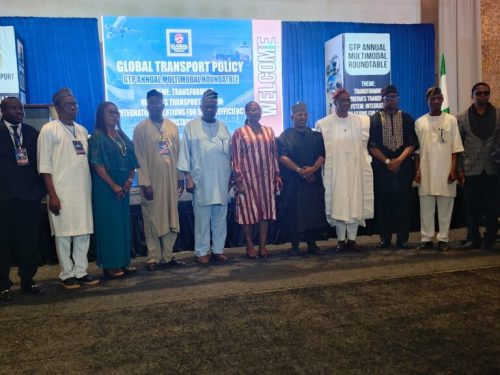
Transport experts have called for the urgent development of a functional multimodal transport system to reduce logistics costs, improve efficiency and support Nigeria’s economic growth.
Speaking at the 2026 GTP Multimodal Roundtable in Lagos, Chairman and Chief Consultant of Global Transport Policy (GTP), Dr. Oluwasegun Musa, said Nigeria’s heavy dependence on road transport continues to weaken the country’s logistics and supply chain performance.
According to him, moving cargo from Lagos to Kano can take up to two weeks, with goods often changing hands several times before reaching their destination. He said this leads to delays and higher costs.
Musa noted that logistics costs account for more than 42 per cent of Nigeria’s Gross Domestic Product (GDP), far above the global benchmark of less than 15 per cent.
He attributed the challenge to the dominance of road transport, which handles over 90 per cent of freight and passenger movement, while rail contributes less than one per cent.
“These are not just statistics; they represent significant economic losses and human tragedies,” he said.
According to Musa, road crashes claim over 12,000 lives annually, while about 70,000 people suffer serious injuries each year.
He said an integrated multimodal transport system could cut travel time by up to 40 per cent, reduce logistics costs by 25 to 30 per cent and boost Nigeria’s GDP by about 1.5 per cent.
Musa also called for stronger collaboration between government and the private sector, stressing the need for Public-Private Partnerships (PPPs), Build-Operate-Transfer arrangements and foreign investments to bridge infrastructure gaps.
Lagos State Governor Babajide Sanwo-Olu said Nigeria’s ambitions of becoming a major African Continental Free Trade Area (AfCFTA) hub, achieving food security and driving industrial growth depend on efficient transport infrastructure.
Represented by the Managing Director of the Lagos Metropolitan Area Transport Authority (LAMATA), Abimbola Akinajo, the governor said fragmented logistics systems have pushed distribution costs to between 20 and 30 per cent of the value of goods, compared to the global average of 8 to 11 per cent.
He also urged Nigeria to embrace technologies such as artificial intelligence, smart mobility systems, digital ticketing, real-time traffic management and connected infrastructure.
President of the Chartered Institute of Logistics and Transport (CILT), Dr. Boboye Oyeyemi, called on the Federal Government to implement the National Land Transport Policy, remove overlapping regulations and accelerate rail modernisation.
He said these reforms would create a transparent and predictable framework capable of attracting large-scale private investment into the transport sector.
Participants at the roundtable are expected to produce recommendations aimed at building a more efficient, integrated and sustainable transport system for Nigeria.