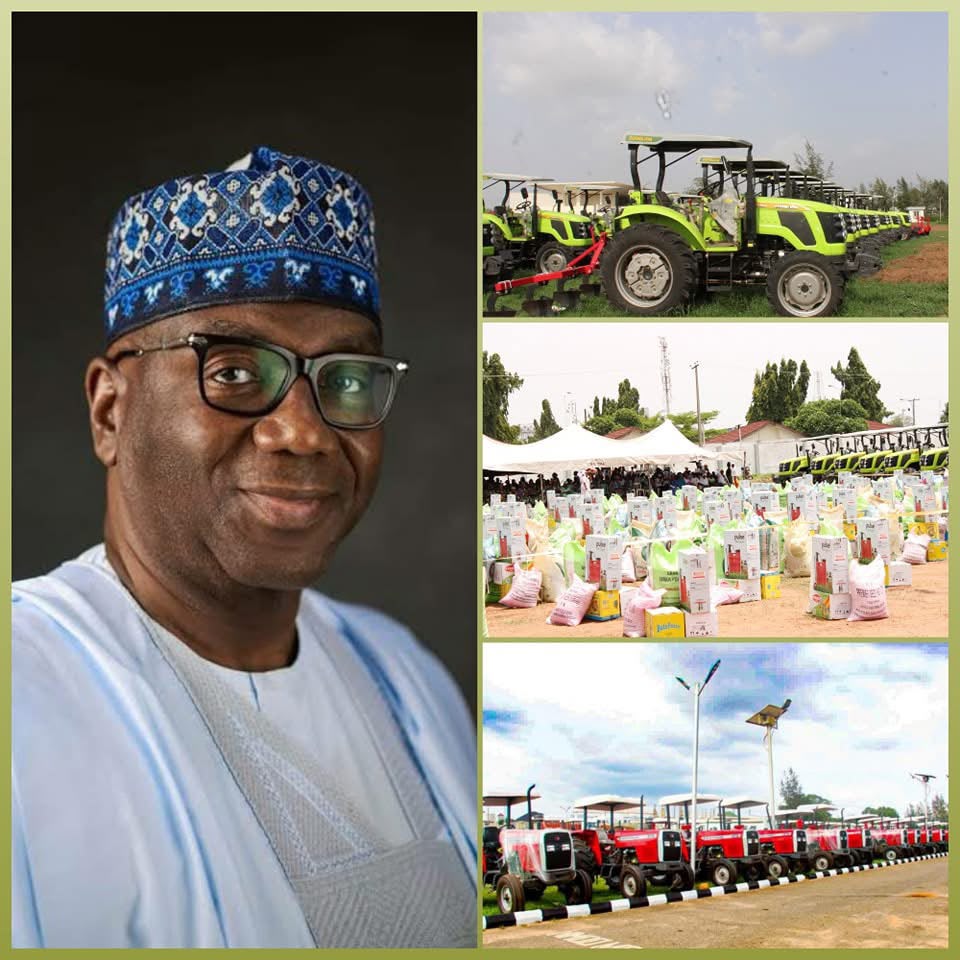
For farming communities across Kwara State, access to markets, farm inputs, machinery, finance, and reliable infrastructure can make the difference between a productive farming season and a difficult one.
The state government is seeking to address some of these challenges through a long-term agricultural development strategy that combines rural infrastructure with mechanisation, livestock production, irrigation, agro-processing and support for farmers.
At the centre of the strategy is the 10-year Agricultural Transformation Plan launched in 2021.
The plan is built around six areas: crop production, agricultural finance, livestock development, market access, value chains and cross-cutting programmes, with the stated objectives of improving food security, attracting investment, creating jobs and reducing poverty.
Opening up rural communities
One of the most visible components of the agricultural strategy is rural infrastructure. Poor roads have long been identified as a major challenge for farmers, particularly during the rainy season, when transporting produce from farms to markets can become difficult and costly.
Through the Rural Access and Agricultural Marketing Project (RAAMP), Kwara is implementing the construction, rehabilitation and upgrading of rural roads across the state.
In October 2024, the state flagged off 209.77 kilometres of rural road projects connecting farming communities across the 16 local government areas. The project is jointly supported by the World Bank and the French Development Agency, with counterpart funding from the state government.
The roads are intended to improve access to markets and facilitate the movement of agricultural inputs and produce.
RAAMP’s objectives include improving rural transportation, reducing post-harvest losses and supporting smallholder farmers and micro-agro-processors.

The project also includes agro-logistics infrastructure. Three agro-logistics centres are being developed around Ajase-Ipo, Alapa and Kaiama to improve market access in the state’s three senatorial districts.
Beyond the farm gate
For the government, however, improving agriculture requires more than producing crops. The administration has also placed emphasis on mechanisation and the provision of agricultural inputs, including improved seeds, fertilisers, irrigation equipment and other farm materials.
The objective is to help farmers increase productivity while reducing reliance on manual labour. Agricultural extension services are another component of the strategy, with officers expected to provide farmers with technical advice and information on improved and climate-resilient farming practices.
The state has also sought to improve the identification of farmers and the targeting of agricultural interventions through the development of a farmer database.
Such measures are particularly important in a sector where access to government support can determine whether smallholder farmers are able to expand production.
Livestock and new opportunities
Crop production is only one part of Kwara’s agricultural economy. Livestock development has increasingly become part of the state’s food-security strategy, with attention being given to cattle, sheep and goat production, veterinary services, pasture development and dairy production.
The Livestock Productivity and Resilience Support Project is among the programmes being implemented in the state. Kwara’s 2024 financial statements also contain budgetary provisions for the Livestock Productivity and Resilience Support project and the National Livestock Transformation Plan.
The development of livestock infrastructure could provide additional income opportunities for farmers and pastoral communities while strengthening the supply of animal protein.
Tackling climate pressures
Climate variability presents another challenge to farmers. Irregular rainfall, rising temperatures, land degradation and water shortages can affect crop yields and make agricultural planning more difficult.
Consequently, irrigation, land restoration and climate-resilient farming have become increasingly important components of agricultural development programmes in the state.
The rehabilitation of irrigation facilities and support for sustainable agricultural practices are intended to give farmers opportunities to produce beyond the limitations imposed by seasonal rainfall.
Adding value to agricultural production
Another concern is what happens after crops leave the farm. Without adequate storage, processing and transportation facilities, farmers can lose part of their harvest or be forced to sell immediately, sometimes at unfavourable prices.
Kwara’s agricultural strategy therefore includes efforts to strengthen value chains and attract investment in processing.
Rice, cassava, soybean and shea are among the commodities with opportunities for processing and value addition, while fisheries and aquaculture are also receiving attention.
The approach reflects a wider shift from viewing agriculture solely as crop production towards an agricultural economy that includes processing, storage, transportation, marketing and other businesses.
Farmers remain central
The success of the strategy will ultimately depend on what happens at the farm level. Government programmes can provide roads, machinery, inputs and policy frameworks, but farmers still have to contend with rising production costs, access to credit, climate-related risks and market uncertainties.
The state government’s own agricultural plan recognises the need for collaboration among government agencies, farmers, financial institutions, development partners and private investors.
The involvement of development institutions is also significant. RAAMP, for example, is supported by the World Bank and the French Development Agency and is designed to improve rural access and agricultural marketing.
Measuring the impact
The longer-term question is whether these interventions will translate into sustained increases in agricultural productivity and improved livelihoods.
For farmers, the real measure will be whether roads remain accessible, machinery is available when needed, inputs reach genuine beneficiaries, produce can be sold at viable prices and processing facilities create additional markets.
For consumers, the expected outcome is greater availability and affordability of food. For rural communities, successful implementation could mean more jobs, stronger local businesses and reduced pressure on young people to leave in search of opportunities elsewhere.
Kwara’s Agricultural Transformation Plan was designed as a 10-year framework. Its progress, therefore, will ultimately be judged not only by the number of roads constructed, machines supplied or programmes launched, but by the extent to which those interventions improve agricultural productivity and livelihoods.
As the state continues to implement its agricultural programmes, the challenge will be to sustain investment, strengthen accountability and ensure that farmers remain at the centre of the transformation.
The experience of Kwara illustrates the complexity of building food security: it requires more than increasing production. It also requires roads to move produce, markets to sell it, infrastructure to process it, finance to expand production and policies capable of responding to the changing realities of agriculture.