

President Bola Tinubu has called on traditional rulers, religious leaders, communities, youths, women, development partners and the private sector in the North Central to strengthen collaboration with government and security agencies to tackle insecurity and build lasting peace.
Tinubu made the call on Monday at the 2026 North Central Regional Security Summit in Makurdi, Benue State, where the Secretary to the Government of the Federation, Senator George Akume, represented him.
The summit, themed “Collaborative Approaches to Strengthening Security and Regional Stability,” brought together governors, ministers, security chiefs, traditional and religious leaders, community representatives, civil society organisations, women, youths and private-sector stakeholders.
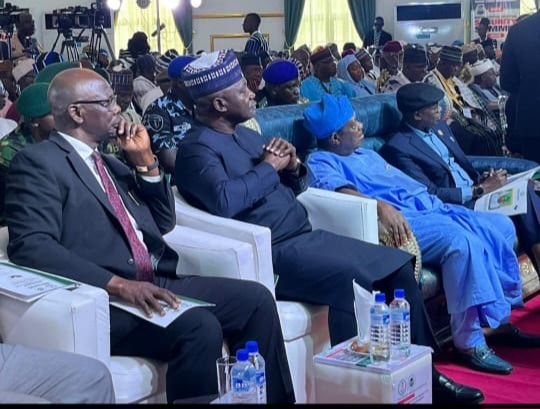
The President stressed that no single security agency, tier of government or community could secure the region alone, noting that insecurity had continued to transcend state boundaries.
He urged stakeholders to overcome rivalry, duplication of efforts and the withholding of vital intelligence, which he said often slowed responses to criminal activities.
“No single agency, no single tier of government and no single community can secure this region acting alone. Insecurity does not respect state boundaries or agency mandates,” Tinubu said.
He charged traditional and religious leaders to serve as the first line of early warning and trusted voices of reconciliation in their communities, while urging citizens to provide timely information to security agencies and refuse to shield criminals because of kinship, ethnicity or other sentiments.
“Security begins with you,” he said.
Tinubu said his administration had strengthened the nation’s security architecture through improved collaboration among the Armed Forces, Nigeria Police Force and intelligence services, while acquiring new platforms and advanced capabilities for the military.
He added that the Nigerian Government was rebuilding Nigeria’s indigenous defence industry through the Defence Industries Corporation of Nigeria Act and improving the welfare of security personnel.
The President commended security agencies for gains against terrorists and criminal elements, including the neutralisation of terrorist commanders, surrender of fighters, rescue of captives and restoration of normalcy to affected communities; however, he cautioned that military action alone could not guarantee lasting peace.
According to him, competition over land and water, climate change, desertification, unresolved land-use issues, weak local dispute-resolution mechanisms and illicit weapons were among factors fuelling conflicts.
“Military action alone will not deliver lasting peace to the North Central. Force can suppress violence; it cannot resolve the grievances that produce it,” he said.
Tinubu said the Federal Government would combine kinetic operations with interventions in livestock development, irrigation, mechanised agriculture, rural roads and access to credit.
He also highlighted the Reclaiming the Ungoverned Space for Economic Benefits Programme of the Ministry of Defence, which seeks to deploy retired military personnel in securing and reviving communities recovering from violence.
The President called on women and youths to play central roles in peace-building and urged the private sector and development partners to increase investment in the region.
“Peace and investment reinforce one another. Every factory built, every farm expanded and every young person employed in this region is a contribution to its security,” he said.
President Tinubu directed the Minister of Defence, General Christopher Musa (rtd.), to transmit the summit’s outcomes to him and report on implementation.
He warned against another communiqué being “filed away and forgotten”, insisting that recommendations must have clear responsibilities, timelines and measurable outcomes.
Musa said the summit offered an opportunity to hear directly from the people and stressed that insecurity could not be resolved by military action alone.
He identified intelligence sharing, coordination, conflict prevention, community engagement, responsible governance and economic opportunities as critical to lasting stability.
Earlier, Governor Hyacinth Alia of Benue State said collaboration must go beyond communiqués and become operational at the community level.
He stressed the economic importance of securing the region, particularly its contribution to Nigeria’s food supply.
“When the North Central is insecure, it is not only our problem; the whole country feels it on its dining table,” Alia said.
He urged stakeholders to ensure the summit produced concrete solutions rather than merely speeches.

