

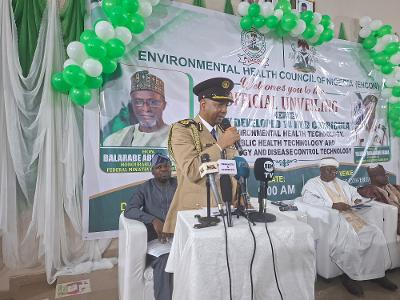
The Environmental Health Council of Nigeria (EHCON) has unveiled 14 Higher National Diploma (HND) curricula aimed at strengthening professional training and environmental health practice in Nigeria.
The newly developed curricula cover Environmental Health Technology, Public Health Technology, Epidemiology and Disease Control Technology, among other specialised areas, and are expected to expand professional knowledge, strengthen preventive healthcare and improve health, safety and quality of life for present and future generations.
Speaking at the unveiling ceremony, the Minister of Environment, Mr Balarabe Lawal, represented by the Conservator-General of the National Parks Service, Mr Ibrahim Goni, called on state and local governments, educational institutions, organised private-sector operators, development partners and professional bodies to support the implementation of the curricula.
“As we unveil these 14 curricula today, let us renew our commitment to building a competent, innovative and responsive environmental health workforce capable of protecting present and future generations.
“It is now my honour and privilege to officially unveil the 14 new curricula for Environmental Health and Public Health programmes for use in Nigerian polytechnics and monotechnics,” he stated.
Goni assured that the Ministry of Environment would continue to support EHCON in effectively discharging its statutory mandate.
“We shall continue to promote policies and partnerships that strengthen environmental health regulation, professional development and the protection of public health throughout the Federation,” he added.
The Registrar of EHCON, Dr Yakubu Mohammed Baba, said the council remained committed to ensuring that implementation of the curricula produces professionals who are technically competent, ethically responsible, innovative and capable of responding to the evolving needs of society.
“We shall continue to discharge our statutory mandate through effective regulation, improved professional standards, institutional collaboration, continuous professional development and the promotion of best practices in environmental and public health,” he said.
Baba further explained that the programmes were designed to produce highly skilled professionals capable of improving sanitation and protecting communities from environmental health risks.
“This initiative aligns with the Renewed Hope Agenda of the administration of His Excellency, President Bola Ahmed Tinubu,” he stated.
He noted that successful implementation of the curricula would require adequate funding, institutional commitment and sustained cooperation among stakeholders.
“We therefore respectfully appeal to the Federal Government, state governments, educational institutions, development partners and the organised private sector to support the provision of laboratories, equipment, digital learning facilities and scholarships,” he added.
The President of the Environmental Health Officers Association of Nigeria, Mr Jamilu Mohammed challenged environmental health professionals and institutions to ensure effective implementation of the newly developed curricula and standards.
He stressed that the success of the initiative would ultimately depend on its implementation.
Mohammed noted that while the council had provided the necessary direction and framework, practitioners and institutions had the responsibility to translate the documents into tangible outcomes.
According to him, effective implementation would improve environmental health services and contribute to healthier workplaces and communities across Nigeria.
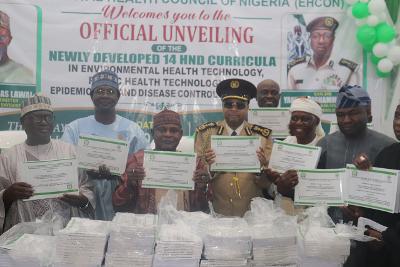
The Executive Secretary of the National Board for Technical Education (NBTE), Prof Idris Bugaje, represented by the Director of Curricular Development, NBTE, Dr Oladipupo Bello, described the introduction of the specialised programmes as timely and critical to addressing Nigeria’s workforce needs.
He said the country required a new cadre of highly skilled and specialised middle-level manpower to tackle emerging public health challenges.
“These curricula bridge critical skill gaps, shifting our educational focus from theoretical knowledge to practical, competency-based execution that directly addresses our national public health priorities,” he said.
The keynote speaker, Prof Agwu Amadi, described the unveiling of the 14 environmental health specialty programmes as a landmark achievement in the advancement of technical education and professional practice in Nigeria.
He said the curricula demonstrated a forward-looking commitment to producing a workforce equipped to address complex environmental, occupational and public health challenges through specialised knowledge and practical competence.
The development of the curricula began with the initial zero draft in 2024 and was finalised at the end of April 2026.


 has unveiled 14 Higher National Diploma (HND) curricula aimed at strengthening professional training and environmental health practice in Nigeria.)