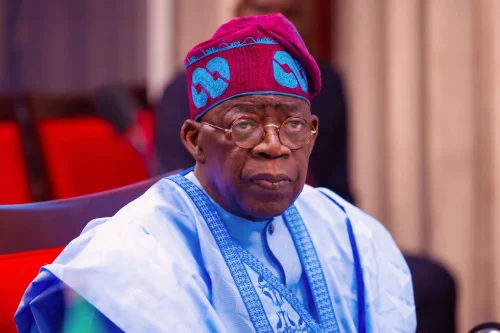
President Bola Ahmed Tinubu will serve as Chief Host at the premiere of MKO, a documentary film that chronicles the 12 June 1993 presidential election, its annulment and the ensuing struggle.
The documentary, produced by international filmmaker Ose Oyamendan, will premiere at the National Theatre, Lagos, on 1 October, Nigeria’s Independence Day, before its nationwide cinematic release on 2 October.
MKO recounts the story of Chief Moshood Kashimawo Olawale Abiola, the businessman, publisher and politician widely linked with the 12 June 1993 presidential poll, its annulment by the military regime and the political crisis that ensued until his death in detention in 1998.
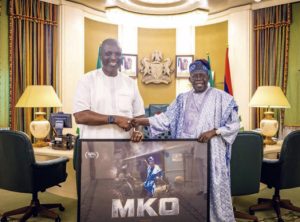
According to the producer, “the documentary combines archival footage with first-hand testimonies from key players and witnesses to one of the most defining periods in Nigeria’s political history.”
It features former Military President, General Ibrahim Babangida, whose administration annulled the election; former Head of State, General Abdulsalami Abubakar, who oversaw Nigeria’s transition to civil rule in 1999; and former President Olusegun Obasanjo.
Other personalities featured include laureate and pro-democracy activist, Prof. Wole Soyinka; Abiola’s running mate in the 1993 election, Ambassador Babagana Kingibe; former United States Ambassador to Nigeria, Walter Carrington; former US Deputy Secretary of State, Thomas Pickering; former Canadian High Commissioner, Gerald Ohlsen; members of Abiola’s family and foreign journalists.
In the documentary, Theodore Zadok, who served as Abiola’s security guard during his detention, gives an account of the final period of the politician’s life.
Oyamendan described Tinubu’s decision to serve as Chief Host as significant, recalling the President’s role in the struggle against military rule following the annulment of the June 12 election.
“For us, as a team, it is an enormous honour that President Tinubu, as Chief Host, is recognising this important documentary,” he noted.
The producer said that the documentary goes beyond Abiola to examine the choices made by political actors during the crisis.
“This was a crucial point in Nigeria’s history where many of our leaders back then chose to side with the dictator,” he shared.
“Tinubu risked his life, livelihood and his family’s safety by standing with the people’s mandate. This is a story of that struggle that has brought us to where we are today,” he highlighted
The 1 October premiere will be followed by a nationwide theatrical release on 2 October, with Nile Entertainment handling distribution.
Speaking, the Managing Director of Nile Entertainment, Moses Babatope, said the Abiola story had a personal connection for him because his father worked at Concord Newspapers, one of the media organisations established by the late politician.
“The story of MKO Abiola is particularly personal to me. My father worked at Concord Newspapers, one of the institutions founded by Chief MKO Abiola. So, his legacy has always had a personal connection to my family,” he stated.
Babatope said the documentary would also help preserve an important part of Nigeria’s political history for younger generations.
“Beyond that personal connection, I believe this documentary is an important contribution to the preservation of Nigeria’s political history. MKO Abiola’s story is one of the most defining periods in our nation’s democratic journey, and it is important that this history is documented and made accessible, particularly to the younger generation,” he disclosed.
“It is a record of a pivotal moment in Nigeria’s history, brilliantly captured by Ose Oyamendan. We are proud to support its release and encourage audiences across the country to experience it in cinemas from October 2,” he stressed.
The documentary film had its world premiere on June 12 at the Sheffield International Documentary Festival, and it’s scheduled for further screenings and theatrical releases in Europe and North America.
For Oyamendan, however, the Nigerian premiere is particularly important because the history documented in the film ultimately belongs to Nigerians.
“This is a story that belongs to Nigerians. It is about memory, power, courage, sacrifice and the consequences of political choices. Most importantly, it is about people who believed that their voices mattered. Thirty-three years after June 12, we have the opportunity to look back at what happened, not simply to remember it, but to understand it and ensure it never happens again,” he emphasised.
The Sun