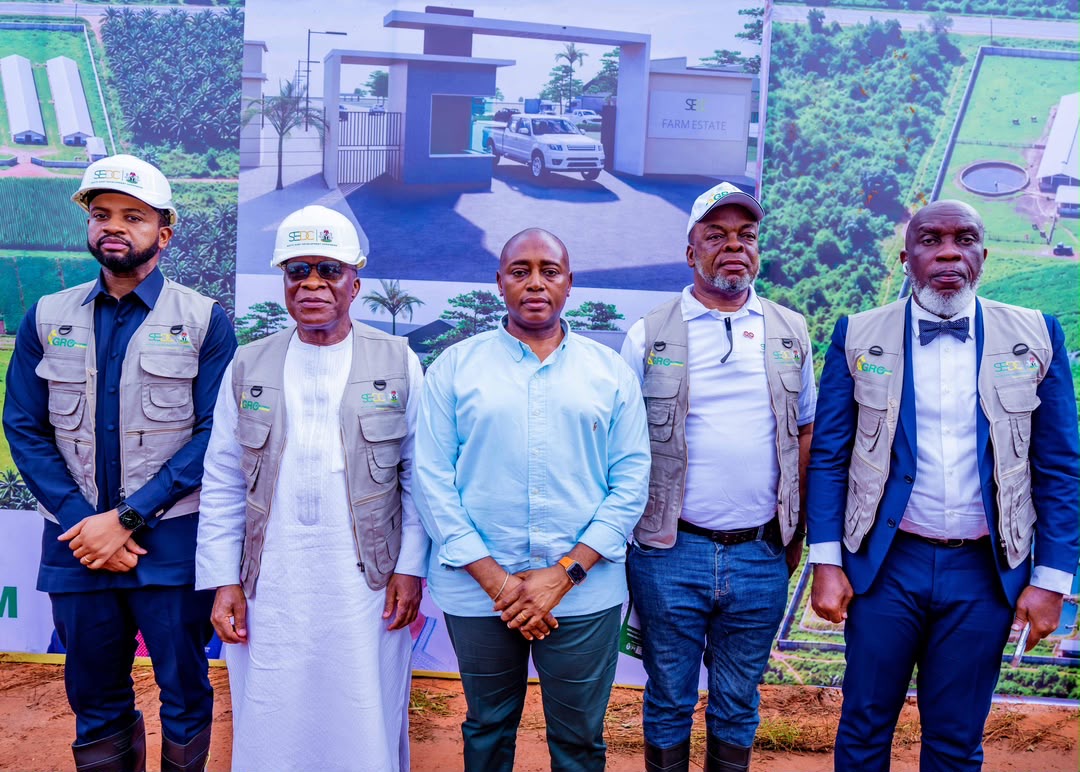
The South East Development Commission (SEDC) has flagged off its South East Agro-Development Programme with the commencement of a 200-hectare integrated model farm at Nomeh Unataeze, Nkanu East Local Government Area of Enugu State.
The pilot project, implemented in partnership with the Enugu State Government, is aimed at boosting agricultural productivity, increasing food production, creating jobs, improving livelihoods and developing agricultural skills across the South East.
The project is also designed to demonstrate a replicable model for modern agriculture in the region.
READ ALSO: Nigerian Government Receives Final AGROW Programme Report
The Minister of Regional Development, Mr Abubakar Momoh, said the project reflected the type of productive regional development the Nigerian Government sought to promote.
“Today is significant because it represents something bigger than the commencement of an agricultural project. It represents the kind of development the Federal Government is seeking to promote across Nigeria: development that is productive, inclusive, regionally balanced and capable of creating opportunities for our people,” Momoh said.
The minister stressed that food security required a complete agricultural ecosystem rather than simply increasing the amount of land under cultivation.
“The objective is not simply to produce more food. We must build an agricultural system that is productive, resilient and capable of creating value across the entire chain. We must produce. We must process. We must create markets. We must reduce post-harvest losses. We must improve productivity and incomes. And we must create opportunities for young Nigerians to participate meaningfully in modern agriculture,” he said.
Momoh said the South East must increase its productive capacity and become a stronger contributor to Nigeria’s food supply.
He added that this required moving beyond fragmented subsistence production to systems connecting land, technology, farmers, machinery, inputs, processing, markets, skills and investment.
Redefine Agriculture
The Managing Director and Chief Executive Officer of SEDC, Mr Mark Okoye, said the project was deliberately designed to redefine how the region approached agriculture.
“The South East Agro-Development Programme is about building productive capacity of the region. We want to demonstrate what agriculture can look like when land, technology, mechanisation, production, processing, training and markets are brought together in one system,” Okoye said.
He said the impact of the project would be measured beyond the physical boundaries of the 200-hectare site.
“The real impact is what happens around the farm and beyond the farm. It is the young person who acquires a practical skill here and starts a farm elsewhere, the farmer who supplies maize or soya to the feed mill, the dairy farmer who gets technical support and access to a reliable market, and the smallholder farmer who is able to increase production because the ecosystem around them has improved,” he explained.
Okoye said a major component of the project was its training and out-grower programme.
He said the training centre would provide practical exposure in dairy husbandry, fodder and silage production, poultry, fisheries and farm mechanisation.
According to him, the proposed facility would accommodate between 100 and 120 trainees at a time, while practical programmes would enable participants to learn within operational agricultural enterprises.
He said the out-grower component would progressively bring surrounding smallholder farmers into the agricultural value chain.
“The programme is expected to begin with approximately 300 households within a 10-kilometre radius of the farm, expanding as production capacity grows,” he said.
Okoye said participating farmers would have access to inputs, technical assistance and mechanisation services, while the farm would provide opportunities for aggregation and market access.
He said the project was expected to support more than 1,000 direct jobs at maturity, with additional employment and livelihood opportunities generated through seasonal agricultural activities and the wider out-grower network.
National Priority
The SEDC chief executive said the project came at a time when food security had become a central national development priority.
He said the project would serve as a pilot and practical template for the Commission’s wider agricultural and agro-mechanisation interventions across the five states of the South East.
“The Nomeh project is therefore not intended to remain an isolated agricultural facility in Enugu State.
“Nomeh is the starting point. This is a pilot. We want to learn from what we build here, document what works, improve what does not, and replicate the model across the South East in line with our mandate,” Okoye explained.
The Deputy Governor of Enugu State described the project as an important example of strategic collaboration between the state and the Commission, particularly at a time when food production and economic diversification had become increasingly important.
The Chairman of SEDC, Dr Emeka Wogu, said the project represented an important step in translating the Commission’s regional development mandate into interventions with practical and measurable impact.
Wogu said the Commission would continue to work with state governments and other stakeholders to ensure that its interventions complemented existing development efforts.
“Regional development requires partnership. The Commission cannot and should not work in isolation from the state governments, communities, the private sector and development partners. Our responsibility is to create platforms that connect these stakeholders around opportunities that can generate sustainable economic value for the people of the South East,” he said.
Speaking on behalf of the community, the President-General of Nomeh Unataeze, Dr Chukwudi Anyianuka, described community participation as critical to the success of the project.
“We welcome this project because we see it as an investment in the future of Nomeh and our people.
“Our community understands that a project of this scale requires cooperation, responsibility and a shared commitment to its success. We are ready to work with SEDC, the Enugu State Government and all the partners involved to ensure that the project delivers the opportunities that our young people, farmers and community deserve,” he said.
The Executive Director, Natural Resources, Agriculture and Rural Development, Dr Cliff Ogbede, said the project demonstrated what was possible when government institutions worked together around a clear development objective.
“The development of this agricultural facility in Nomeh demonstrates what is possible when government institutions work together around a clear development objective. Enugu State is committed to creating the conditions for productive investment, and we are pleased to partner with SEDC on a project that will not only produce food, but also create jobs, develop skills, support farmers and strengthen the agricultural value chain,” Ogbede said.
According to him, the project could become an important part of the economic development of Nkanu East, Enugu State and the wider South East.
Regional Growth
The Commission said the project was part of its broader agro-development and mechanisation strategy, aimed at using agriculture as a platform for food security, enterprise development, employment, skills acquisition and regional economic growth.
Unlike a conventional farm focused on a single agricultural enterprise, the Nomeh project integrates fodder production, dairy, poultry, fisheries, greenhouse production, processing, mechanisation, renewable energy and practical agricultural training.
The Commission said the integrated model would allow different components of the agricultural value chain to support one another through shared feed, water, machinery, processing and other systems.
It said the model provided for a 200-head dairy herd, poultry production of up to 20,000 birds per cycle, fisheries infrastructure, extensive fodder cultivation and silage production, alongside processing and demonstration facilities.
The Commission said the objective was to demonstrate how different components of the agricultural value chain could work together to create a more productive and sustainable system.
It added that the community should not be viewed simply as the host of the project, but as an important stakeholder in its success.
The South East Agro-Development Programme is expected to contribute to food security, employment, skills development and economic activity across the region.