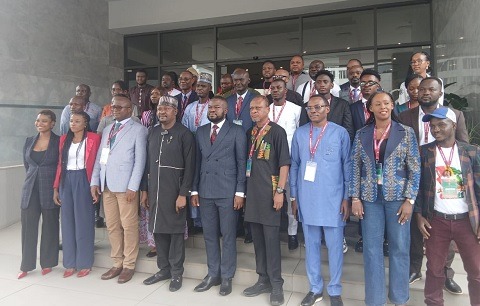
More than 40 journalists from 12 Economic Community of West African States (ECOWAS) member countries and the three Alliance of Sahel States (AES) countries have been trained on investigative reporting of money laundering, terrorist financing and other economic and financial crimes.
The three-day training, held in Ghana, was organised by the Inter-Governmental Action Group Against Money Laundering in West Africa (GIABA), a specialised ECOWAS institution supporting the adoption and implementation of anti-money laundering (AML) and counter-financing of terrorism (CFT) measures across the region.
GIABA Director-General Mam Cherno Jallow said journalists were critical to efforts to promote transparency and accountability and should be equipped to investigate and report financial crimes accurately.
“Your role in keeping watch, raising awareness and investigating places you at the heart of our push for transparency and accountability,” Jallow said in a speech delivered on his behalf by Timothy Melaye, Acting Principal Officer, Communication and Advocacy at GIABA.
He said the training was designed to strengthen journalists’ understanding of economic and financial crimes, improve reporting on AML/CFT issues and foster closer cooperation between GIABA and the media.
READ ALSO: ECOWAS Court to Train Journalists on Court Reporting
Jallow also expressed concern about what he described as poor reporting, inadequate due diligence and misinformation in some coverage of AML/CFT issues.
He urged participants to use the training to strengthen their investigative skills and build professional networks capable of supporting more accurate and informed reporting across West Africa.
FIC Director Calls for Collaboration
Albert Kwadwo, Director of Ghana’s Financial Intelligence Centre and National Correspondent of GIABA, said combating financial crime required cooperation among law enforcement agencies, regulators, prosecutors, the judiciary, the private sector, civil society and the media.
He said financial crimes were becoming increasingly complex as criminals exploited digital financial services, technology, virtual assets, corporate structures and cross-border transactions.
“Proceeds from fraud, corruption, tax offences, drug trafficking and organised crime can cross several jurisdictions within a short time,” Kwadwo said.
He urged journalists reporting financial crime to “follow the money” by developing the ability to examine corporate structures, financial records, procurement information and beneficial ownership arrangements, while using open-source intelligence to connect seemingly unrelated transactions.
Kwadwo said financial intelligence could reveal patterns that individual transactions might not show, enabling journalists to identify networks and explain complex financial activities to the wider public.
He stressed the importance of accuracy, professionalism and respect for due process, saying the objective should not simply be to increase the volume of financial crime reporting but to produce evidence-based journalism that explains how such crimes operate and affect communities and economies.
Journalists Learn Investigative Techniques
During the training, Melaye addressed participants on GIABA’s role, Mutual Evaluation Reports (MERs), the National Risk Assessment Framework and the AML/CFT status of countries as potential sources for investigative reporting.
Dr Bisi Olawuyi of the Department of Communication and Language Arts, University of Ibadan, examined the use of solution journalism in reporting economic and financial crimes.
Other resource persons included Claude Plagbeto, who discussed reporting predicate offences linked to money laundering, and Dr Hermenegildo Pereira, who addressed strategies for building trust and cooperation with information sources.
The training is part of GIABA’s broader efforts to strengthen media capacity and promote informed public reporting on money laundering, terrorist financing and related financial crimes in West Africa.