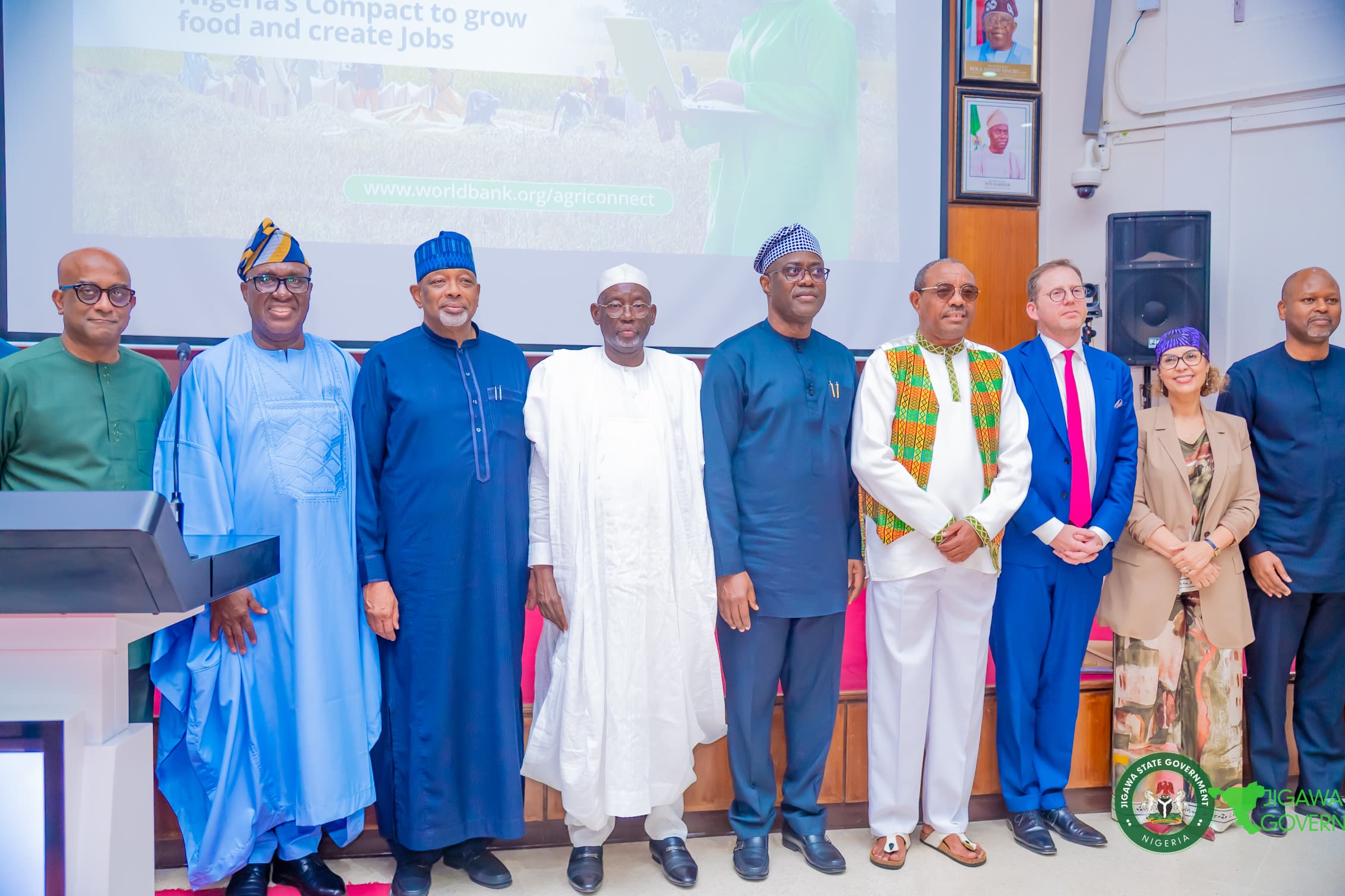
Jigawa State Governor Malam Umar Namadi says his administration is laying sustainable foundations to transform agriculture into a productive, technology-driven and commercially viable sector capable of improving livelihoods and creating opportunities for citizens.
Governor Namadi stated this on Friday at the formal launch of the Nigeria AgriConnect initiative and the CGIAR System Board Dinner held at the International Institute of Tropical Agriculture (IITA), Ibadan.
He said agriculture remains central to his administration’s 12-Point Agenda for Greater Jigawa, with investments and institutional reforms targeted at increasing productivity, strengthening value chains and improving the resilience and profitability of the sector.
According to him, Jigawa is a major producer of rice, wheat and sesame, while the government is expanding irrigation and dry-season farming, strengthening agricultural extension services and extending mobile veterinary services across all 287 wards.
“Jigawa is a leading producer of rice, wheat, and sesame. We are expanding irrigation and dry-season farming, strengthening extension services, and extending mobile veterinary services across all 287 wards,” the governor said.
READ ALSO: Jigawa Unveils Aquaculture Expansion Plan
Namadi disclosed that the state had established the Agricultural Transformation Agency and the Ministry of Livestock Development to provide focused leadership, coordination and accountability in the implementation of its agricultural development agenda.
He said the administration was also addressing key constraints to agricultural productivity, including limited access to mechanisation, extension services, entrepreneurship, research and innovation.
The governor revealed that Jigawa had established 60 mechanisation centres equipped with 400 tractors and 60 combine harvesters, while the number of agricultural extension agents had increased to nearly 2,000.
He also disclosed that the state had entered into a partnership for an agribusiness incubation programme designed to develop 10,000 entrepreneurs and facilitate the emergence of at least 500 new small and medium-sized enterprises.
Namadi said the programme was part of efforts to move agriculture beyond subsistence production by connecting farmers to technology, finance, processing facilities, markets and viable business opportunities.
On agricultural research, the governor said the Jigawa State Agricultural Research Institute was being repositioned to ensure that research activities respond more directly to the practical challenges confronting farmers and the wider agricultural sector.
He said research priorities include seed systems, soil fertility, irrigation, livestock productivity, post-harvest management and agro-processing.
According to him, targeted research scholarships and specialist training, including MSc and PhD programmes, are also being provided to strengthen the human capacity required to sustain the agricultural transformation.
The governor said Jigawa’s partnership with IITA would further strengthen efforts to apply science, research and innovation to the state’s agricultural challenges and opportunities.
He said the collaboration covers improved varieties of maize, soybean and cassava, soil health and mapping, stronger seed systems, pest and disease management, competitive agricultural value chains and youth-led agribusiness.
“What excites us most is the opportunity to connect IITA’s science and innovation with Jigawa’s land, farmers, institutions, and entrepreneurial energy,” Namadi said.
He stressed that the ultimate goal was to ensure that research reaches farmers, improved technologies increase productivity, production is linked to processing and markets, and agriculture generates viable businesses and decent employment opportunities for young people.
Namadi reaffirmed Jigawa State’s commitment to working with IITA, CGIAR, the Federal Government, development partners, financial institutions and investors to translate research and innovation into measurable improvements in agricultural productivity and livelihoods.
He said the impact of the partnership would ultimately be measured through improved yields, healthier soils, reliable seed systems, reduced post-harvest losses, stronger value chains, thriving agribusinesses, increased farm incomes and improved access to nutritious food.
The governor also invited the leadership of the CGIAR System Board and other development partners to visit Jigawa State to witness first-hand the ongoing transformation in the agricultural sector.
According to a statement by the Governor’s Chief Press Secretary, Hamisu Mohammed Gumel, Namadi said the state was ready to deepen collaboration with stakeholders in order to achieve sustainable agricultural development.
“Together, let us demonstrate what becomes possible when science, government, farmers, young people, and markets work as one,” the governor said.