
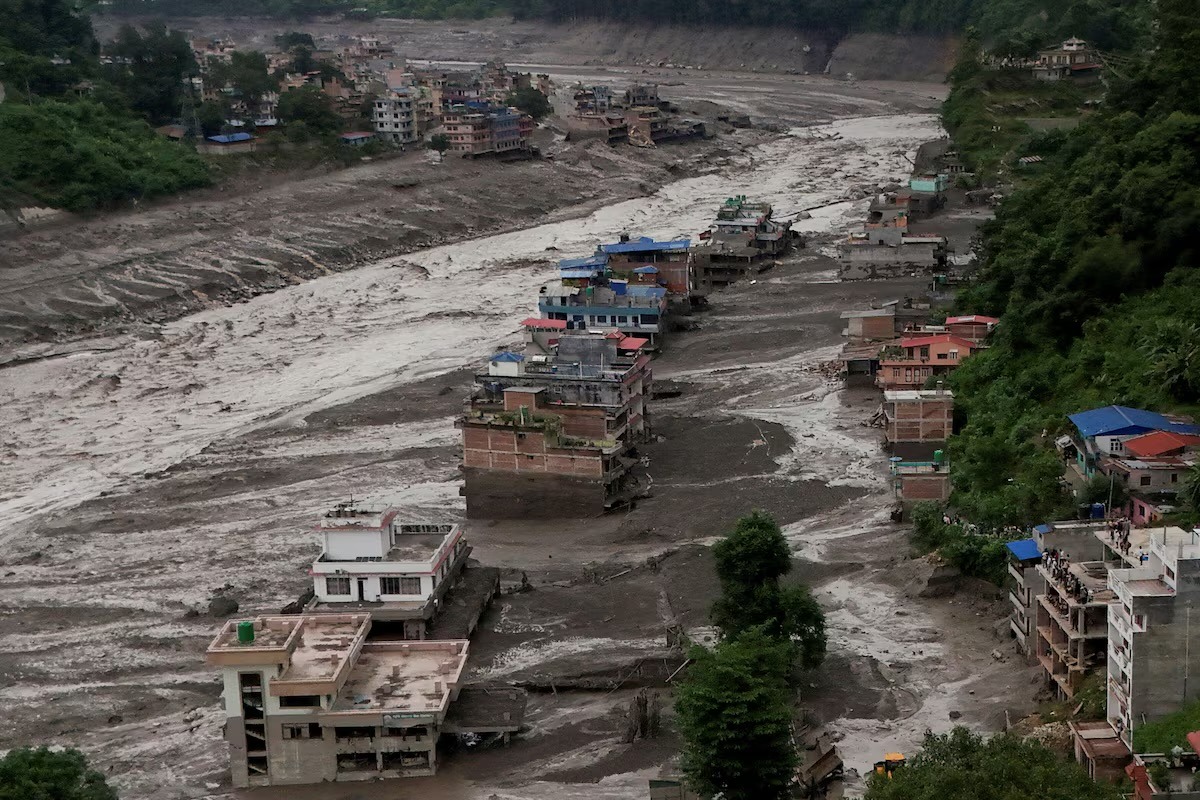
Nepal is preparing to drain four glacial lakes this fiscal year as it steps up efforts to reduce flood risks following a recent disaster that claimed the lives of more than 1,400 people.
According to reports, rescuers are still searching for more than 5,000 people missing in the border region with China after August’s glacier collapse unleashed landslides and a flash flood that tore through valleys.
An expert with a government research centre, Subash Tuladhar said; ”Our aim is to lower the risk of the lakes breaching their natural dams and reduce the risk of downstream floods.”
He said Canals will drain water into nearby rivers in a regulated way, and workers faced health risks as a result of the lengthy periods of high-altitude work required, in addition to the dangers of sudden flooding.
- READ ALSO: Floods Claim 56 Lives In India, 14 In Nepal
Authorities said; “design work and detailed studies targeting the central and eastern lakes of Thulagi, Lower Barun, Lumding Tsho and Hongu II, will begin in the fiscal year that runs until mid-July 2027.”
The United Nations Development Programme and the International Centre for Integrated Mountain Development (ICIMOD) said “in a 2020 report, the lakes, at heights ranging from 4,050 m to 5,483 m, rank among Nepal’s most dangerous.’
ICIMOD Executive Director, Sanjeeb Baral said the work of draining “through gated structures” will start after a detailed study and could take up to six years to complete.
Nepal’s disaster served as a warning to the world, Prime Minister Balendra Shah, 36, told the United Nations in an impassioned speech last month that blamed climate change despite his country’s negligible emissions.
Prime Minister Balendra Shah, told the United Nations last month that Nepal’s disaster served as a warning to the world, blaming climate change despite the country’s negligible emissions.
He said; “retreating glaciers, unstable mountain slopes and increasingly unpredictable rivers showed Nepal was paying a heavy price.’
Nepal has reported about 26 Glacial Lake Outburst Flood events in the past four decades, which claimed more than 300 lives and property worth millions of dollars to extreme climate events annually on average.
A retired ICIMOD expert on glaciers, glacial lakes and outburst floods, Samjwal Ratna Bajracharya, said lowering the lakes by 3 m would significantly reduce the threat.
“They are growing fast, are high up in the Himalayas and could cause outbursts any time, due to earthquakes, avalanches, climatic conditions and unplanned human-induced activity,” he said.
Reuters

