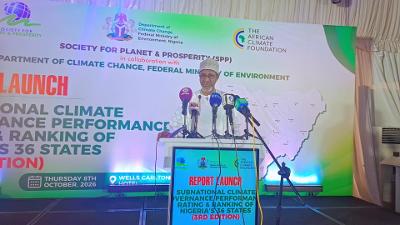
The Society for Planet & Prosperity in collaboration with the Federal Ministry of Environment has launched the 3rd report on Sub-national Climate Governance Performance Rating and Ranking across Nigeria.
The Sub-national Climate Governance Performance Rating and Ranking is an annual assessment tool that evaluates how well Nigeria’s 36 state governments handle climate change, environmental sustainability, and policy implementation at the local level.
Speaking at the launching ceremony in Abuja Nigeria’s capital, Minister of Environment, Mr Balarabe Lawal call on states Governors to make climate action an integral part of their development and investment priorities.
He says the Nigerian Government, under the Renewed Hope Agenda of President Bola Tinubu remains committed to partnering with relevant stakeholders to provide the technical assistance, capacity development and collaboration needed to support this journey.
READ ALSO: Borno Hosts Environment Ministry Retreat on Sustainable Environmental Governance
“Let us use this Third Edition to transform competition into constructive learning, rankings into accountability, and commitments into tangible outcomes. I commend all 36 States and FCT for their participation and continued commitment, and encourage every State to use this initiative as a pathway towards stronger climate governance, greater resilience and sustainable development,” he said.
He added that Nigeria can build a more resilient, low-carbon and prosperous Nigeria-leaving no State and no community behind, with the commitment of states government.
President Society for Planet &Prosperity, Professor Chukwumerije Okereke in his presentation says the ranking was not based simply on a state’s climate record or its vulnerability to climate change.
According to Professor Okereke the assessment examined how effectively Nigeria’s 36 states were governing and implementing climate action across five main areas, Climate institutions and governance, Climate policy and action plans, Climate-project implementation and monitoring, Climate budget and finance and Online visibility of climate activities, he said.
He noted that this year, states were required to provide evidence of five major climate projects, from which the best three were selected for scoring.
“The assessment also examined budgeting, access to climate finance, stakeholder participation, monitoring and evaluation, and online visibility. The ranking was based on evidence submitted by the states, followed by verification, with strict emphasis on transparency and integrity,” he said.
Professor Okereke noted that overall, the results demonstrated substantial improvement in state-level climate action and showed that continued collaboration, peer learning, stronger implementation, and better access to climate finance can further strengthen Nigeria’s response to the climate emergency.
In his acceptance speech, the winner of the 2025 Sub-national Climate Governance, Katsina State Commissioner of Environment, and Special Adviser on Climate Change, Professor Mohammed Alamin, says, for Katsina, the climate agenda is also being presented as a development and security issue, with particular attention to the effects of desertification, resource pressure and climate variability on agriculture, livelihoods and communities.
He noted that the administration of Governor Dikko Radda has emphasised the involvement of young people and women in climate action and is pursuing initiatives including the Katsina One-Person-One-Tree programme, which targets two million trees in 2026 and 11 million by 2030.
“The state is also positioning its climate, agriculture, renewable-energy and carbon-market opportunities for international engagement, making the latest ranking both a recognition of its climate-governance efforts and a platform for showcasing its broader green-development agenda,” he said.
Mr Yusuf Hassan from Global Engagement Under2 Coalition Climate commended the Society for Planetary Prosperity (SPP) for its efforts to track and promote climate action among Nigerian states.
Speaking at the event, Hassan said the coalition was ready to support Nigerian states through technical assistance and grant programmes.
He stressed that no state should undertake climate action alone, “the improvement recorded by nearly all states between the first and second editions of the climate rankings demonstrated the value of making climate performance visible, the progress had resulted in the emergence of new action plans, climate policies and dedicated institutions, while allowing states to learn from one another.”
The Edo State Commissioner of Environment, Mr Noas Adams, says at National levels the states Commissioners were committed to ensuring that all activities at the sub-national level are guided by actions and initiatives that protect the environment and safeguard the ecosystem.
“As Commissioners of Environment, we recognise the importance of translating environmental policies into practical actions that will promote sustainability and preserve our natural resources for present and future generations, we are prepared to organise ourselves and rise to the challenge of being properly rated and ranked among the best-performing states in the country. We are determined to work hard and demonstrate excellence in our environmental responsibilities,” he said.
According to the 2025 Year Report ranking, Kwara State came in 5th position, Lagos State ranked 4th, Kano State took 3rd place, Abia State came 2nd, while Katsina State emerged in 1st position.