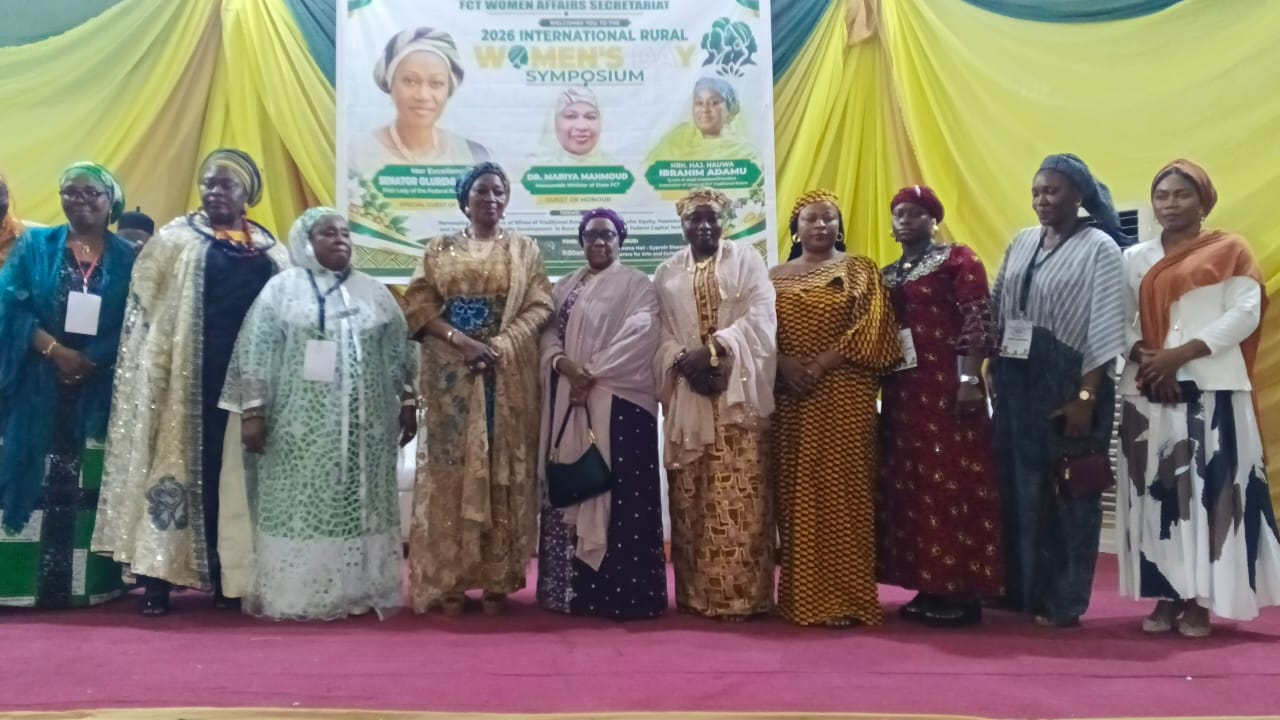
Nigeria’s First Lady, Senator Oluremi Tinubu, has called for concrete measures and inclusive policies to improve the welfare of rural women and expand their opportunities for economic and social advancement.
She made the call at a symposium in Abuja on Wednesday to mark the 2026 International Rural Women’s Day.
The event was organised by the Association of Wives of FCT Traditional Rulers (WOFCTTRA), in collaboration with the FCT Women Affairs Secretariat, under the theme: “Harnessing the Influence of Wives of Traditional Rulers to Advance Gender Equity, Peacebuilding, and Sustainable Community Development in Rural Communities of FCT”.
Represented by a former All Progressives Congress (APC) women leader in the FCT, Mrs Hilmary Aipoh, the First Lady commended rural women for their resilience and contributions to national development.
She urged members of WOFCTTRA to translate their influence into practical action and use traditional institutions to promote inclusion, gender equality and sustainable community development.
Tinubu said the contributions of rural women as farmers, traders, craftswomen, caregivers and community organisers should be matched with policies that address the challenges they face.
“Rural women remain the backbone of local economies and cultural preservation, yet continue to face significant systemic hurdles.
“Many rural women still face barriers to education, healthcare, land ownership, finance and participation in decision-making. Recognising their contributions must translate into greater opportunities, protection and inclusion,” she said.
The First Lady highlighted the influence of traditional institutions in promoting social cohesion, describing traditional rulers as custodians of culture and their wives as important links between community members and local leadership.
She urged royal wives to engage market associations, women’s groups and young people to ensure that the concerns of rural communities reached decision-makers.
“Your influence is a privilege, but it is also a responsibility. You can help your husbands better understand the everyday challenges of the people they serve,” she said.
She cited challenges including limited access to maternal healthcare, rising agricultural production costs, girls dropping out of school and young women struggling to secure funding for businesses.
Tinubu encouraged the wives of traditional rulers to promote girls’ education, discourage harmful traditional practices, increase women’s participation in community decision-making and mediate local disputes to strengthen peace.
Earlier, the President of WOFCTTRA and Queen of Abaji Chiefdom, Hajiya Hauwa Adamu, described rural women as essential to national development and called for stronger efforts to bridge the gap between urban progress and rural welfare.
“If you develop the city and forget the village, you have built a house without foundation,” she said.
Adamu outlined proposals to strengthen support for rural women across the FCT’s six area councils, including the establishment of Rural Women Safe Motherhood Clubs and a Palace-Based Peacebuilding Network.
She said the proposed initiatives would provide platforms for women to access maternal health support, report gender-based violence and seek community-based mediation.
She also called for collaboration with the Renewed Hope Initiative to extend support to rural women and proposed the establishment of an official FCT Rural Women Traditional Institution Desk to channel concerns from traditional institutions to government decision-makers.
Adamu said royal palaces often served as first points of contact for women and families seeking assistance with domestic disputes, threats of early marriage and maternal health emergencies.
“When a young girl in Kwali says she does not want early marriage but wants school, she runs to the Queen’s palace, not to the police station.
“When there is misunderstanding between husband and wife in Bwari, it is the wife of the chief they call; when a woman bleeds during childbirth in hard-to-reach Abaji, it is we who mobilise the midwife. We are the bridge,” she said.
The Permanent Secretary of the FCT Women Affairs Secretariat, Hajiya Asmau Mukhtar, reaffirmed the administration’s commitment to improving the welfare, economic capacity and livelihoods of rural women across the six area councils.
Mukhtar acknowledged the contributions of rural women to agriculture, food security, family welfare, entrepreneurship and community development, adding that their inclusion remained important to the territory’s development efforts.
Also speaking, the President of the Helpline Social Support Initiative (HSSI), Dr Jumai Ahmadu, called for practical measures to accelerate grassroots development, promote gender equality and strengthen peace in rural communities.
Ahmadu, who was represented by the organisation’s Programme Officer, Mrs Amina Omale, said sustainable national development must begin at the grassroots.