


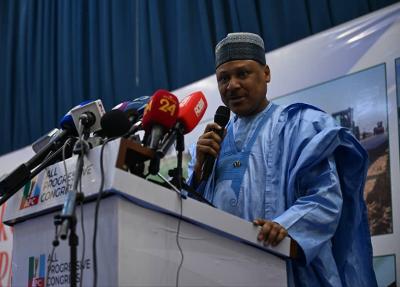
Nigeria’s Minister of Information and National Orientation, Mohammed Idris, says President Bola Ahmed Tinubu’s economic reforms are laying the foundation for shared prosperity, insisting that Nigerians across social and economic backgrounds are benefiting from the policies.
Idris who made this known at the All Progressives Congress (APC) manifesto for the 2027 presidential election, also highlighted the administration’s interventions in infrastructure, security, education and investment.
Responding to concerns that only a few Nigerians were benefiting from the reforms, Idris cited public infrastructure as an example of government projects accessible to all citizens, irrespective of political affiliation or economic status.
“When the road between Abuja and Kano is being put together, I’m not aware that anybody needs to show his ID card that he belongs to the APC, or that he is a rich man, or that he belongs to a particular class before he plies it,” he said.
READ ALSO: Information Minister Hails President Tinubu’s Education Reforms
He also cited the Abuja-Kaduna highway, recalling how motorists previously had to establish whether bandits and kidnappers were operating along the route before travelling.
“Today, nobody asks this question. You take your car from here to Kano, and nobody asks questions whether the terrorists, the bandits, the kidnappers or whoever was there. This wasn’t the case,” he said.
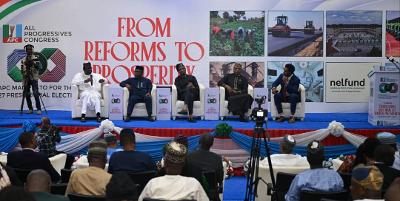
On education, he identified the Nigerian Education Loan Fund (NELFUND), which he said had benefited about 1.6 million students, as evidence of the administration’s commitment to expanding access to higher education.
“What President Bola Ahmed Tinubu sought to say is that there is no reason why any young man or woman who has the credentials to go to school, who indeed has secured admission into any higher institution, should be unable to do so simply on account of the inability of his or her parent or guardian to pay for not just tuition, but also upkeep,” he noted.
Signs of Progress
The minister also cited Nigeria’s removal from the Financial Action Task Force (FATF) grey list, improved international credit ratings and declining inflation as signs of progress in the economic reforms. Stressing that the administration had restored investor confidence by addressing foreign exchange challenges that previously prevented some foreign investors and airlines from repatriating funds.
“Once you bring your dollar or naira to this country, you are sure that you can repatriate your funds, provided you do that through legal means,” he said.
Acknowledging the economic challenges facing Nigerians, Idris maintained that the country’s indicators were improving.
“Inflation is on the decline. Yes, you may say that we are not there yet. Headline inflation, food inflation, are all on the decline. Our GDP is on the rise. We have laid the foundation for reforms and we are progressively going towards the period of prosperity”, he said
Idris also urged journalists to balance their watchdog responsibilities with fair reporting of government achievements.
“It is important to criticise. It is important to point out areas of correction for any government. Indeed, that is your role as a journalist. But it is also important that you know that it is not only when you are adversarial that you can lay claim to good journalism. If you see anything good, please also say it,” he urged.
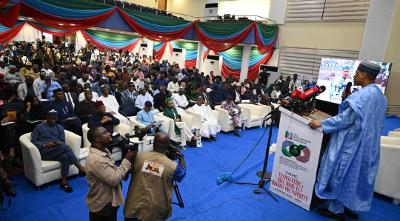
Also speaking, the Minister of Budget and Economic Planning, Senator Abubakar Bagudu, described the APC manifesto as a collective vision involving millions of Nigerians beyond government officials.
He said the political movement around Tinubu, which he called “Team Asiwaju”, encouraged citizens to participate in policy discussions and take ownership of the administration’s vision.
Bagudu also recounted an incident in Zaria involving a carrot seller whose goods remained unsold late in the evening, saying the president’s concern about the trader reflected his commitment to ordinary Nigerians.
Defending the economic reforms, he recalled that 27 governors were unable to pay workers’ salaries in 2015 despite the country having enjoyed significantly higher international oil prices.
He said the experience demonstrated the need to address structural weaknesses in the economy rather than rely solely on oil revenues.
“Mr President was not concerned about the next election, but about prosperity,” he added
The Minister of Industry, Trade and Investment, Dr Jumoke Oduwole, said the proposed APC manifesto for 2027–2031 was designed to move Nigeria from economic reforms to shared prosperity.
She explained that the framework was built around four pillars: a secure and resilient nation; better quality of life and affordability; energy, infrastructure and economic growth; and effective and accountable governance.
“Mr President said on October 1st that Nigeria is moving from reforms to prosperity. He made the point that over the last three and a half years, a lot has happened, and thanked Nigerians for their patience and resilience,” she said.
Oduwole disclosed that the proposed agenda included increasing electricity generation to more than 10,000 megawatts, creating one million export-linked jobs for young Nigerians by 2030, accelerating annual economic growth to six per cent and halving unemployment.
“Other targets include halving the number of out-of-school children by 2031, recruiting and training 20,000 additional teachers, expanding health insurance coverage to 40 per cent of Nigerians and establishing an industrial hub in each geopolitical zone,” she noted.
According to her, the manifesto was developed through consultations with government institutions, state governments, development partners, business organisations, civil society groups, women, young people, persons with disabilities and the media.
The proposed manifesto sets out the APC’s priorities for 2027–2031, with emphasis on consolidating ongoing reforms and expanding opportunities in security, education, healthcare, infrastructure and employment.

