


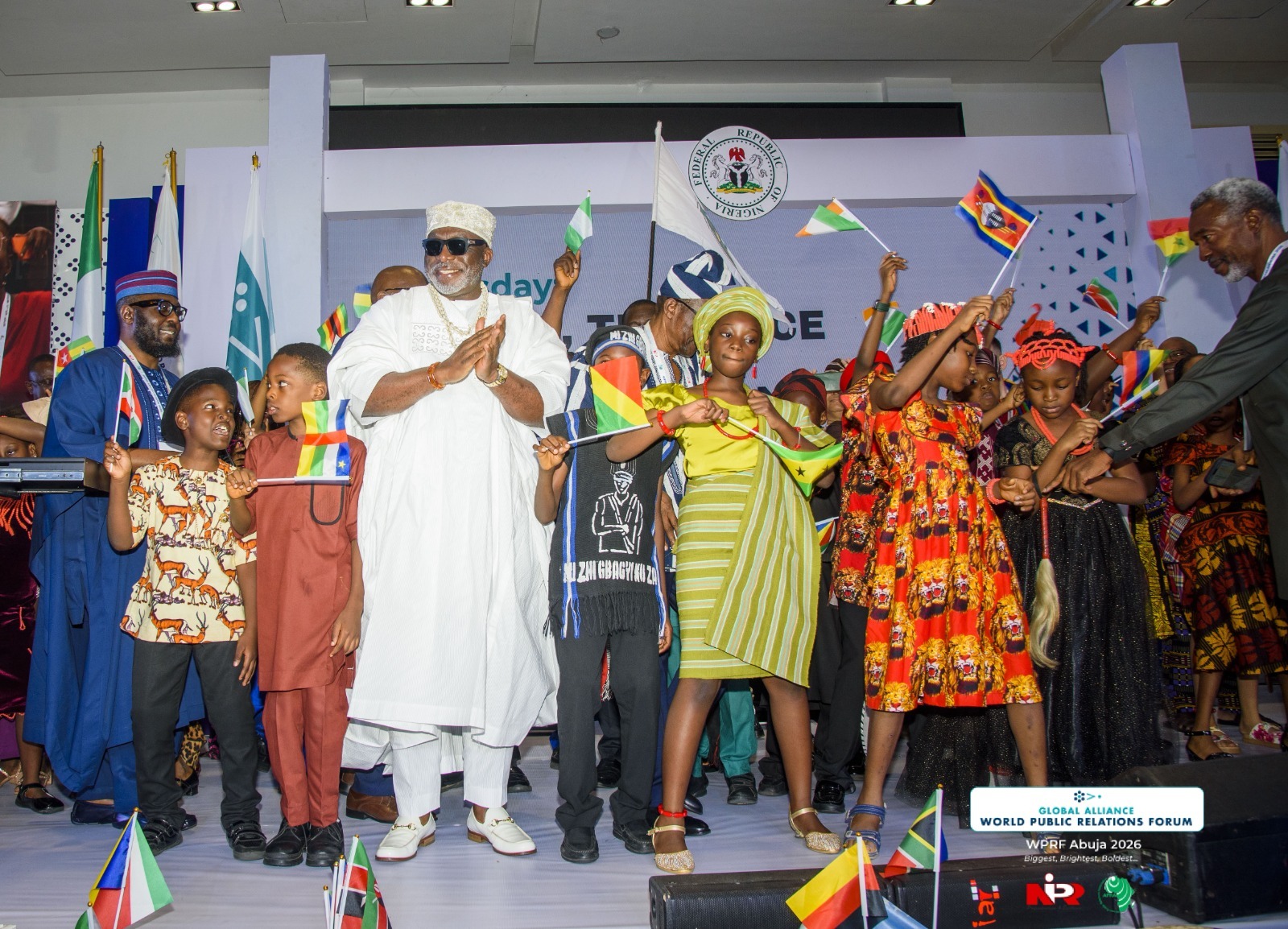
The Chairman of United Nigeria Airlines, Professor Obiora Okonkwo, has warned that irresponsible communication, misinformation and disinformation pose serious threats to peace, democracy and sustainable development in Africa, urging media and public relations professionals to embrace self-regulation and ethical standards.
He said communication professionals must prioritise truth, integrity and public interest to prevent the misuse of information to manipulate public opinion, fuel divisions and undermine public confidence in democratic institutions.
Mr Okonkwo made the call during the African Day celebration on the sidelines of the ongoing World Public Relations Forum in Abuja, Nigeria, where he spoke on responsible communication, self-regulation, information and media literacy.
“In an age of unprecedented information flow, the credibility, integrity and social value of what we communicate are as important as the freedom and the platform through which we communicate,” he said.

He warned that communication could either promote understanding and national unity or deepen prejudice, hatred and divisions, depending on the values and professional standards guiding its use.
READ ALSO: Osun Poll: EU Hub Warns Media Against Information Disorder
“Communication can build bridges or deepen divisions, enlighten citizens or manipulate them, strengthen democratic institutions or weaken confidence in them,” he stated.
Citing the 1994 Rwandan genocide as an example of the dangers of irresponsible communication, Mr Okonkwo recalled how radio station RTLM was used to propagate ethnic hatred, dehumanisation and incitement to violence.
“The lesson is unmistakable. Communication is not always an innocent exercise. In the hands of irresponsible actors, the microphone can become as destructive as a very dangerous weapon,” he warned.
He also cited Nigeria’s 2023 presidential election, during which social media platforms facilitated political mobilisation but were also used to circulate unverified claims, fabricated results and divisive ethnic and political narratives.
The airline chairman further referenced misinformation during the COVID-19 pandemic and Ebola outbreaks in parts of the Democratic Republic of Congo, noting that false information had undermined public confidence in health institutions and interventions.
He said the examples demonstrated that irresponsible communication could threaten not only democratic stability but also human lives.
Drawing from his experience in the aviation industry, Mr Okonkwo said truthful and timely communication was essential to maintaining corporate reputation and public confidence, particularly in a high-trust sector where flight disruptions, cancellations and safety-related incidents could generate public anxiety.
“Truthfulness is not the enemy of reputation management. It is its most sustainable foundation,” he said
Adding that corporate leaders must communicate facts accurately and sustain stakeholder confidence through honesty, accountability and transparency.
Mr Okonkwo expressed concern over the growing scale of disinformation across Africa, citing a 2024 analysis by the Africa Center for Strategic Studies which documented 189 disinformation campaigns across at least 39 African countries.
He also referenced a UNESCO survey which found that 62 per cent of digital content creators did not undertake rigorous fact-checking before sharing information, while 73 per cent expressed interest in receiving training.
To address the challenge, he identified professional self-regulation, information literacy and media literacy as three critical responsibilities for strengthening Africa’s communication ecosystem.
He urged journalists, public relations practitioners, advertisers and corporate communicators to uphold professional integrity, stressing that self-regulation must include accountability, continuous professional education, accuracy and commitment to public interest.
“Public relations in particular must resist being reduced to propaganda, image manipulation and the manufacture of favourable impressions irrespective of the truth. Our greatest professional asset must be public trust,” he said.
However, he cautioned that professional self-regulation must not become a tool for censorship or political control, insisting that freedom of expression must go hand in hand with professional responsibility.
On information and media literacy, Mr Okonkwo said citizens must be equipped with the skills to identify credible sources, evaluate evidence and understand how information is produced, framed and distributed.
He called for the integration of these competencies into educational systems, public enlightenment programmes and professional development initiatives.
He also warned that artificial intelligence, with its ability to generate convincing fabricated images, videos and voices, had made media literacy and information verification more urgent.
According to him, responsible communication was directly linked to peace, democracy and development, as these depended on public trust, credible information, transparent governance and informed citizen participation.
He challenged participants at the forum to develop practical solutions for strengthening professional self-regulatory institutions, protecting freedom of expression and preparing African communication professionals and citizens for emerging disinformation threats.
Mr Okonkwo added that the value of communication should be measured not by how widely information travelled or how loudly messages resonated, but by their positive impact on society.
“Communication is indeed the voice of the world, but its power lies in the responsibility with which that voice is exercised,” he said.
He urged African communication professionals to ensure that communication informed rather than misled, built bridges rather than created divisions, and advanced truth rather than amplified falsehood.

