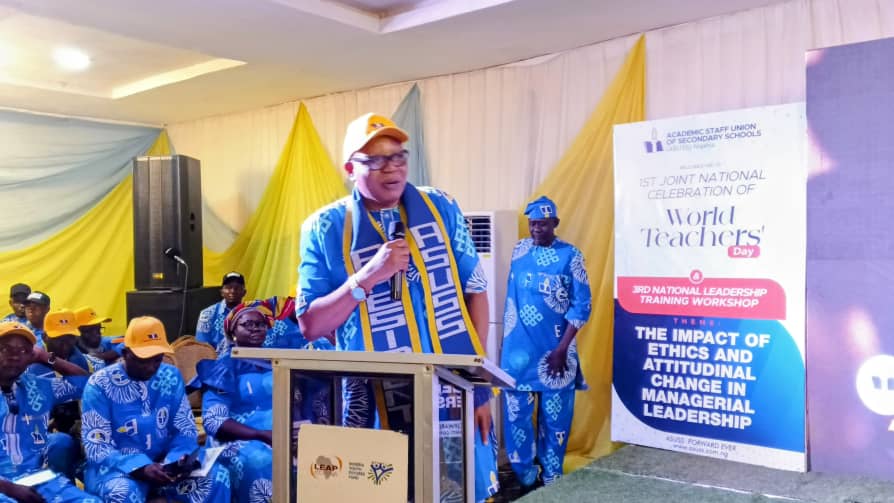
The Academic Staff Union of Secondary Schools (ASUSS) has called for stronger professional ethics, continuous training and attitudinal change among teachers to restore public confidence in the teaching profession.
The National President of ASUSS, Mr Sola Adigun, made the call in Abuja on Tuesday at the union’s 3rd National Workshop, themed “The Impact of Ethics and Attitudinal Change in Managerial Leadership.”
The workshop was organised as part of activities marking the 2026 World Teachers’ Day.
Adigun said the initiative was designed to move beyond annual celebrations of teachers to practical capacity building that would equip educators with the skills required to meet emerging demands in and outside the classroom.
He said the initiative followed the union’s assessment of professional standards within the education sector.
“ASUSS believes that you cannot give what you don’t have. If we have been complaining about the way society is looking down on us, then we too have to look inward,” he said.
Adigun said continuous learning and adherence to professional ethics were essential for teachers to become effective classroom instructors and educational managers.
Reflecting on his previous tenure as the union’s Secretary-General, he said visits to schools across the country had revealed lapses in professional ethical standards among some educators.
“We have been complaining that we are not well respected, but respect begets respect. If you don’t carry yourself well, people will not respect you,” he said.
He explained that the union’s leadership training programme was introduced to address some of the identified gaps and had now reached its third edition.
Adigun stressed that although ASUSS remained committed to advocating improved welfare for its members, the union also had a responsibility to promote quality education and positive social change.
“Our agitation is also for us to do the right thing and make the right contribution to society. We cannot give the best if we are not the best,” he said.
He added that ASUSS was prioritising executive and managerial training for its leaders to enable them to transfer effective leadership and management practices to schools and classrooms.
Also speaking, the Chairman of ASUSS in the Federal Capital Territory (FCT), Mr Julius Ogundiran, commended the national leadership for organising the workshop.
Ogundiran described the training as timely, saying it would strengthen teachers’ knowledge and capacity, particularly in effective leadership, accountability and professional conduct.
The lead speaker, Dr Adeola Faleye, an Associate Professor of African Literature, Media and Gender Studies at Obafemi Awolowo University, Ile-Ife, also called for greater attention to the professional image of teachers.
Speaking on the theme of 60 years of standing with teachers, Faleye said teachers should complement efforts to improve their welfare by taking responsibility for upholding the dignity of the profession.
She urged educators to maintain integrity, embrace accountability and adhere to professional ethics.
“As a teacher, if you carry your image high and uphold the ethics of your profession, you will be respected by the school administration, the students and society,” she said.
Also, Mr Samuel Ojo of the University of Saskatchewan, Canada, urged teachers to embrace Artificial Intelligence (AI) as a tool for improving teaching and learning.
Speaking on “Technology, Professionalism and Ethics in the Digital Age,” Ojo described AI as both “an opportunity and a responsibility”.
He said AI could support lesson planning, feedback, translation, accessibility and administrative tasks but urged teachers to use the technology responsibly.
“AI can support lesson planning, feedback, translation, accessibility, and administration. However, we must strike a balance between how it is being used and what it is being used for.” He said.