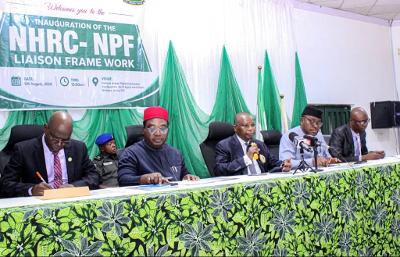
The Attorney General of the Federation and Minister of Justice, Lateef Fagbemi, has inaugurated the National Human Rights Commission–Nigeria Police Force (NHRC–NPF) Liaison Framework, describing it as a major institutional reform designed to strengthen cooperation between the two agencies, promote respect for fundamental human rights, improve accountability, and reinforce public confidence in Nigeria’s criminal justice system.
Speaking at the formal inauguration in Abuja, Fagbemi said the framework demonstrates that lasting reforms in the justice sector are achieved through institutional collaboration rather than isolated efforts.
He said the initiative establishes a structured mechanism for the NHRC and the Nigeria Police Force to improve communication, resolve complaints more efficiently, strengthen oversight of police detention facilities, and develop coordinated responses to systemic human rights challenges.
The Attorney General stressed that effective policing and respect for human rights are complementary objectives that enhance public confidence, strengthen cooperation between law enforcement agencies and communities, and improve the overall effectiveness of the criminal justice system.
READ ALSO: NHRC Strengthens Capacity to Advance Socioeconomic Rights
Fagbemi said President Bola Ahmed Tinubu’s administration had continued to strengthen the rule of law through measures aimed at expanding access to justice, enhancing judicial independence, improving the welfare of judicial officers, and reinforcing institutional mechanisms for protecting fundamental rights.

He also highlighted the President’s recent approval of a 30 to 80 percent salary increase for personnel of the Nigerian Armed Forces, saying the decision forms part of broader efforts to improve professionalism, boost morale, and strengthen the capacity of security institutions to protect lives and uphold constitutional rights.
According to him, the new NHRC–NPF framework introduces designated national and operational focal officers, transforming cooperation from informal engagement into a permanent institutional platform focused on accountability, transparency, and rights-based policing.
“The success of this Framework will ultimately depend not on today’s inauguration but on the commitment of all designated focal officers and participating institutions to faithfully discharge their respective responsibilities,” Fagbemi said.
Also speaking, the Executive Secretary of the National Human Rights Commission, Dr Tony Ojukwu, described the inauguration as an institutional milestone that reflects a renewed partnership built on constitutional mandates, mutual respect, and a shared commitment to embedding human rights protection, accountability, and legal professionalism throughout policing in Nigeria.
Ojukwu explained that the framework establishes a permanent platform for cooperation in implementing criminal justice legislation, integrating international human rights standards into police operations, preventing torture, monitoring detention facilities, protecting vulnerable groups, expanding access to legal representation, strengthening complaint resolution mechanisms, and enhancing capacity through continuous training.
He emphasised that the initiative is intended to support, rather than criticise, police officers by providing operational guidance, technical assistance, and policy support while ensuring compliance with Nigeria’s Constitution and international human rights obligations.
The NHRC chief added that the establishment of national and state focal persons would improve operational continuity, accelerate inter-agency communication, and enable faster responses to human rights concerns across the country.
Also, the Inspector-General of Police, Olatunji Disu, who was represented by the Assistant Inspector-General of Police in charge of the Force Criminal Investigation Department, Ihebom Chukwuma, emphasised that modern policing cannot succeed without respect for human rights, the rule of law, professionalism, and transparency.