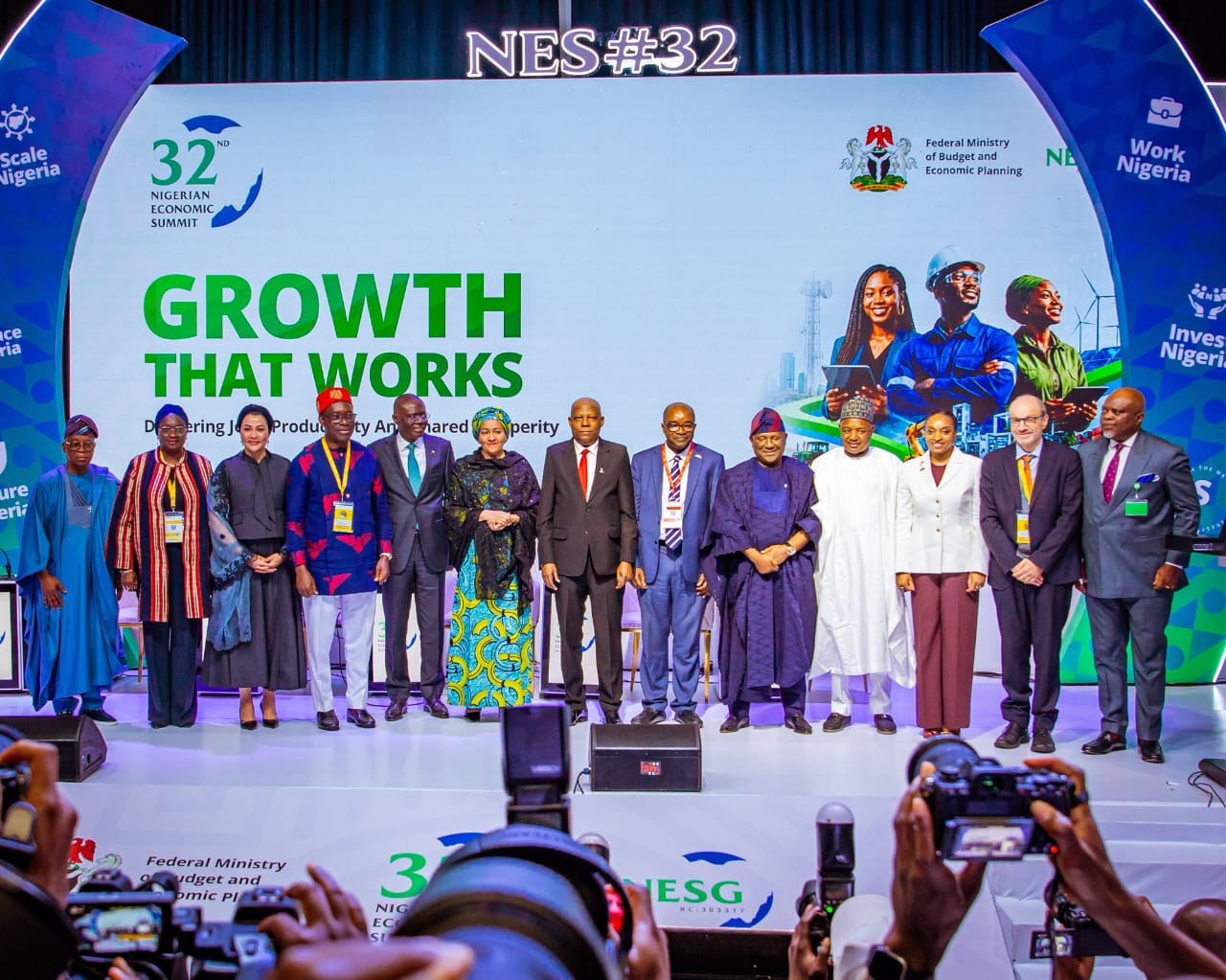
The Minister of Budget and Economic Planning, Senator Abubakar Bagudu, and the outgoing Chairman of the Nigerian Economic Summit Group (NESG), Olaniyi Yusuf, have called for greater focus on translating Nigeria’s economic reforms into job creation, increased productivity and improved living standards.
They made the call at the 32nd Nigerian Economic Summit in Abuja, organised by the Federal Ministry of Budget and Economic Planning in partnership with the NESG.
The summit, themed “Growth That Works: Delivering Jobs, Productivity and Shared Prosperity,” brought together government officials, private-sector leaders, development partners and other stakeholders to discuss strategies for strengthening the Nigerian economy.

READ ALSO: Nigeria Partners NESG to Boost Economic Diplomacy, Investment
Bagudu commended the NESG for sustaining its partnership with the Nigerian Government and providing a platform for policy dialogue, collaboration and practical solutions to the country’s economic challenges.
He said the summit’s theme underscored the need to ensure that economic growth translated into decent jobs, improved livelihoods, higher productivity, better public services and wider opportunities for Nigerians.
The minister said the administration of President Bola Tinubu had introduced reforms to address longstanding economic distortions and establish a foundation for sustainable growth.
He maintained that reversing the reforms was not an option, stressing the need to sustain implementation while making necessary adjustments to ease economic pressures on households and businesses.
Bagudu said Nigeria had recorded positive economic growth for 19 consecutive quarters, adding that the reforms had also increased revenue allocations to state and local governments.

He noted that some states and local governments had reported more than fivefold increases in monthly revenues, attributing the development to the distribution of federally collected revenue among the three tiers of government.
According to him, the approach reflects the administration’s commitment to fiscal federalism and places greater responsibility on state and local governments to improve service delivery.
The minister also disclosed that the National Economic Council had reached agreements to strengthen coordination among the three tiers of government on monetary and fiscal policies.
Other areas of agreement included increased spending on security and infrastructure, addressing irregularities in the extractive industry, promoting grassroots development and boosting domestic production.
Bagudu expressed optimism that sustained reforms and stronger cooperation among the tiers of government would support Nigeria’s ambition of building a one-trillion-dollar economy.
He said the government was also working to identify economic opportunities across the country’s 8,809 wards through a proposed grassroots development strategy aimed at helping communities maximise their productive potential.
According to him, the initiative would support productivity, self-employment and income generation through the development of locally available resources and economic activities.
Bagudu further disclosed that more than six billion dollars had been mobilised from Goldman and other development partners for programmes aimed at strengthening household resilience and expanding economic opportunities.
On employment and skills development, he said the government recognised the need to prepare young Nigerians for changing labour market demands through investments in foundational education, skills acquisition and human capital development.
He stressed that private-sector partnerships remained essential to achieving sustainable growth, improving productivity and expanding economic opportunities.
In his remarks, Yusuf said Nigeria had undertaken difficult but necessary reforms to restore macroeconomic stability, but warned that stabilisation alone would not guarantee improved living standards.
He identified the removal of the petroleum subsidy, changes in the oil and gas market, fiscal restructuring, tax reforms and banking-sector recapitalisation as major changes to the country’s economic policy framework.
While acknowledging the importance of the reforms in addressing economic distortions and strengthening public finances, Yusuf said their success should ultimately be measured by their impact on businesses, households and the wider economy.
“Stabilisation creates the conditions for progress. It does not automatically deliver it,” he said.
Yusuf argued that a stable exchange rate alone would not make Nigerian manufacturers competitive, just as economic reforms would not automatically translate into decent jobs, increased purchasing power, improved security or reduced poverty.
He said businesses needed lower production costs, reliable infrastructure, affordable financing and improved access to electricity to enhance competitiveness and expand operations.
The NESG chairman called for a decisive shift from economic policy changes to measurable socioeconomic outcomes, saying economic success should be assessed beyond gross domestic product growth.
He identified productivity, human capital development and resilience as three interdependent priorities for Nigeria’s economic transformation.
On productivity, he called for measures to reduce production costs, improve efficiency and strengthen the competitiveness of Nigerian businesses.
On human capital development, he emphasised investments in education, healthcare, nutrition and skills development to prepare workers for a more productive economy.
He also called for stronger household and business resilience to enable them to withstand economic shocks and sustain productive activities.
Yusuf said skilled workers would be more productive when businesses had reliable infrastructure and access to modern technology, while competitive enterprises required predictable regulations, fair competition and an efficient legal system to expand investment and create jobs.
He added that effective public services, security and social protection were also essential to ensuring that households benefited from economic opportunities.
The outgoing chairman reaffirmed the NESG’s commitment to promoting constructive engagement between the government and the private sector.
He urged policymakers to move beyond policy consensus and focus on practical measures that would strengthen businesses, create better employment opportunities, increase household incomes and improve living standards.