

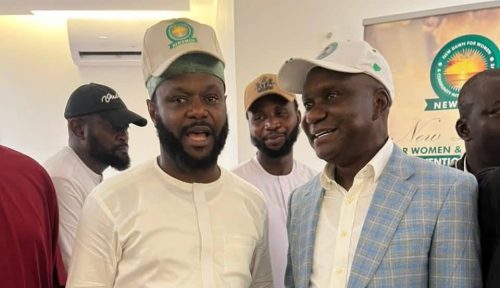
Former Speaker of the Abia State House of Assembly, Chinedum Orji, says the City Boy Movement (CBM), led by Seyi Tinubu, is expanding youth participation in governance and national development through structured civic engagement and grassroots mobilisation.
Orji, the All Progressives Congress (APC) House of Representatives candidate for Ikwuano/Umuahia Federal Constituency, stated this in an article titled, “Seyi Tinubu and the City Boy Movement: Building a New Architecture for Nigerian Youth in Politics and Nation-Building.”
He said the movement, which began as a campaign platform during the 2022 election cycle, had evolved into a structured political organisation with operational structures across Nigeria’s 36 states and the Federal Capital Territory (FCT).
According to Orji, the organisation provides young Nigerians with an avenue for organised, institutional and solution-driven participation in governance, offering an alternative to political apathy and issue-based protests.
“For too long, youth engagement in Nigeria oscillated between protest and apathy. The City Boy Movement offers a third lane: organised, institutional and solution-driven participation,” he wrote.
Orji said the movement’s convener, Seyi Tinubu, had positioned the organisation as a bridge between government and citizens by promoting responsible advocacy, explaining public policies and relaying public feedback to policymakers.
The former Speaker noted that the movement had established a nationwide structure comprising a National Working Committee, State Directors and officials at zonal, local government and ward levels, creating leadership opportunities for young people while strengthening accountability.
He further explained that the organisation had focused on engaging citizens on key government reforms, including the removal of fuel subsidies and the liberalisation of the foreign exchange market.
According to him, members are encouraged to communicate government policies in a “responsible, factual and compassionate” manner to promote informed public discourse and strengthen engagement between citizens and government.
Orji also highlighted the movement’s community outreach programmes, including free medical missions, campus engagements and nationwide food distribution during the Ramadan and Lenten seasons.
He said the organisation had supported youth entrepreneurship through grants, business support and skills development initiatives.
In Ogun State, he noted, grants of ₦500,000 were awarded to 50 small and medium-sized enterprises, while 100 micro-businesses received ₦200,000 each. Technology innovation winners also received awards of up to ₦5 million.
Orji said the movement’s target of mobilising 10 million young voters ahead of the 2027 general elections reflected its commitment to grassroots mobilisation and sustained civic engagement, saying that the organisation’s expansion into the South-East was aimed at encouraging youth participation across regional and political divides as part of broader nation-building efforts.
“The goal is not to erase differences, but to create a national conversation where youth in every zone see themselves in the same project. That is nation-building work. It is slow, unglamorous and necessary,” he wrote.
While acknowledging concerns that youth organisations aligned with political leaders could become partisan echo chambers, Orji said the movement’s long-term credibility would depend on its ability to convey citizens’ concerns to government with the same commitment it applies to communicating public policies.
He said that if sustained, the model could provide a framework for institutionalising youth participation in governance, strengthening public communication and supporting long-term national development.
Orji concluded that Nigeria needs “more builders than spectators,” expressing confidence that the City Boy Movement could become a lasting platform for youth engagement in governance and nation-building.

, led by Seyi Tinubu.......................)