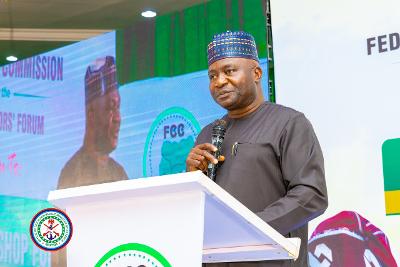
Nigeria’s Defence Minister, General Christopher Musa has called for a grassroots security framework that places local government leadership, traditional and religious institutions, communities, security agencies and the private sector at the centre of early warning, prevention and local resilience.
General Musa made the call in Abuja while presenting a paper titled “Strengthening Grassroots Security Through Inclusive Local Leadership, Community Partnership and Inter-Agency Collaboration,” where he said that Nigeria’s security architecture must become more closely connected to the communities where threats first emerge.
He said insecurity is experienced most directly at the grassroots, where residents are often the first to observe unusual movements, emerging tensions, criminal activity and other warning signs.
Harnessing that knowledge responsibly, he said, could enable authorities to identify and address threats before they develop into wider security crises.
The Minister welcomed the proposal for the establishment of Local Government Security Coordination Committees across the 774 Local Government Areas, but stressed that their “effectiveness would depend on functionality rather than the creation of another layer of bureaucracy.”

He envisaged the committees as practical coordination mechanisms through which local government authorities, security agencies, traditional institutions and other stakeholders can regularly exchange information, identify emerging threats and agree on appropriate responses.
At the heart of the proposed framework is a stronger connection between communities and the national security architecture, particularly through improved information flow and early intervention.
General Musa explained that no security agency, regardless of its capabilities, can maintain a physical presence in every village, ward, market and farming community across Nigeria. Local leaders and residents, however, are permanently embedded within those environments and possess knowledge that can provide critical early warning when properly gathered, assessed and transmitted.

He consequently framed grassroots security as a shared responsibility rather than an exclusive function of the Armed Forces or other security agencies.
According to the Minister, “the Nigerian Government provides national direction and strategic capabilities, State Governments provide leadership and coordination within their jurisdictions, while Local Governments have a particularly important responsibility because of their proximity to citizens and knowledge of local conditions.’
Traditional rulers, religious leaders and community leaders, he stressed, can strengthen the same architecture by building trust, resolving tensions and preventing the exploitation of ethnic, religious and social differences.

The Minister also placed development at the centre of the security equation, saying “communities with economic opportunities, functioning infrastructure, productive activity and a sense of inclusion are better positioned to resist criminality and violent extremism.”
He cited the protection of farming communities, for example, as simultaneously a security responsibility and a means of protecting livelihoods and food production. Securing business districts protects investment and employment, while protecting critical infrastructure safeguards the services on which communities depend.
According to him, the implication is that grassroots security should extend beyond conventional military and policing operations to include the protection of the conditions necessary for communities to live productive and dignified lives.

General Musa also called for greater private-sector participation, describing businesses as “both beneficiaries of security and potential partners in building local resilience.’
He identified private investment, infrastructure, technology and institutional knowledge as resources that could contribute to stronger community security when properly coordinated within existing government and security structures.
He said; “Trust will remain essential to the success of the proposed framework. Communities must have confidence in the channels through which they provide sensitive information, while security agencies must be able to assess and act upon information responsibly.”
The Minister therefore advocated clear mechanisms for information sharing and regular engagement, while warning against the creation of parallel security structures outside Nigeria’s constitutional and institutional framework.

For the Ministry of Defence, General Musa said “the approach reinforces the understanding that national defence forms part of a wider national security effort, While the Armed Forces must remain prepared to confront threats within their constitutional mandate, sustainable security also requires prevention, resilience, effective governance and institutional cooperation.’
He challenged participants at the summit, particularly local government leaders, to translate the discussions into practical mechanisms for gathering and sharing information, identifying emerging threats, coordinating security agencies and involving communities in local security processes.
General Musa said the objective should be to leave the summit with more than a communiqué, but with a framework that can be implemented across Local Government Areas through regular engagement, improved information flow, stronger community trust and faster intervention.