
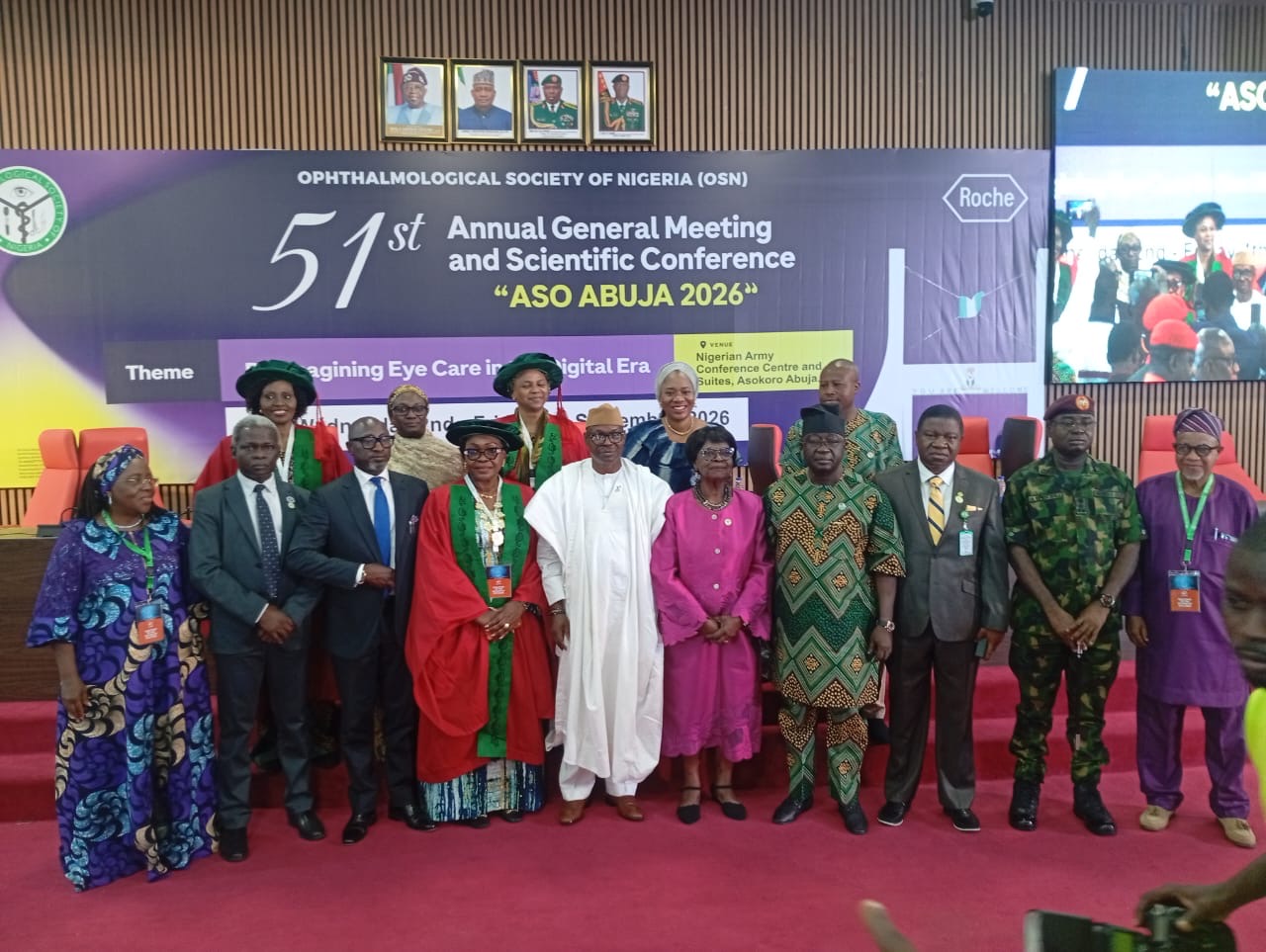
The Nigerian government has called for greater adoption of digital technology and innovation to expand access to quality eye-care services and reduce avoidable blindness in Nigeria.
The Minister of State for Health and Social Welfare, Dr Iziaq Adekunle Salako, made the call while declaring the opening of the 51st Scientific Conference and Annual General Meeting of the Ophthalmological Society of Nigeria (OSN), themed “Reimagining Eye Care in the Digital Era”.
Salako said digital transformation had become essential to expanding healthcare access, improving clinical outcomes and eliminating avoidable blindness, particularly among underserved populations.
He noted that millions of Nigerians continued to live with unaddressed visual impairment and preventable blindness caused by conditions including cataracts, glaucoma, refractive errors and diabetic retinopathy.
According to him, geographical barriers, unequal distribution of healthcare workers and socioeconomic disparities had continued to restrict access to specialised eye-care services, especially in rural communities.
He said technologies such as tele-ophthalmology, remote screening, digital imaging, smartphone-based cameras and artificial intelligence-enabled diagnostic tools could extend specialised eye-care services beyond tertiary hospitals to primary healthcare facilities and rural communities.

The minister noted that artificial intelligence was already improving the early detection of conditions such as diabetic retinopathy and glaucoma, allowing healthcare professionals to intervene before irreversible vision loss occurred.
Salako disclosed that the Federal Ministry of Health and Social Welfare had developed tools for collecting and reporting routine eye-health data at the facility level, urging practitioners to provide accurate information to support evidence-based planning and decision-making.
He further disclosed that the ministry had signed a Memorandum of Understanding with Peak Vision, a digital eye-health company, to deploy an artificial intelligence-powered screening device for school health programmes and strengthen the integration of eye care into primary healthcare.
The minister said the government was also expanding health insurance coverage for essential eye-care procedures in collaboration with the National Health Insurance Authority while investing in digital infrastructure, regulatory frameworks and data protection standards.
READ ALSO:Foundation Provides Free Eye Care to 18,000 Patients in Katsina
Salako said the DigiBola 2.0 programme had screened nearly two million people and provided more than 1.3 million free reading glasses nationwide.
He said the initiative was being expanded under the Renew Hope Health Connect programme, with a target of providing at least five million free pairs of spectacles and 25,000 free cataract surgeries by the end of 2027.
The minister challenged ophthalmologists and other stakeholders to develop affordable and locally relevant digital solutions capable of functioning in low-resource and off-grid communities.
He also urged stakeholders to ensure that technological advancement narrowed rather than widened existing inequalities in access to eye care, particularly among rural populations, the elderly and other underserved groups.
Salako assured the OSN of the ministry’s continued partnership, stressing that the future of ophthalmology depended on embracing new technologies, rethinking traditional service-delivery models and strengthening cross-sector collaboration.
In a goodwill message delivered on behalf of the Speaker of the House of Representatives, the Chairman of the House Committee on Health, Hon. Amos Gwamna Magaji, said emerging technologies offered significant opportunities to improve early detection, diagnosis, treatment and access to eye care.
Magaji said artificial intelligence, tele-ophthalmology, digital imaging, advanced diagnostics and other smart technologies were transforming healthcare delivery but stressed that such innovations must be guided by ethics, patient privacy, informed consent and professional accountability.
He expressed concern over the increasing use of smartphones, computers, tablets and other digital devices, noting that excessive screen exposure could contribute to digital eye strain, dry eyes, blurred vision, headaches and other forms of visual discomfort.
The lawmaker called for the integration of eye care into primary healthcare through the Basic Health Care Provision Fund, saying primary healthcare centres should provide basic eye screening, early detection and treatment of common conditions, health education and appropriate referrals.
He also called for stronger regulation of ophthalmic technologies, medicines, medical devices and digital health platforms to ensure that they were safe, reliable, affordable and operated by appropriately trained professionals.
Magaji said legislators had a responsibility to support universal access to quality eye care, digital health infrastructure, research and development, effective regulation and the integration of eye health into primary healthcare.
Also speaking, the Mandate Secretary, Health and Environment Services Secretariat, FCT Administration, Dr Adedolapo Fasawe, who represented the Minister of the Federal Capital Territory, said the FCT Administration remained committed to strengthening eye-care services across the territory.
Fasawe said ophthalmology services were currently available at Asokoro District Hospital, Wuse General Hospital, Kubwa General Hospital and Bwari General Hospital.
She disclosed that the FCT Minister had approved the establishment of a general comprehensive and subspeciality training centre at Karu General Hospital, with particular attention to ophthalmology and the development of specialised glaucoma surgery services.
According to her, eye surgeries performed in the FCT increased from 745 in 2021 to more than 1,200 in 2025.
She said the increase had created more opportunities for residents to regain improved vision, independence, productivity and quality of life.
Fasawe added that the FCT ophthalmology residency programme had received full accreditation from both the National Postgraduate Medical College of Nigeria and the West African College of Surgeons.
She said FCT residents had emerged as the best candidates in Part One and Part Two examinations of both colleges, describing the achievement as a testament to the quality of training and commitment of ophthalmic specialists in the territory.
Fasawe also highlighted the growing capacity of FCT eye specialists, recounting how a patient who had planned to travel to the United Kingdom for treatment of high intraocular pressure was successfully treated by a Nigerian ophthalmologist.
She said the patient’s UK-based surgeon later acknowledged the quality of treatment provided by the Nigerian specialist, describing the development as evidence of the growing capacity of local eye-care professionals.
Fasawe commended teachers, residents, consultants and other stakeholders for their contributions to building capacity, strengthening specialist training and advancing eye care in the FCT.
She also commended the Ophthalmological Society of Nigeria for its contribution to the advancement of eye care in Nigeria and pledged continued collaboration with the society and other stakeholders to promote innovation, research, professional development and access to quality eye-care services.

