


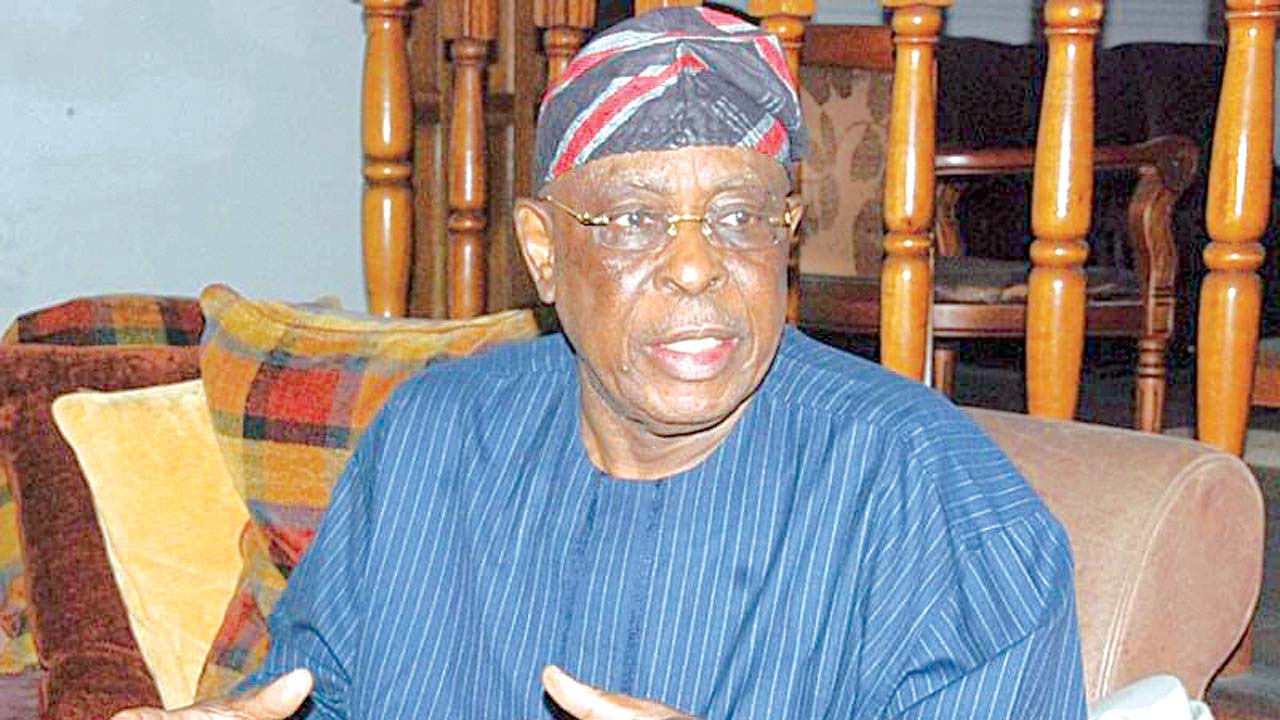
Former Ogun State Governor and national leader of the All Progressives Congress (APC), Olusegun Osoba, has commended President Bola Tinubu’s efforts in sustaining Nigeria’s multiparty democracy, strengthening opposition politics and resisting attempts to establish a one-party state.
Osoba gave the commendation on Tuesday at the Presidential Villa, Abuja, during the public presentation of a book by veteran journalist Sam Omatseye, titled From AD to APC: The Evolution of Nigerian Political Parties and the Exploits of One Man (1998–2015).
Reflecting on Nigeria’s political evolution, the former governor recalled how President Tinubu initiated the formation of alternative political platforms following the defeat of the Alliance for Democracy (AD) in the 2003 general election, which left him as the party’s only serving governor.
READ ALSO: APC Leader Commends President Tinubu’s Housing Reforms
Osoba explained that the initiative was informed by concerns over the weakening of opposition parties and what he described as attempts by the political establishment at the time to transform Nigeria into a one-party state.
“The decision was made to destroy the progressives, destroy AD, and they had formed a parliamentary body against us, and the President decided that we should fight it because the powers that be were going in for a one-party state,” Osoba stated.
He disclosed that President Tinubu later facilitated the registration of two political parties through Senator Adefuye and Opadokun, without the knowledge of the administration of former President Olusegun Obasanjo and the security agencies.
Beyond preserving opposition politics, Osoba recalled President Tinubu’s involvement in mobilising prominent Nigerians, including the late former Head of State, General Muhammadu Buhari, and former Inspectors-General of Police, Gambo Jimeta and M.D. Yusuf, to resist the third-term agenda of the Obasanjo administration.
Political Alliances
The former governor also highlighted President Tinubu’s efforts to build political alliances across regional divides, recounting negotiations involving the late former President Muhammadu Buhari, Atiku Abubakar and, subsequently, former anti-corruption chief Mallam Nuhu Ribadu ahead of the 2007 and 2011 presidential elections.
According to Osoba, these efforts culminated in the formation of the All Progressives Congress (APC) in 2013, bringing together different political interests under a common platform that eventually secured electoral victory in 2015.
He recalled that 68 political leaders participated in developing the party’s constitution and manifesto, while former Lagos State Governor Babatunde Fashola coordinated the governors involved in the merger.
Osoba attributed the APC’s electoral success in 2015 to President Tinubu’s decision to support Buhari’s presidential candidacy.
“What made APC successful? The President decided that we should please adopt Buhari as the presidential candidate. It was that singular decision, having decided on who would be the presidential candidate, that made APC successful,” he said.
Continuity
Speaking on contemporary political developments, Osoba advocated continuity in governance, drawing parallels between President Tinubu’s support for Buhari’s second term in 2019 and the President’s own re-election bid.
He also cited President Tinubu’s handling of the tax reform legislation as an illustration of his determination to implement policies he considers necessary for national development, despite resistance from some stakeholders.
The former governor urged APC leaders to engage Nigerians at the grassroots and explain the objectives of the administration’s policies ahead of the 2027 general election, expressing confidence that the reforms would yield positive outcomes for the country.

