


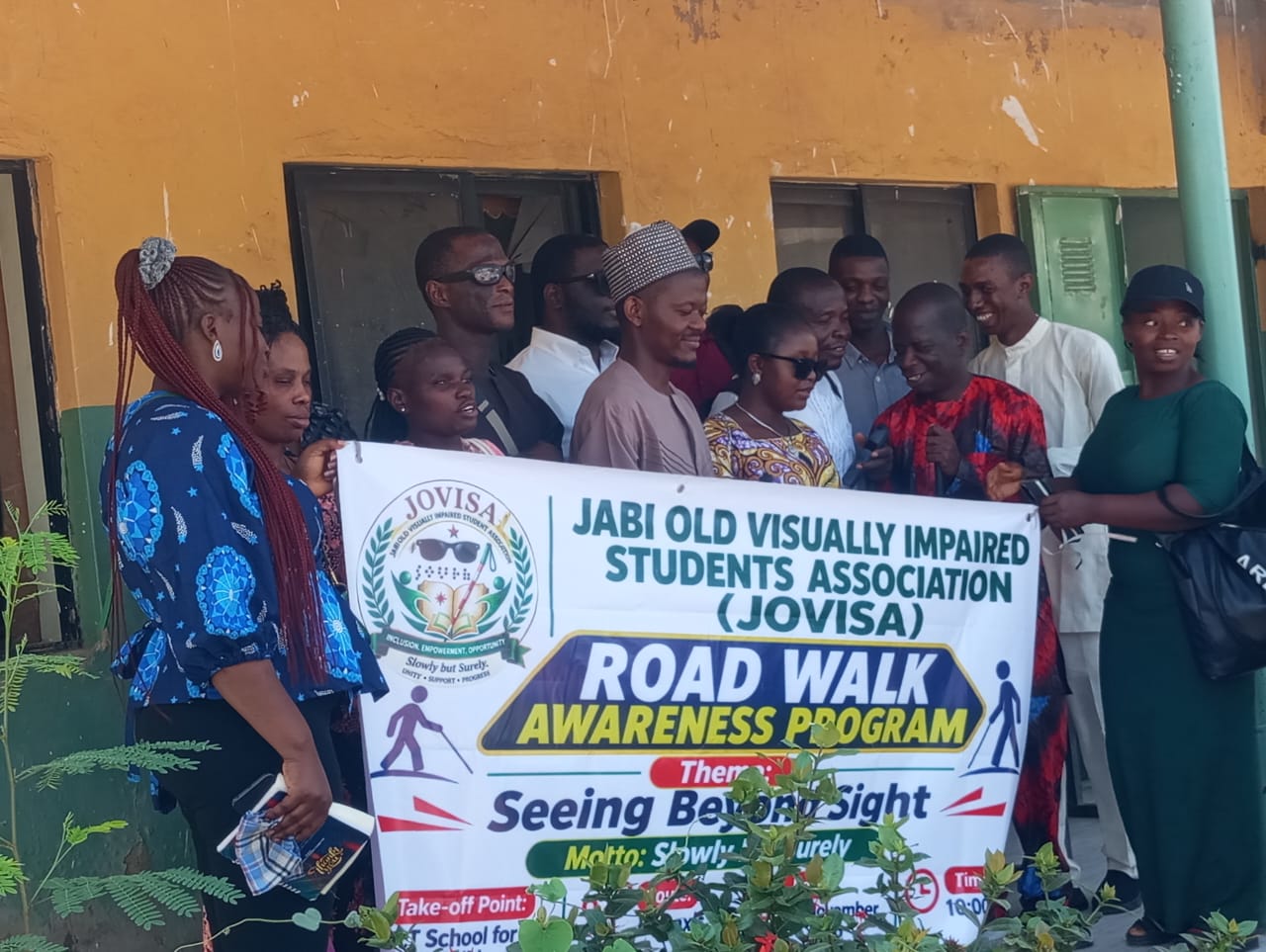
The Jabi Old Visually Impaired Student Association (JOVISA) has called on the Federal Capital Territory Universal Basic Education Board (FCT-UBEB) to urgently review its policies governing the education of blind and visually impaired persons in Nigeria’s capital city, Abuja.
JOVISA, which represents graduates of the Federal Capital Territory (FCT) School for the Blind Children, made the demand during a public awareness road walk on Thursday, November 19, 2026 — its first outing since formally registering with Nigeria’s Corporate Affairs Commission (CAC) following its initial launch in December 2025.
The walk, held under the motto “Slowly But Surely“, brought public attention to severe structural gaps in educational access and disability inclusion within the Federal Capital Territory.
Growing Capital
For an entire federal capital, relying on a single specialised primary school for blind children leaves the territory grossly ill-equipped to handle growing demographic demands.
READ ALSO: Nigerian Government Commissions School For Blind In Lagos
JOVISA Acting President Mr. AbdulAzeez Ahmed explained that the road walk was organised to build awareness both within the school community and among the wider public about the registered alumni association.
“Primarily, the road walk and awareness, as we tagged the event, is to create awareness within the school environment and to the outside world in general,” Mr. Ahmed said. “Awareness that there is now an alumni association for the school—a registered body—out to advocate for improved learning environment, learning conditions for pupils still in the school, and improved life for those that have passed through the school.”
Mr. Ahmed emphasised that improving outcomes means expanding empowerment opportunities, scholarships, employment pathways, and political participation spaces for persons with visual impairment in particular and persons with disabilities in general.
Late Onset of Blindness
A central policy challenge highlighted by the association is the school’s strict admission threshold, which bars prospective learners above the age of 15. JOVISA Acting Vice President Ms. Jummai Monday warned that the restriction unfairly shuts out people who lose their sight later in life — whether during secondary school, after secondary school, or during tertiary studies — as well as families who only discover specialised educational options late.
Without alternative pathways, late-blinded youths and adults face severe barriers to literacy, mobility, and independent living. Ms. Monday noted that commuting daily from home with a visual impairment is financially and logistically prohibitive for many families in Abuja, placing excluded individuals at high risk of total educational abandonment.
“If the people who are above 15 cannot be enrolled to study in the school, they should provide a center where those people will get their own education and be empowered,” Ms. Monday said.
School Fees vs. Free Primary Education
Ms. Monday also drew attention to the ongoing burden of school and tuition fees imposed on visually impaired pupils, noting that financial hardship forces several children to drop out.
Under Nigeria’s Universal Basic Education Act of 2004, free basic primary education is a statutory entitlement nationwide, making tuition charges at a public special-needs primary school a direct contradiction of federal policy.
JOVISA appealed to educational authorities and philanthropic organizations to review the fee regime and offer financial support to ensure uninterrupted learning.
Partnership and Post-School Pathways
Ahead of the event, JOVISA formally notified school administrators and FCT-UBEB to seek institutional support and guidance. While commending ongoing campus construction works as a welcome sign of infrastructure investment, Mr. Ahmed urged UBEB to upgrade all facilities to international accessibility standards while prioritising student and staff welfare.
He further urged authorities to look beyond primary school operations and collaborate with non-governmental organisations and the alumni association to create structured post-rehabilitation pathways.
Leaving pupils without clear progression into secondary education, vocational training, or employment, he warned, wastes human potential and undermines national development goals.

 has called on the Federal Capital Territory Universal Basic Education Board (FCT-UBEB) to urgently review its policies governing the education of blind and visually-impaired persons in Nigeria’s capital city, Abuja.)