
The Kebbi State Government has stepped up efforts to combat a growing infestation of Quelea birds that has affected farmlands across several local government areas, threatening dry-season rice production and farmers’ livelihoods.
Speaking at a press briefing, the Commissioner for Agriculture, Shehu Mu’azu, said migratory quelea birds had invaded fadama farming areas in Argungu, Gwandu, Birnin Kebbi, Kalgo, Bunza and Augie local government areas within the past 72 hours.
The Commissioner described the infestation as a serious threat to agricultural production, noting that quelea birds move in massive flocks and are capable of destroying an entire hectare of grain crops within a few hours.
“Our field assessments indicate that dry-season rice production is currently under threat, with significant damage already recorded in some early-planted fields,” the commissioner said.
Mu’azu assured farmers that the state government was fully committed to protecting livelihoods and safeguarding food security across the state.
According to the commissioner, the Kebbi State Governor Nasir Idris directed the Ministry of Agriculture to immediately activate its emergency response plan following reports of the infestation.
“As part of the response, agricultural extension agents and crop protection officers have been deployed to identify infested areas and monitor bird movements on a daily basis”.
The government has also established a dedicated reporting hotline to enable farmers report new sightings in real time.
The commissioner disclosed that the state government had procured Fenthion 5EC and commenced ground-control operations, which he described as successful so far.
“In addition, the government has engaged an experienced aerial surveillance and pest-control company to carry out aerial spraying operations targeting high-density and hard-to-reach roosting sites.”
He explained that the aerial operation would begin once the necessary approvals are secured from relevant security agencies and aviation regulatory authorities.
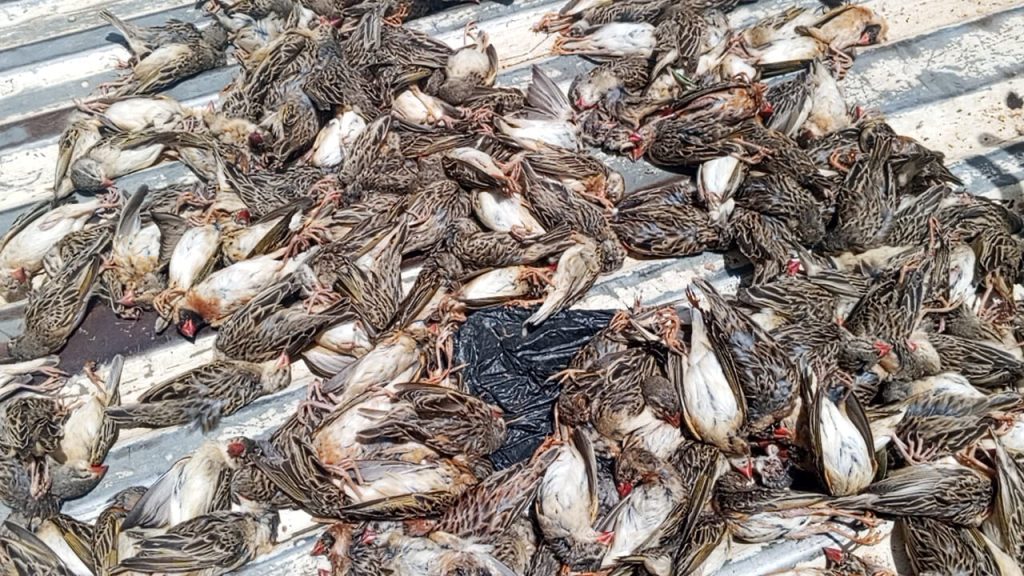
The Ministry has also intensified public sensitisation efforts, with crop protection teams conducting daily field demonstrations on safe and effective bird-control methods.
The government urged farmers and members of the public not to harvest, handle or consume birds killed during spraying operations, warning that the avicide being used is toxic to humans and livestock.
Farmers were also advised to report bird roosting sites at night when the birds are settled, as this would improve the effectiveness of control operations.
The commissioner further cautioned against the use of unapproved chemicals, saying they pose serious risks to human health, livestock and the environment.
The commissioner announced that a second phase of aerial spraying had been scheduled and would commence once all required permits were obtained.
He added that Kebbi State was working closely with neighbouring states to coordinate cross-border control measures, noting that quelea birds move freely across administrative boundaries.
The commissioner commended traditional rulers, community leaders and farmers for their vigilance and cooperation in reporting bird sightings.
He reaffirmed the government’s commitment to protecting farms, supporting agricultural production and ensuring food security.