


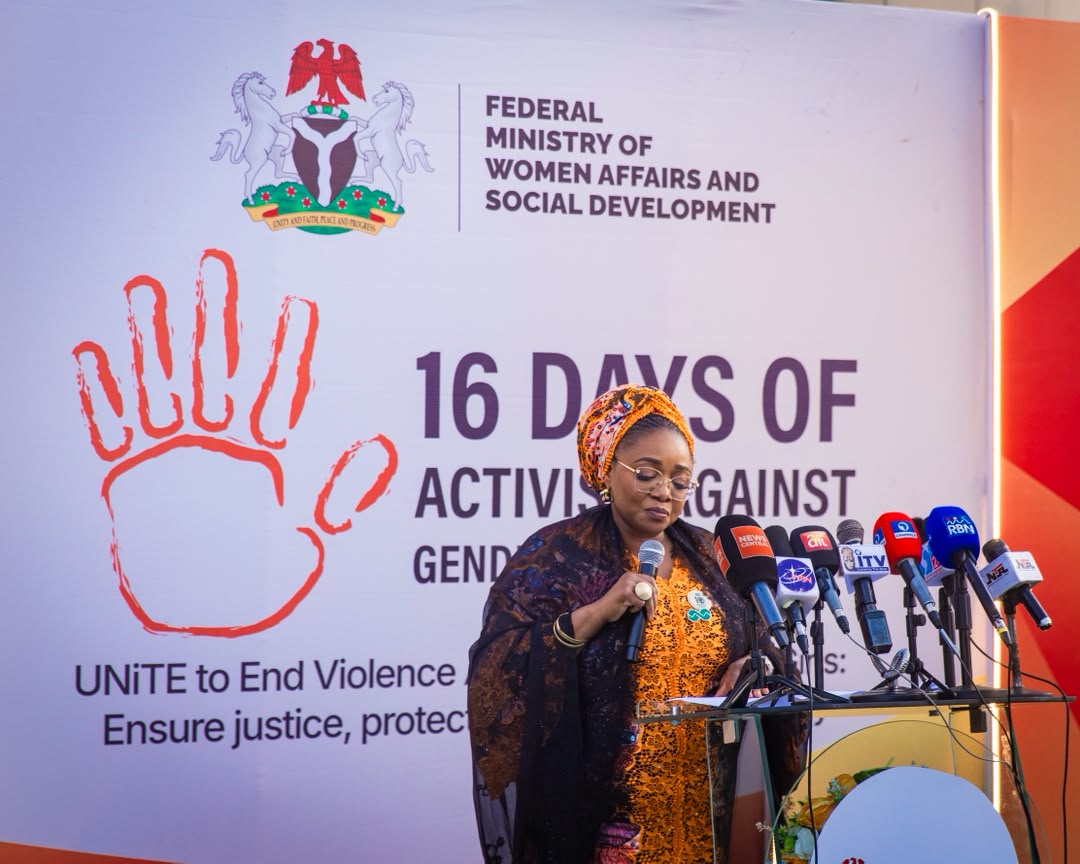
The Minister of Women Affairs and Social Development, Imaan Sulaiman-Ibrahim, says the Nigerian Government is pursuing tougher penalties for sexual and gender-based violence through the ongoing review of the Child Rights Act and the Violence Against Persons (Prohibition) Act.
Sulaiman-Ibrahim stated this during the 2026 Ministerial Press Briefing to kick-start the 16 Days of Activism Against Gender-Based Violence in Abuja.
The Minister said: “the reviews were part of efforts to strengthen legal responses, protect survivors and address impunity.”
The Child Rights Act has been domesticated in all 36 states, while the VAPP Act has been domesticated in 35 states.
She said the Ministry was also strengthening reporting and response mechanisms. The national SGBV Dashboard and Situation Room are now operational, while 52 Sexual Assault Referral Centres provide support to survivors.

She disclosed plans to establish Sexual Assault Referral Centres (SARCs) in each of Nigeria’s 774 local government areas to improve survivors’ access to medical care, psychosocial counselling and referrals for legal assistance, particularly for women and girls in underserved communities.
“Across Nigeria, 52 Sexual Assault Referral Centres currently provide vital medical, psychosocial, and referral support to survivors.
“However, for a nation of over 240 million people, 52 centres are grossly inadequate,” the Minister said.
Sulaiman-Ibrahim said the scale of violence remained a major concern, noting that nearly one in three Nigerian women aged 15 to 49 had experienced physical or sexual violence.
More than 27,000 cases of sexual and gender-based violence had been documented in recent reporting cycles, while many others remained unreported.
The Minister called for sustained action by government institutions, traditional and religious leaders, the media and the creative industry, stressing that “the campaign must extend beyond its annual observance.”
“The 16 Days of Activism must translate into 365 days of relentless commitment,” Sulaiman-Ibrahim said.
The Minister also announced that the Ministry had commenced a review of the National Gender Policy 2021–2026, following an end-term review and the launch of the Nigeria Gender Profile. Stakeholders are expected to contribute to the process.
In an interview, the Minister said: “I don’t believe that anybody should be raped, anybody should be abused. Our review of the Child Rights Act and the VAPP Act comes very strongly with punitive measures and they are stronger than the existing ones.”
The Director-General and Chief Executive Officer of the Maryam Babangida National Centre for Women Development, Adedayo Benjamins-Laniyi, called for collective action across communities and institutions.
“For every one of us today, the collective call to action is clearly what as women in a set time of women o’clock must clock, not just as women, but as a team in action,” she said.
Benjamins-Laniyi said the Ministry and its partners were prepared to mobilise action nationwide, adding: “On behalf, therefore, of the collective action of the Ministry, and all of the 774, 8,809 community wards and local government areas, we are ready. Stop SGBV.”
The 2026 campaign is themed “UNiTE to End Violence Against Women and Girls: Ensure Justice, Protect Survivors, End Impunity.”
The global campaign runs from 25 November to 10 December, with activities planned across Nigerian communities.

