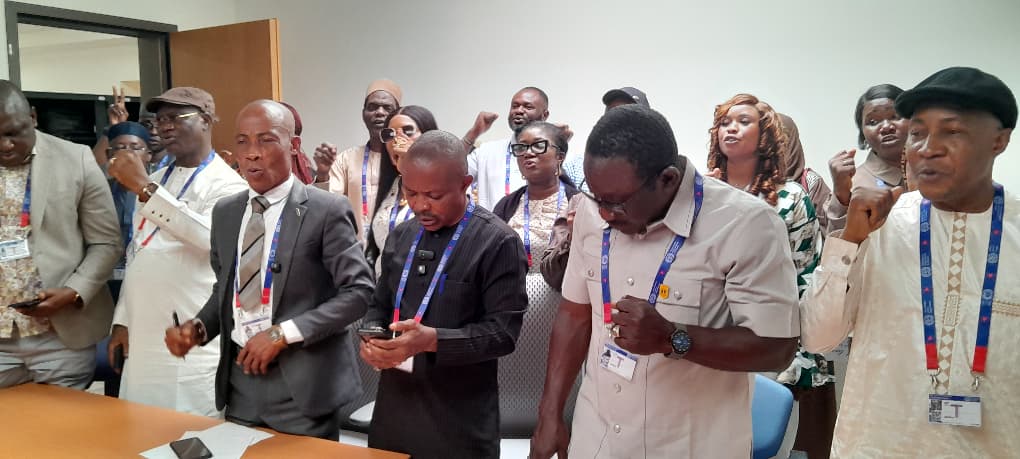
The Trade Union Congress of Nigeria (TUC) and the Nigeria Labour Congress (NLC) say they will commence the re-negotiation of a reviewed National Minimum Wage with the government in July 2026.
This was disclosed by the Deputy President of the TUC, comrade Jimoh Oyibo, while addressing the media during a joint media briefing with the NLC in Geneva, Switzerland.
He said that the current National Minimum Wage Act will expire early next year, 2027, “and we have announced to commence by July 2026 to avoid the painful delays of the past”.
“As soon as we leave here, we shall write again to the government demanding a commencement of the process for renegotiating the national minimum wage.
“We demand nothing less than a genuine living wage that reflects today’s harsh economic realities.
“We once again demand immediate relief measures by governments at all levels until the new minimum wage is signed into law.
“We also reject outright any attempt to tax the minimum wage or to levy further burdens on the poor,” Oyibo stated.
Recall that Nigeria’s Governors Forum, NGF, had proposed a new National Minimum Wage of one hundred thousand naira, saying it will improve the purchasing power of workers in the face of rising global inflation.
Also speaking, President of the NLC Joe Ajaero insisted that the current wage structure no longer reflects Nigeria’s economic realities, adding that inflation, rising food prices and transport costs have worsened the living conditions of workers nationwide.
He said that labour’s demand goes beyond wage adjustment, stressing that Nigerian workers deserve a genuine living wage capable of meeting basic needs.
“We demand nothing less than a genuine living wage that reflects today’s high-speed economic realities facing Nigerian workers.”
The NLC President called on the federal, State and Local governments to introduce immediate relief measures for workers pending the conclusion of ongoing wage negotiations.
He said that failure to provide relief would worsen economic hardship, especially among low-income earners already struggling with the high cost of living.
Ajaero said that the minimum wage negotiation process would remain a tripartite arrangement involving government, organised labour and private sector stakeholders for fair outcomes.
He said some States had already begun paying above the current minimum wage, proving that higher wage structures were economically feasible within Nigeria’s federating units.
“Some States are paying N85,000, some are paying N100,000. It shows that N70,000 is no longer realistic or relevant,” he said.
Meanwhile, the Nigeria Employers’ Consultative Association (NECA) has called for early consensus-building among stakeholders ahead of negotiations for a new national minimum wage in 2027.
The Director-General of NECA, Mr Adewale-Smatt Oyerinde, who made the call during an interview in Geneva, said the review of the current minimum wage would require realistic engagement among government, employers and organised labour to achieve an outcome acceptable to all parties.
According to him, the process must be guided by the prevailing economic situation, workers’ welfare needs, enterprise sustainability and productivity considerations.
“We must look at the issue from a realistic context. There are four critical pillars that must guide whatever we are going to do next year.
“The first is the overall economic situation of the country, the second is the needs of workers and their families, the third is enterprise sustainability, and the fourth is productivity,” he said.
He said the four pillars were interconnected and should form the basis for determining a minimum wage capable of supporting workers and sustaining businesses.
Oyerinde noted that a viable minimum wage was not only beneficial to workers but also essential for employers because increased disposable income could stimulate business activities and economic growth.
“It’s not only workers that the minimum wage will serve; it will also serve employers because when people have enough disposable income, they can patronise businesses.
“If businesses cannot sell, they cannot survive, and if businesses cannot survive, we cannot create jobs. It is a circle that requires balance.”
He cautioned against arbitrary wage proposals, saying figures should emerge from social dialogue and evidence-based consultations rather than political pronouncements.
He also questioned recent suggestions on a N100,000 minimum wage, arguing that such figures should be supported by research and consensus among social partners.