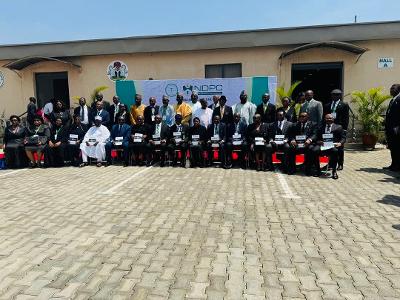
- The Nigeria Data Protection Commission (NDPC) in collaboration with the National Judicial Institute (NJI) has commenced a capacity-building workshop for judicial officers on data protection aimed at strengthening the judiciary’s understanding of privacy rights, data governance and emerging digital challenges.
Speaking at the opening ceremony in Abuja, the National Commissioner and Chief Executive Officer of the NDPC, Dr Vincent Olatunji, called on judicial officers to play a pivotal role in safeguarding citizens’ fundamental rights in an increasingly technology-driven society.
Dr Olatunji said the rapid expansion of digital platforms, electronic transactions, virtual court hearings and electronic evidence had made personal data protectiona critical issue requiring robust legal safeguards and judicial oversight.
He urged judicial officers to give greater attention to Section 37 of the 1999 Constitution, which guarantees and protects the privacy of citizens, their homes, correspondence, telephone conversations and telegraphic communications.
READ ALSO: NITDA, NDPC Reaffirm Commitment to Data Protection
According to him, personal data protection extends beyond confidentiality to include individuals’ ability to exercise controlover their personal information, subject to reasonable limitations imposed by law in a democratic society.
“My lords, if we construe data privacy not merely as a right to confidentiality but as a bundle of rights which a data subject may exercise over his data just like the right to own a property, there may be no difficulty in seeing the challenge to the enjoyment of the right to privacy in the case of denial of access to information.”
The NDPC chief executive explained that the Nigeria Data Protection Act,2023, was enacted to strengthen the states obligation to protect privacy rights, adding that the Commission’s regulatory responsibilities complement the judiciary’s power to adjudicate disputes andprovide remedies for aggrieved citizens.
He referenced Section 50 of the Act, which provides for judicial review of the Commission’s orders by persons dissatisfied with such decisions, within 30 days of the orders being made.
Dr Olatunji reaffirmed the Commission’s commitment to working with the judiciary to advance fundamental freedoms, protect citizen’s personal information and promoteaccountability in the digital economy.
In his welcome address, the Administrator of the National Judicial Institute, Hon.Justice Babatunde Adejumo described data as a valuable resource whose misuse could undermine national sovereignty, public trust and the integrity of government institutions.
He observed that the rapid evolution of digital technologies had increased the volume, accessibility and vulnerability of personal information, making data protection a matter of national importance with implications for governance, economic growth, crime prevention and national security.
Adejumo said the judiciary had a crucial responsibility to adjudicate disputes arising from data processing, determine liability for violations of privacy rightsand balance individual freedoms against legitimate public interests.
He emphasised the need for judicial officers to familiarise themselves with the Nigeria Data Protection Act, 2023, relevant legal principles and international best practices to ensure informed and effective adjudication of data protection cases.
According to him, the workshop would provide a comparative analysis of advanced data governance jurisdictions, offering insights that could support the interpretation of Nigerian laws and inform future legal reforms.
The NJI administrator further called for stronger inter-agency collaboration, stressing that effective data protection required cooperation among Ministries, Departments and Agencies beyond the statutory responsibilities of the NDPC.