



Nigeria’s Minister of State for Foreign Affairs, Ambassador Sola Enikanolaiye, has led high-level engagements at COP31 in Türkiye, strengthening the country’s energy, economic and security partnerships while promoting a just energy transition and showcasing indigenous renewable energy innovations.
Enikanolaiye was part of the Nigerian delegation to the 31st Conference of the Parties (COP31) to the United Nations Framework Convention on Climate Change (UNFCCC) in Antalya, led by the Minister of Environment, Balarabe Abbas Lawal, and including the Minister of Agriculture and Food Security, Senator Abubakar Kyari, among other government officials.
At the announcement of the UK-Nigeria Energy Security and Transition Partnership, Enikanolaiye, who represented the Minister of Environment, stressed that Nigeria’s energy transition must be just, orderly and equitable, taking into account the country’s national circumstances, energy security and development priorities.
He said Nigeria remained committed to achieving net-zero emissions by 2060, while recognising natural gas as a transition fuel to support affordable and reliable energy access.
The Minister identified methane reduction as an immediate opportunity to advance decarbonisation without undermining national development objectives, reaffirming Nigeria’s commitment to ending routine gas flaring by 2030.
READ ALSO: Nigeria Calls for Equitable Energy Transition
He explained that the UK-Nigeria Methane Partnership would accelerate efforts across the oil and gas, waste and agricultural sectors through improved methane monitoring, reporting and verification, leak detection and repair, as well as reductions in gas flaring and venting.
“Our collective success will depend not merely on the commitments we announce, but on the practical results we achieve,” Enikanolaiye said.
He further stated that addressing methane emissions would deliver immediate climate benefits while improving infrastructure, air quality and energy security.
The Minister of State subsequently signed a non-binding Memorandum of Understanding (MoU) with the UK Government on the Energy Security and Transition Partnership and participated in a panel discussion on Nigeria’s commitment to an equitable energy transition.

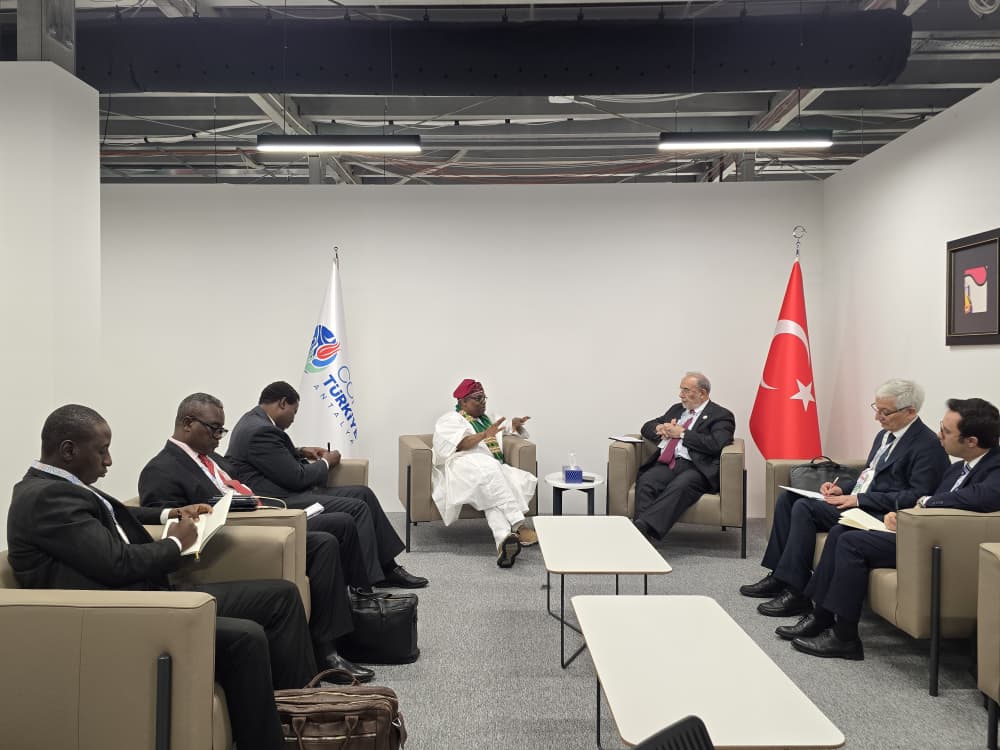
In another development, Nigeria and Türkiye agreed to convene a Joint Economic Commission (JEC) in the first quarter of 2027 to strengthen trade, investment and bilateral relations.
The agreement followed a high-level bilateral meeting between Enikanolaiye and Türkiye’s Deputy Minister of Foreign Affairs for Africa, Ambassador Musa Kulaklikaya, on the sidelines of COP31.
Both countries expressed readiness to expand cooperation in defence, energy, infrastructure development and trade.

Enikanolaiye highlighted Nigeria’s vast natural gas reserves and invited Turkish investors to participate in major infrastructure projects, including the Trans-Saharan Gas Pipeline and the Nigeria-Morocco Gas Pipeline.
On security cooperation, Nigeria appreciated Türkiye’s support for capacity building, particularly the training of Nigerian special forces.
The two countries were also working towards finalising an MoU to institutionalise defence industry cooperation and strengthen their security capabilities.
The meeting further addressed regional stability in West Africa, with Nigeria acknowledging Türkiye’s constructive role in the Sahel and emphasising the importance of diplomatic engagement to promote peace and cooperation between the Economic Community of West African States (ECOWAS) and the Alliance of Sahel States (AES).
Both countries also agreed to streamline consular procedures and visa arrangements for holders of diplomatic and official passports.
Meanwhile, Nigeria’s indigenous innovation received recognition at COP31, as Enikanolaiye commended a Nigerian entrepreneur for developing a solar-powered backpack showcased by Innovative Renewable Energy Storage Solution (iRESS).
He also praised President Bola Ahmed Tinubu’s administration for implementing reforms aimed at addressing the country’s energy challenges and creating an enabling environment for indigenous businesses to thrive.
The Minister noted that macroeconomic stability remained essential to improving livelihoods and supporting the growth of innovative enterprises.
Enikanolaiye, alongside the Minister of Agriculture and Food Security, Senator Abubakar Kyari, and the Minister of Environment, Balarabe Abbas Lawal, also declared open Nigeria Day at the country’s pavilion, commending the organisation of the event.
The engagements highlighted Nigeria’s efforts to use climate diplomacy to advance its development priorities through international partnerships, energy security, economic cooperation and indigenous innovation.

