The National Council on Climate Change (NCCC) has commenced the socialisation of Nigeria’s Third Nationally Determined Contribution (NDC 3.0), aimed at deepening stakeholder understanding, strengthening inter-ministerial coordination and accelerating the implementation of the country’s climate commitments.
The exercise, held in Abuja, also featured the inauguration of the Inter-Ministerial Steering Committee on NDC Implementation and Climate Action. It highlighted the roles of government institutions, development partners and the private sector in translating Nigeria’s climate targets into practical development outcomes.
Nigeria launched NDC 3.0 in 2025, outlining its commitments to reduce greenhouse gas emissions and strengthen resilience to climate change. The current socialisation exercise is intended to raise awareness of the framework, clarify institutional responsibilities and promote coordinated action across sectors of the economy.
Speaking at the event, the Director-General of the NCCC said the priority was to move beyond presenting climate commitments to ensuring that relevant institutions and stakeholders understood their responsibilities and the resources required to deliver the targets.

The Director-General explained that the gathering was designed to align Nigeria’s climate priorities with the financing, technology, expertise and investment needed for implementation.
NDC 3.0 as a National Development Agenda
The Director-General stressed that NDC 3.0 should not be treated solely as an environmental policy document but as a national development instrument with implications for economic planning, infrastructure, agriculture, energy, public health and employment.
According to her, Nigeria’s climate commitments present opportunities to expand energy access, improve food security, protect vulnerable communities, strengthen public services and promote green economic growth.
She noted that Nigeria’s NDC 3.0 sets an economy-wide target of reducing emissions by 32 per cent by 2035, relative to the 2018 base year, as part of the country’s pathway towards net-zero emissions by 2060.
Adaptation measures are also central to the framework, particularly in addressing flooding, extreme heat, coastal erosion and other climate-related risks affecting communities, livelihoods and infrastructure.
Priority areas include agriculture and food systems, water resources, health, coastal and urban resilience, and disaster-risk management.
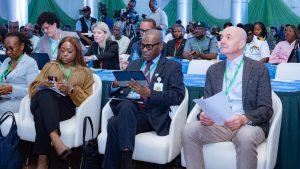
The socialisation process is expected to help relevant institutions understand how these priorities relate to their mandates and how climate considerations can be incorporated into sectoral policies, work plans and budgetary decisions.
The committee is expected to provide strategic direction and oversight, facilitate coordination among ministries and agencies, integrate climate priorities into national planning and budgeting, support resource mobilisation and address implementation challenges across sectors.
The Director-General noted that effective implementation would require sustained collaboration across government, adding that no single ministry or institution could deliver the country’s climate commitments independently.
She urged the committee to ensure that the objectives of NDC 3.0 were reflected in government programmes, institutional responsibilities and public investment decisions.
She also emphasised that the committee’s performance should be assessed by the obstacles it removes, the investments it helps unlock and the results achieved, rather than the number of meetings held.
$337 Billion Required for Implementation
The financing needs of NDC 3.0 also featured prominently at the event, with the Director-General disclosing that approximately 337 billion dollars would be required between 2026 and 2035 to implement the framework’s mitigation and adaptation measures.
The estimated requirement comprises about 195 billion dollars for mitigation and 141.5 billion dollars for adaptation.

The Secretary to the Government of the Federation, George Akume, said the launch of NDC 3.0, the Net Zero Investment Plan and the Long-Term Low-Emissions Development Strategy represented an important step towards addressing climate change.
“The greater task, however, lies ahead: translating these commitments into coordinated action, credible investments and tangible improvements in the lives of Nigerians,” he said.
Akume called on ministries, departments and agencies, state governments, development partners, the private sector, research institutions and civil society organisations to work together to advance the national agenda.
Nigeria’s Minister of Livestock Development, Idi Maiha, highlighted the critical role of livestock in food security, employment, poverty reduction and economic growth, while calling for urgent and coordinated action to address the growing effects of climate change.
He said Nigeria’s livestock sector sustained millions of livelihoods, particularly in rural communities, by providing meat, milk, eggs and other essential products.
However, he noted that rising temperatures, drought, flooding, water scarcity, pasture degradation and changing disease patterns continued to threaten livestock productivity, pastoral livelihoods and the stability of livestock value chains.
Maiha said efforts were ongoing to integrate livestock development into Nigeria’s climate commitments through climate-smart and low-emission production systems.
The United Nations Development Programme (UNDP) Resident Representative in Nigeria, Elsie Attafuah, reaffirmed the organisation’s commitment to supporting Nigeria in implementing NDC 3.0.
She stressed the need to translate climate commitments into practical development outcomes that improve citizens’ lives, noting that climate action depended on decisions across finance, planning, energy, agriculture, transport and other sectors, each with its own responsibilities and competing demands.